Retained vs Contingency Search: Differences, Fees and When to Use Each
Retained search is exclusive and paid in stages; contingency search is non-exclusive and paid only on placement. How they differ, which roles suit each, and what to agree before you sign.
Beatview Team
· 10 min read
Key takeaways
- Retained search is exclusive and paid in stages tied to milestones; contingency search is non-exclusive and paid only when a candidate the agency introduced is placed.
- Retained suits senior, executive, niche, specialist and confidential roles; contingency suits roles where suitable candidates are easy to reach.
- Neither model has a standard rate: agree what triggers each payment, whether the fee is fixed or a percentage of salary, and the guarantee, in writing.
- Exclusive contingency and engagement fees sit between the two models; judge them by what each side commits to, not by their names.
- A good retained search runs from a written brief through research, structured assessment and a reported shortlist to references, offer and an agreed guarantee period.
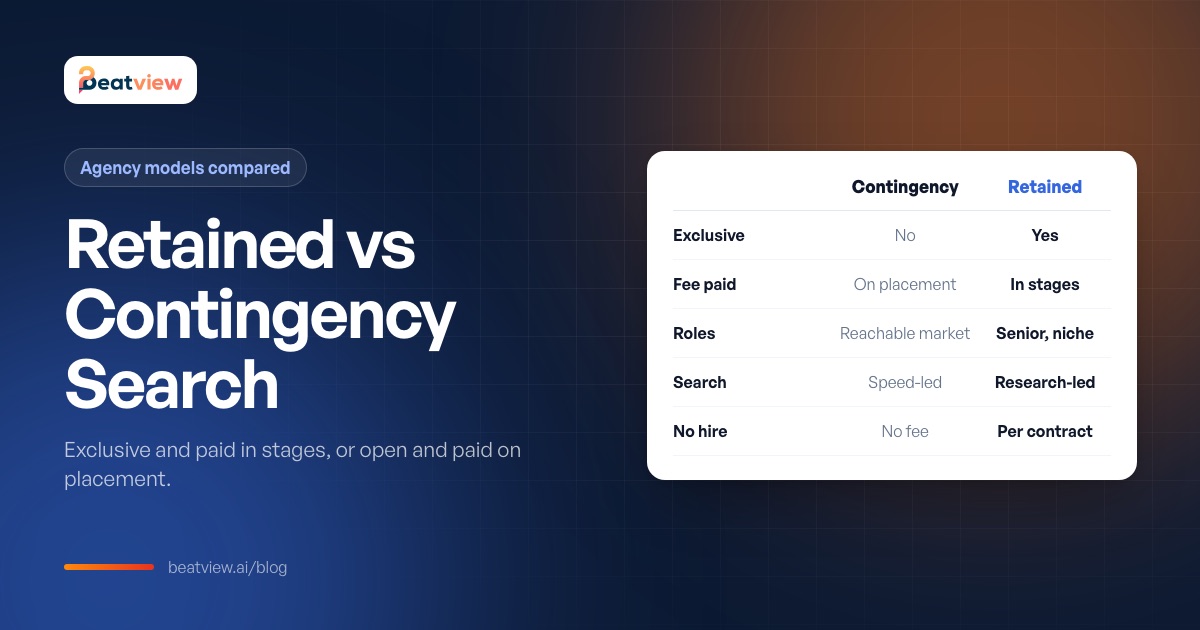
Retained search is an exclusive arrangement in which a client hires one search firm to fill a role and pays it in agreed stages as the search moves forward, mainly for senior, executive, niche or confidential positions. Contingency search (contingency recruitment) is non-exclusive: the client can brief several agencies, and an agency is paid only if a candidate it introduced is hired. Put simply, retained buys a committed search process; contingency buys an outcome and costs nothing if nobody is placed.
Retained vs contingency search at a glance
Scroll to compare →
| Retained search | Contingency search | |
|---|---|---|
| Engagement | Exclusive: one firm works the role | Non-exclusive: several agencies can work the role |
| When the fee is paid | In stages tied to milestones in the search | When a candidate the agency introduced is placed |
| Fee basis in the UK government framework (RM6002) | A fixed rate | A percentage of the worker's salary |
| If nobody is hired | Depends on the contract: check which stage payments are refundable | No fee is due |
| Service level | Closer engagement and a defined process from brief to start date | Set by each agency, which puts its time into roles it expects to fill |
| Best suited to | Senior, executive, niche, specialist or confidential roles | Roles where suitable candidates are easy to reach |
What is retained search?
Retained search, also called executive search, is a service in which the client commits to one firm and pays for the search itself, not only for a result. In the FAQ for its RM6002 permanent recruitment framework, the UK government's Crown Commercial Service (CCS) describes it as involving closer engagement with customers and higher service levels, for senior and executive roles and for niche and specialist ones. In the US, the Census Bureau classifies executive search as its own industry (NAICS 561312), separate from employment placement agencies (561311).
The NAICS description doubles as a checklist of what a retained firm does: build a search strategy and position specification around the client's needs and culture; research, identify, screen and interview candidates; verify qualifications; and help with the offer and the new hire's integration. Members of the Association of Executive Search and Leadership Consultants (AESC), a global professional association for search firms, commit to working on a retained and exclusive basis. For how search consultants differ from other recruiters, see headhunter vs recruiter.
What is contingency search?
CCS defines contingency recruitment as a non-exclusive service with payment when a candidate is placed, also known as general recruitment. The client can brief several agencies, each decides how much effort to invest, and only the agency whose candidate is hired gets a fee. Because agencies earn nothing on roles they do not fill, contingency rewards speed: agencies race to get credible candidates in front of the client first. That is a low-risk way to hire when suitable people are plentiful; for a hard or sensitive role it can produce plenty of activity and little real coverage of the market. See permanent recruitment for how agencies run contingency desks, and how staffing agencies work and contract-to-hire for temporary and contract models.
How each model is paid
There is no standard rate for either model; fees are agreed by contract. What differs is the structure: when money changes hands and what it buys. For what is publicly known about fee levels, see our guide to recruitment agency fees.
Retained: stage payments
A retained fee is paid in instalments tied to milestones. Under the CCS framework, executive search was priced at a fixed rate, payments were staged to match milestones in the recruitment process, and if a placed candidate left within six months the customer was due a rebate of 50% of the fixed fee. That is one published public-sector example, not a market norm, but it shows what to pin down: which event releases each payment (signing, a shortlist, an appointment), whether the fee is fixed or a percentage of salary, and what happens if the hire leaves early.
Contingency: payment on placement
A contingency fee is one payment due once the candidate is placed, set as a percentage of the hire's salary or as a fixed amount. The CCS contingency lots were priced as a percentage of salary with no rebates built in; commercial contracts may add a rebate or free replacement. Check what counts as salary (base pay only, or bonus and allowances too), what counts as placed (offer accepted or first day worked), how long the agency "owns" a candidate it submitted, and the conditions attached to any rebate.
Exclusivity and service level
Exclusivity is what the client gives in return for a committed process. AESC explains to candidates that its members hold an exclusive agreement for each assignment, so only one firm is authorized to run the search and the same person is not approached by several firms about one job. That matters most for senior and confidential roles, where several agencies calling the same small group of people can leak the search.
Service level follows from the money. AESC's professional standards say the written terms should name the lead consultant and cover the scope, timing, fees and payment schedule, deliverables, and terms such as guarantees, off-limits, conflicts and data handling. Regular reporting on market response and the candidate list is part of the service, and AESC tells clients a search can take from a few weeks to several months. A contingency agency, by contrast, decides for itself how much time your role gets.
Which roles suit each model
Scroll to compare →
| Situation | Better fit | Why |
|---|---|---|
| Chief executive, board or other senior appointment | Retained | A small pool of mostly employed people; needs research, discretion and in-depth assessment |
| Niche role with few qualified people | Retained or exclusive contingency | Someone has to map the market rather than wait for applicants |
| Confidential replacement of someone still in post | Retained | One firm, controlled approaches, no public adverts |
| Mid-level role in an active candidate market | Contingency | Suitable people are reachable quickly; paying on results keeps risk low |
| A role contingency agencies have not filled | Retained or exclusive contingency | Commitment buys the time to search properly |
Pros and cons for clients and agencies
Scroll to compare →
| Retained | Contingency | |
|---|---|---|
| Client: pros | Research-led search; one voice in the market; confidentiality; deeper assessment | No fee unless someone is hired; several agencies at once; quick to start |
| Client: cons | Pays before the outcome; tied to one firm for the term | Agencies favor easy roles; duplicate submissions; less control over how the role is presented |
| Agency: pros | Committed income; time to research; an advisory relationship | Easy to win roles, since the client risks nothing; many roles in play |
| Agency: cons | Harder to win; must deliver and report on a defined process | Unpaid work on roles that never fill; racing other agencies |
For agencies, moving a client to retained terms is mainly a sales conversation about risk and service; see recruitment business development and recruitment agency marketing. If you are still setting up, see our guides to starting a recruitment agency in the UK and starting a staffing agency.
Middle-ground arrangements
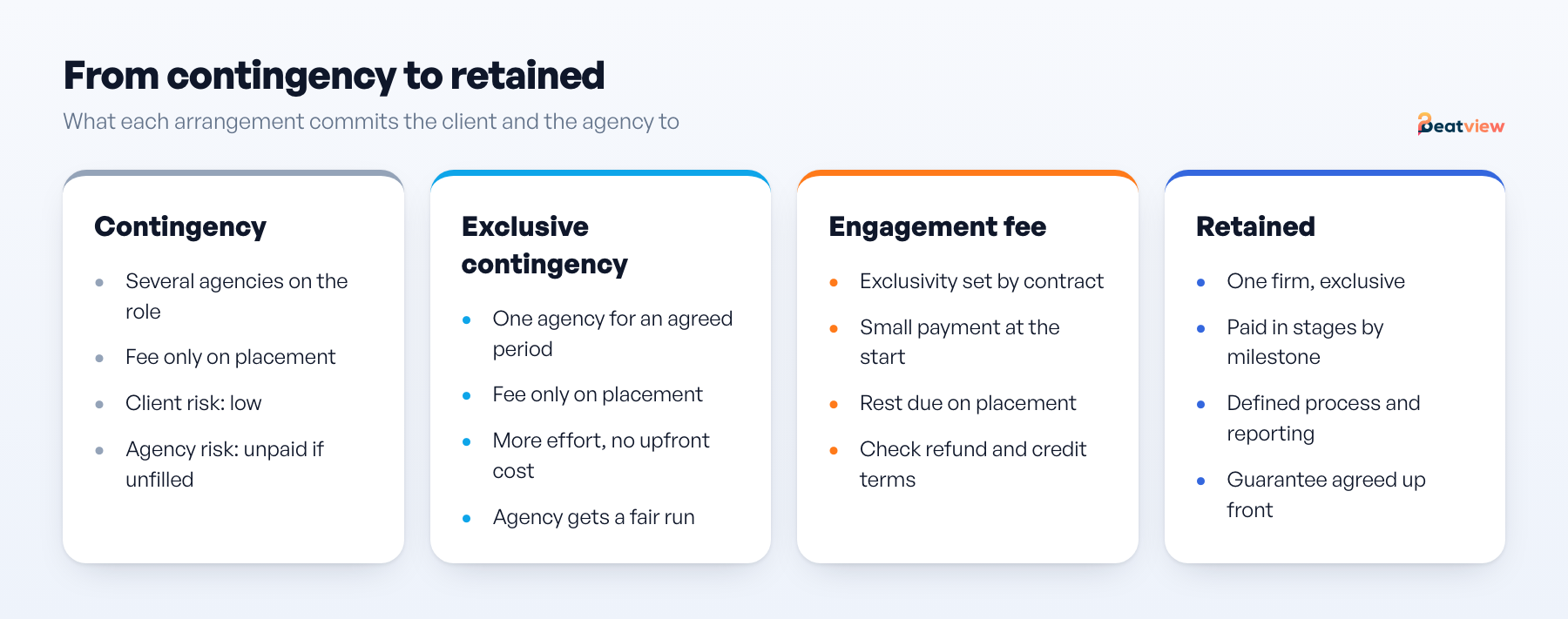
Agencies and clients can also agree terms between the two. Names vary, so read what a contract does rather than what it is called:
- Exclusive contingency. One agency works the role alone for an agreed period but is still paid only on placement: more effort for the client without an upfront payment.
- Engagement fee. A smaller payment at the start, with the rest due on placement. Check whether it is deducted from the final fee and whether it is refundable if the search stops.
- Fixed-fee project. An agreed price for a defined piece of work, such as a campaign for several similar roles.
- Talent mapping. The client pays for a picture of the market without a placement; the CCS framework treated it as a separate research service priced by the day or half day.
Questions to ask before you sign
- Who will run the search day to day, and who will speak to candidates?
- What triggers each payment, and is the fee fixed or a percentage of salary?
- What happens if we pause, cancel, or hire someone we found ourselves?
- What is the guarantee if the hire leaves early, and on what conditions?
- Which organizations are off-limits, including our own staff?
- Are you working on similar roles for competitors?
- How often will you report, and will we see the evidence behind each recommendation?
- How will candidate data be stored and shared?
For contingency, also ask how many other agencies are on the role, how duplicate submissions are settled, and how long candidate ownership lasts.
What a good retained search process looks like
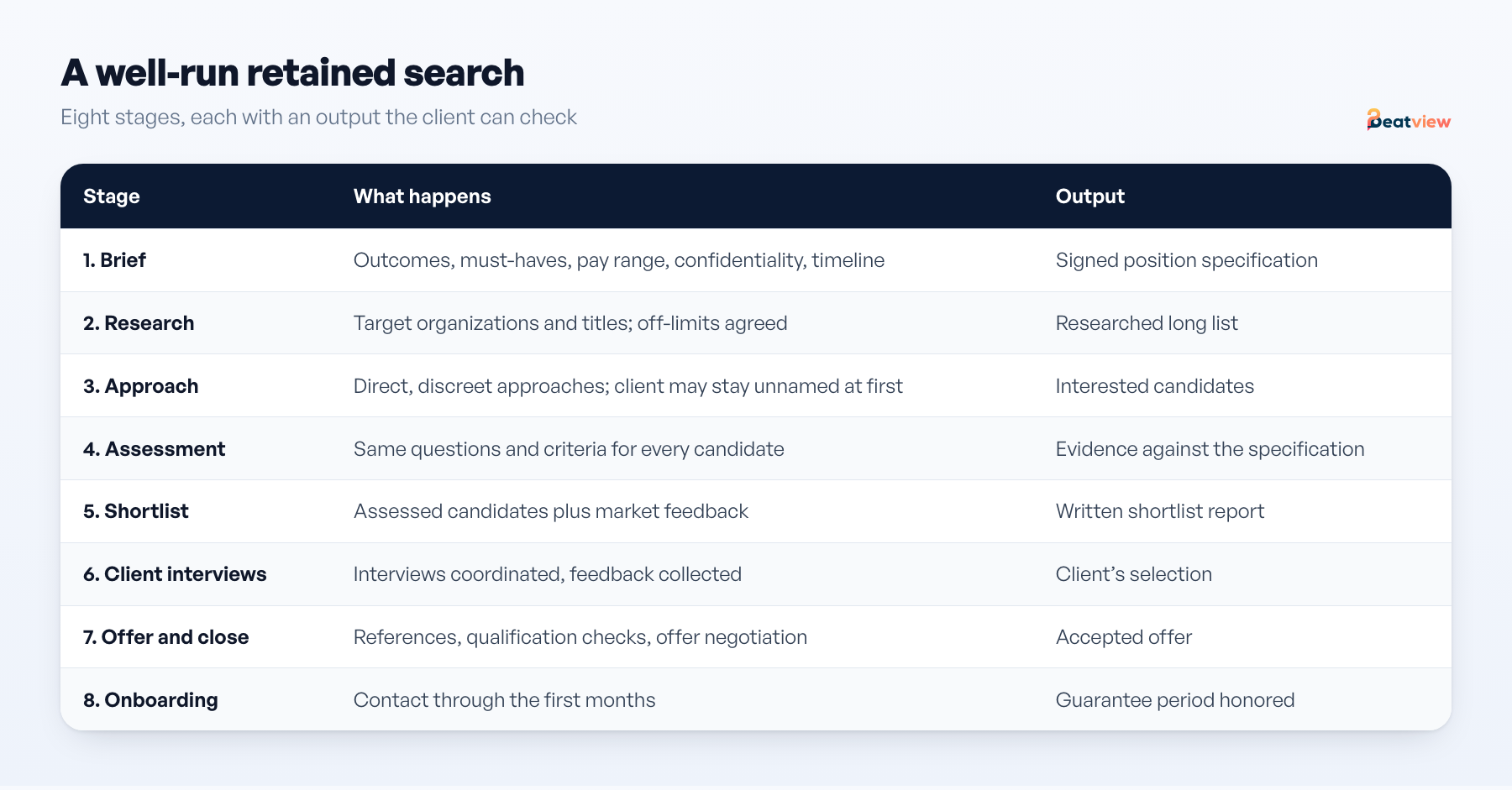
- Brief. Agree what the role must deliver, the must-have criteria and the evidence that will show them, the pay range, confidentiality and timeline, in a written specification.
- Research. Target organizations and titles, an agreed off-limits list, and a long list that reaches, in AESC's phrase, beyond the usual suspects. Researchers use tools such as Boolean search.
- Approach. Direct, discreet approaches to people who are often not looking; the client may stay unnamed at first.
- Assessment. The same questions and criteria for every candidate, so the shortlist can be compared fairly. See structured interviews and our interview question library.
- Shortlist. A few interested, assessed candidates, each with written evidence against the specification, plus market feedback on the role and pay.
- Client interviews. The consultant coordinates interviews and feedback; the final decision is always the client's.
- Offer and close. Qualifications verified, references taken (see our reference check questions), and help with the offer and resignation.
- Onboarding. Contact with the client and new hire through the first months, under the guarantee agreed at the start.
Where Beatview fits
Beatview does not run searches or replace a consultant's judgment. It supports the screening and assessment stages of both models: it screens applications against the criteria the agency sets and runs structured AI video interviews, so every candidate answers the same questions and each score sits beside its evidence. Agencies can share a shortlist with the client through a password-protected link, which suits a retained shortlist that needs a rationale for every name and a contingency desk where speed to a credible shortlist decides who gets paid. The Free plan covers one active job with unlimited candidates; AI interviews are on Pro. See Beatview for executive search, Beatview for recruitment agencies and our phone screening questions.
Frequently asked questions
What is the difference between retained and contingency search?
In retained search the client engages one firm exclusively and pays in stages tied to milestones in the search. In contingency search the client can brief several agencies, and only the agency whose candidate is hired is paid, on placement.
Is retained search the same as executive search?
Largely, yes. The UK government’s Crown Commercial Service treats the two names as one service, though it expects retained search to be used for niche and specialist roles as well as senior and executive ones.
How are retained search fees paid?
In instalments tied to milestones agreed in the contract; the fee may be a fixed amount or a percentage of salary. In one published example, the UK government’s RM6002 framework priced executive search at a fixed rate, paid in stages, with a 50% rebate if the hire left within six months.
Do you pay a contingency recruiter if you do not hire anyone?
No. A contingency fee is due only when a candidate the agency introduced is placed. Check the candidate-ownership terms, though: if you hire someone the agency submitted at a later date, a fee may still be due.
What is exclusive contingency recruitment?
A middle-ground arrangement in which one agency works the role alone for an agreed period but is still paid only on placement. The client gets more commitment without paying up front.
When should you use retained search?
For executive and board roles, niche roles with few qualified people, confidential replacements, and roles contingency agencies have not filled — where a researched, discreet search is worth paying for before the outcome is known.
Sources
- Crown Commercial Service (2018). RM6002 Permanent Recruitment Customer FAQ Document (PDF).
- U.S. Census Bureau (2022). 2022 NAICS descriptions: 561311 Employment Placement Agencies and 561312 Executive Search Services (XLSX).
- Association of Executive Search and Leadership Consultants (2025). AESC Professional Practice Standards (PDF).
- Association of Executive Search and Leadership Consultants. AESC Client Bill of Rights.
- Association of Executive Search and Leadership Consultants. AESC Candidate Bill of Rights.
Move an application from screening to interview
Use your configured workflow and review the completed result.
Start with one active job for free, or explore how Pro adds AI video interviews.
- Application screening
- AI video interviews
- Candidate event log
Related Articles
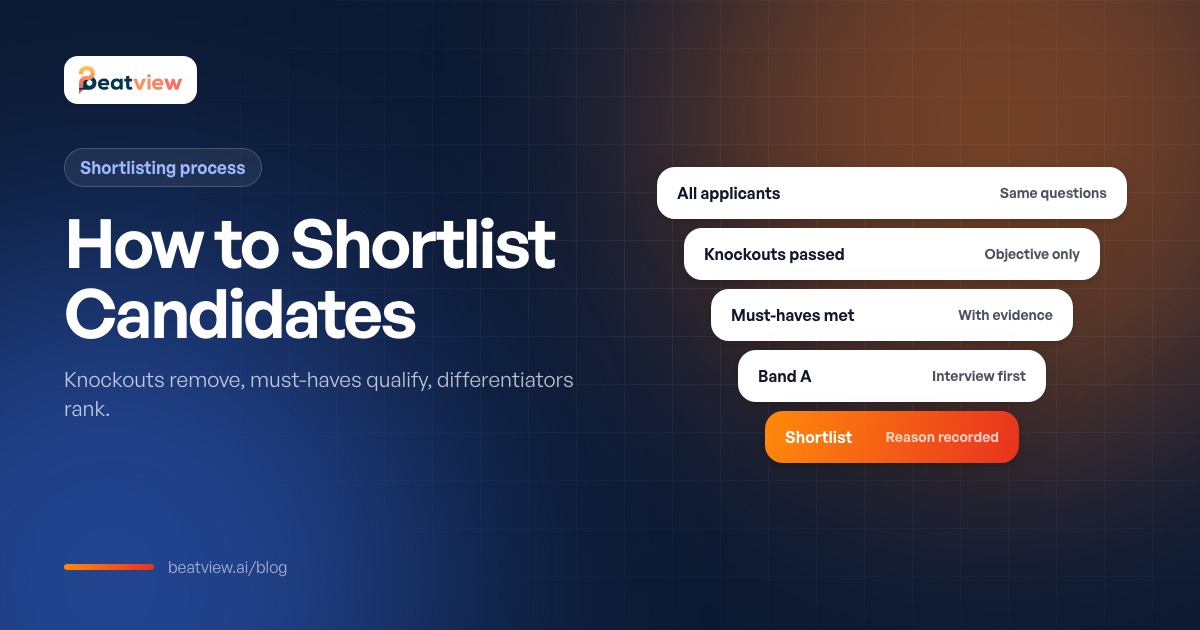
How to Shortlist Candidates: A Step-by-Step Shortlisting Process
How to shortlist candidates after CV or resume screening: knockouts, must-haves and differentiators, a six-step process, a shortlisting matrix template and how many candidates to shortlist.
Candidate Screening Process: 7 Stages, Methods and a Free Checklist
What candidate screening is, the screening methods compared, a seven-stage process with an owner and output for each stage, and a downloadable candidate screening checklist.

Time to Fill: Formula, Benchmarks and How to Reduce It
What time to fill measures, the formula with a worked example, how it differs from time to hire, the SHRM benchmark in context, and the seven intervals that show where the days actually go.