Recruitment Business Development: How to Win and Keep Clients
A practical guide to recruitment business development: build a target account list, spot hiring signals, use short call openers and emails, market candidates with consent, agree terms and track BD metrics.
Beatview Team
· 12 min read
Key takeaways
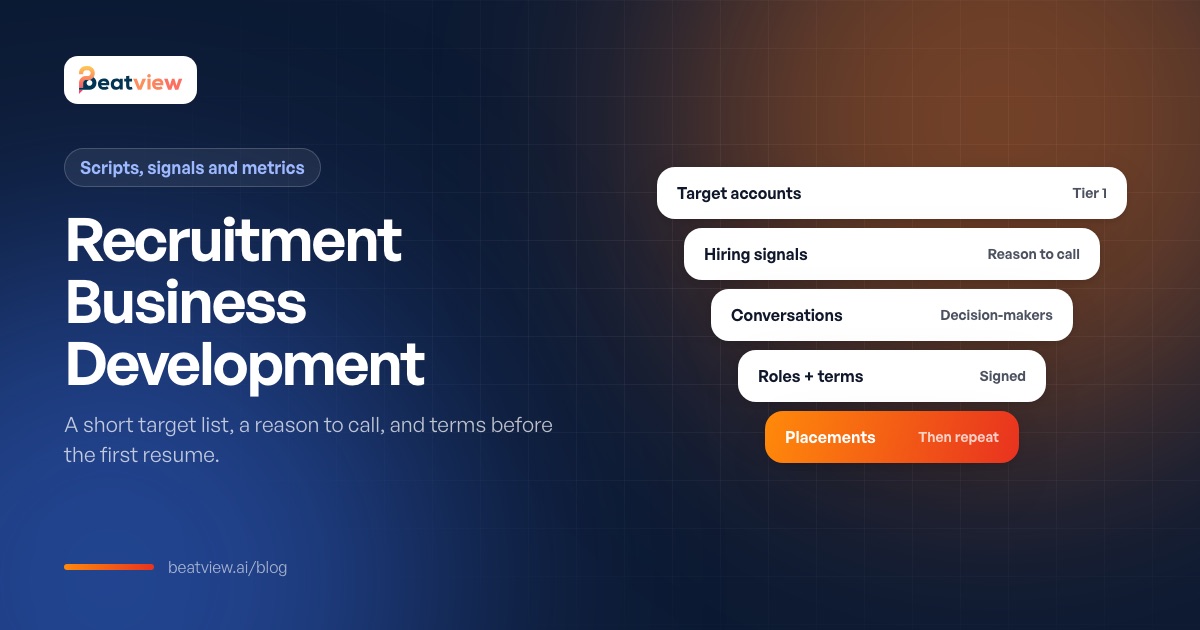
- Recruitment business development is targeted outreach: a short list of accounts in your niche, contacted when a hiring signal gives you a reason to call.
- The best signals are public and specific: new or reposted jobs, growth news, leadership changes and contacts moving companies. Never use a candidate’s confidential plans as a lead.
- Market a candidate to a prospective client only with their agreement. In Great Britain, regulation 19(3) of the Conduct Regulations requires confirmation that the candidate is willing to work in the position.
- Qualify every role and agree terms of business in writing before you send a single resume.
- Track activity and conversion (conversations, meetings, roles, terms agreed, fill rate and repeat clients) against your own baseline.
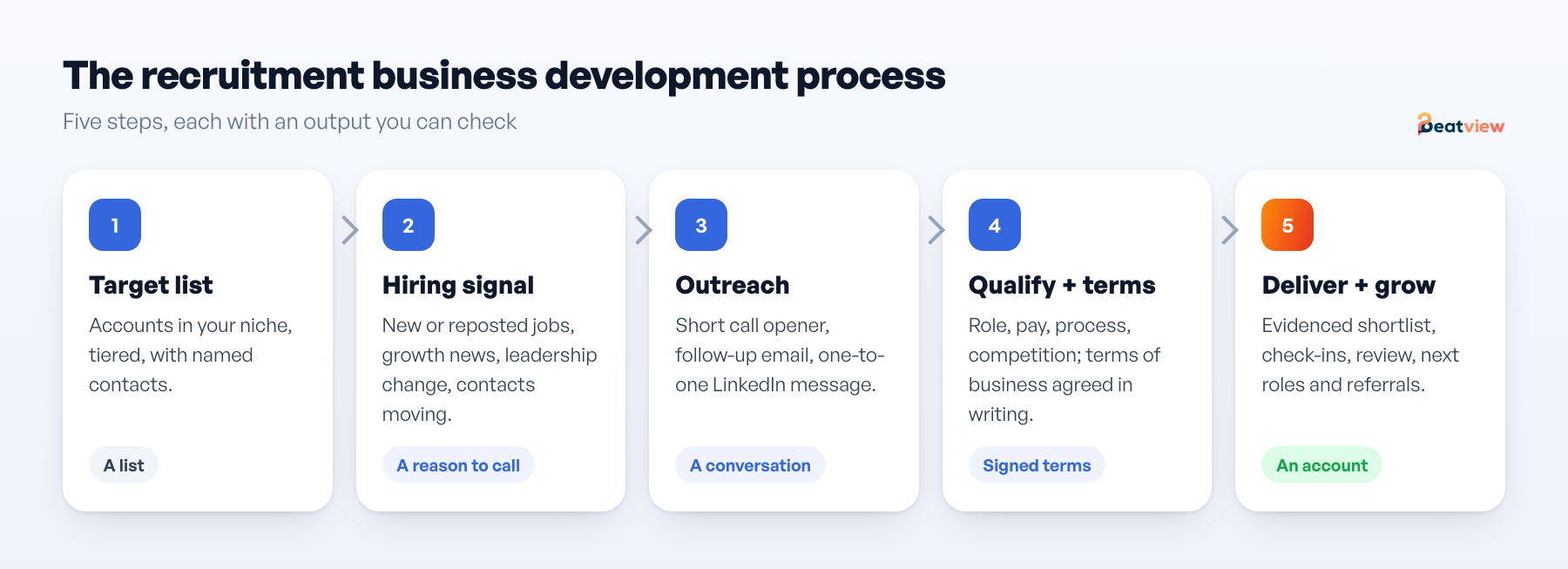
Recruitment business development is the work of finding employers who are hiring or about to hire, starting conversations with the people who own those hires, and turning a first role into a long-term client. The method that works for most agencies is a short list of target accounts you can serve well, outreach triggered by real hiring signals, brief messages that show you understand the role, terms of business agreed before you work a vacancy, and a few metrics that show what converts.
This guide covers direct outreach and sales, whether you work as a headhunter or a recruiter. For the work that makes prospects recognize your name before you call, see recruitment agency marketing.
Build a target account list
A focused list beats a big database. Start from your niche (the roles you place, for whom and where) and choose accounts where you could genuinely fill permanent or contract roles, not every company with a vacancy. Still setting up? Define the niche first with how to start a staffing agency or the UK start-up guide.
- Tier 1: best fit, researched properly, contacted every week or two with something relevant. A few dozen is plenty for one recruiter.
- Tier 2: good fit; contact when a hiring signal appears.
- Tier 3: possible fit; park for later.
For each Tier 1 account, keep a short record:
Scroll to compare →
| Field | Example (illustrative) |
|---|---|
| Company and why it fits | Regional logistics firm, three warehouses, hires supervisors every quarter |
| Roles you could fill | Shift supervisors, inventory controllers, forklift trainers |
| People | Operations director (budget), site managers (hiring), HR lead |
| Latest signal | Fourth site announced on its news page |
| Next step | Email with market note on Tuesday |
Build it from your own history first (past clients and hiring managers), then from job boards, careers pages, local news and sector associations.
Find hiring signals
A hiring signal is a reason to call this week rather than someday:
Scroll to compare →
| Signal | Where to spot it | What it suggests |
|---|---|---|
| New or repeated job postings | Careers pages, job boards | An active need; a reposted role may be struggling |
| Growth news | Company news pages, press, local business news, LinkedIn | New sites and contract wins bring several hires |
| Leadership change | LinkedIn, company announcements | A new head of department may want to reshape the team |
| Contacts moving jobs | Your network, LinkedIn job changes | A former client contact at a new company is a warm introduction |
| Seasonal or contract cycles | Your own placement history | Peaks you can raise before the client starts searching |
One signal to leave alone: a candidate telling you in confidence that they plan to leave. Pitching their employer a "backfill" can reveal it. In Great Britain, regulation 28 of the Conduct of Employment Agencies and Employment Businesses Regulations 2003 (the Conduct Regulations) bars agencies from disclosing information about a work-seeker without their prior consent, apart from narrow exceptions such as providing work-finding services to that person, and specifically from disclosing it to their current employer without consent.
Outreach channels and the rules that apply
- Phone is the fastest way to qualify a need. In the UK, the live-call rules in the Privacy and Electronic Communications Regulations (PECR) cover business numbers: screen against the Telephone Preference Service (TPS), the Corporate Telephone Preference Service (CTPS) and your own do-not-call list, say who is calling, display your number, and give contact details if asked. In the US, the FTC says most sales calls to businesses are exempt from the Telemarketing Sales Rule's Do Not Call provisions, but that FCC rules must also be considered.
- Email carries detail a call can't. In the UK, emails to companies and LLPs don't need PECR consent, but sole traders and some partnerships do, and UK GDPR applies to named contacts. In the US, CAN-SPAM covers business-to-business email. The marketing guide compares both.
- LinkedIn is for research and one-to-one messages. The Information Commissioner's Office (ICO) treats direct messages via social media as electronic mail under PECR, so the email rules apply.
- Introductions and events are the warmest route: ask past clients and placed candidates who else is hiring.
A sample week of BD activity (illustrative)
BD works as a weekly routine, not a burst.
Scroll to compare →
| Day | BD block | What "done" looks like |
|---|---|---|
| Monday | Check Tier 1 accounts for new signals; choose 10 priority accounts | 10 accounts, each with a named contact and a reason to call |
| Tuesday | 90-minute call block, priority accounts first | Every call logged with an outcome and next step |
| Wednesday | Candidate-led outreach for one candidate who agreed to be marketed | Anonymized profile sent only to the companies they approved |
| Thursday | Follow-up emails, LinkedIn messages and meetings | Every conversation has a dated next step |
| Friday | Update the CRM, record the week's numbers, plan next week | Metrics recorded; next week's list ready |
What to say: call openers and emails
Lead with the signal, make one relevant point, ask one question. These examples were written for this guide; names and details are illustrative.
Call openers
Job posting: "Hi Sam, it's Priya from [Agency]. I'm calling about the night shift supervisor role on your careers page. I recruit shift supervisors for warehouses in the region, and I'm working with two who've run night shifts at sites your size. Is the role still open, and how's the search going?"
Growth news: "Hi Alex, it's Priya from [Agency]. I saw you're opening a fourth site in the spring. Have you planned how you'll staff the supervisor and team leader roles?"
Referral: "Hi Jordan, Priya from [Agency]. Chris Lee suggested I call; we placed two team leaders with Chris last year. Chris mentioned you're building a new inventory team. Is that right?"
If you hear "we don't use agencies", don't argue. Ask which roles take longest to fill directly, offer your latest market note, and ask to check back next quarter.
A three-email sequence
Subject: Night shift supervisor role
Hi Sam, your night shift supervisor role has been on your careers page for a few weeks. I recruit shift supervisors for warehouses in the region, and every candidate I shortlist has completed the same structured interview, so you only meet people who have done the job. Worth 10 minutes this week?
Subject: Supervisor hiring notes
Hi Sam, following up with something useful either way: our quarterly note on supervisor hiring, drawn from the roles we filled this year, covering notice periods and why candidates turned offers down. Happy to talk it through.
Subject: Closing the loop
Hi Sam, I haven't heard back, so I'll assume the timing isn't right. If supervisor hiring comes back on the agenda, I'm on [phone].
End every sales email with your name, company, postal address and an opt-out line such as "Reply 'no thanks' and I won't contact you again." CAN-SPAM requires a valid physical postal address and opt-outs honored within 10 business days; PECR requires UK senders not to conceal their identity and to give a valid opt-out address. Check your do-not-contact list before every sequence.
Marketing a candidate to a prospective client
Sending a strong candidate's profile to a company that hasn't asked can open an account, but only with the candidate's agreement. In Great Britain, regulation 19(3) of the Conduct Regulations says: "Neither an agency nor an employment business may introduce or supply a work-seeker to a hirer unless it has obtained confirmation that the work-seeker is willing to work in the position which the hirer seeks to fill." The ICO's draft recruitment guidance adds that if a candidate hasn't been told the employer's identity, a recruiter should send the employer only anonymized information, and that what you disclose must be limited to what is relevant at that stage.
- Ask first. Tell the candidate which companies you'd like to approach and why. Record their agreement, the date, the companies named and any they want excluded, always including their current employer.
- Send an anonymized profile: skills, achievements, availability and general location, with no name, employer or other identifying detail.
- Confirm before the full resume. If the company is interested, describe the actual role to the candidate and confirm they are willing to be put forward for it.
- Report back to the candidate, whatever the outcome.
Example profile (illustrative): Shift supervisor, East Midlands. Six years running night shifts of 25–40 people at a multi-client distribution site; led the move to a new warehouse management system; certified forklift instructor; four weeks' notice; looking for a permanent role near Derby.
Elsewhere, treat the same steps as good practice: unapproved submissions lose candidates' trust and cause duplicate-submission disputes.
Qualify the role and agree terms before you start
Qualify every new vacancy on the first call:
Scroll to compare →
| Question | Why it matters |
|---|---|
| Why is the role open, and what happens if it stays empty? | Urgency and budget |
| What must the person have done before, and what is a nice-to-have? | Your screening criteria (see the phone screening questions) |
| What are the pay, benefits, hours and location? | Whether candidates will accept |
| Who decides, and what are the interview stages and dates? | How fast the process can move |
| Who else is working on it: internal team, other agencies, job ads? | Your real chance of filling it, and whether to propose exclusivity or a retained search |
| Will you agree our terms before we send candidates? | Whether you get paid |
In Great Britain, regulation 18 of the Conduct Regulations lists what an agency must obtain from a hirer before introducing anyone, including the hirer's identity and business, start date and likely duration, the type of work, location, hours and known health and safety risks, the experience, training and qualifications required, any expenses and, for an agency introducing candidates for direct employment, the minimum pay and benefits, pay intervals and notice periods.
Then agree terms of business in writing before you send a resume: the fee or rate and when it is payable, payment terms, any rebate or replacement period, how long an introduction remains valid, and what happens if the client hires a contractor permanently (see contract-to-hire). Recruitment agency fees explains the common fee structures and the UK limits on temp-to-perm fees, and the staffing agency business plan template has a pricing section. Have a lawyer review them once.
Turn a first placement into an account
- Deliver an evidenced shortlist. Source with Boolean search, then send fewer, better-documented candidates; see how to shortlist candidates, the interview questions library and the reference check questions.
- Stay close after the start date: check in during week one and near the end of probation or your guarantee period.
- Hold a short review: what worked, which roles are coming next, and who else in the business hires. Record each hiring manager in your CRM.
- Ask for a referral once the client is happy.
BD metrics to track
Track activity (what you did) and conversion (what it produced), counted the same way every week against your own baseline, not someone else's benchmark.
Scroll to compare →
| Metric | Type | Definition |
|---|---|---|
| Accounts researched | Activity | Target accounts with a named contact and a current signal, per week |
| Calls made | Activity | Outbound sales calls dialled |
| Decision-maker conversations | Activity | Conversations with someone who can give you a role |
| Conversation-to-meeting rate | Conversion | Meetings booked ÷ decision-maker conversations |
| Meeting-to-role rate | Conversion | New roles received ÷ meetings held |
| Terms agreed | Conversion | New clients who accepted your terms of business |
| Fill rate | Conversion | Roles filled ÷ roles taken on (see recruitment metrics) |
| Repeat client rate | Conversion | Clients who gave you a second role within 12 months ÷ clients you placed with |
Common mistakes
- Pitching every company with a vacancy instead of the accounts in your niche.
- Working a role before terms are agreed, then arguing about the fee after the placement.
- Sending resumes without the candidate's agreement, or using their confidential plans as a lead.
- Calling UK numbers without screening against the TPS and CTPS, or ignoring a clear "no".
- Not recording how each client was won, so you can't tell which activity pays.
Where Beatview fits
Business development wins the role; delivery keeps the client. Once a role is live, Beatview screens every application against the criteria you agreed with the client and runs structured AI video interviews, so every candidate answers the same questions and you can send an evidenced shortlist. Share it with the client through a password-protected link. The Free plan covers one active job with unlimited candidates; AI interviews are on Pro. See Beatview for recruiting agencies, or compare recruitment agency software and AI recruiting software. New to agency models? Read how staffing agencies work.
Frequently asked questions
How do recruitment agencies get new clients?
Mostly through targeted business development: a list of employers in their niche, outreach timed to hiring signals such as new job postings or growth news, referrals from existing clients, and marketing that makes prospects recognize the agency before it calls. A strong first shortlist then turns one role into repeat business.
What is a hiring signal in recruitment?
A public sign that an employer is hiring or soon will: a new or reposted job advert, a new site or contract win, a leadership change, or a former client contact joining another company. A signal gives you a specific reason to call.
Can I send a candidate’s resume to a company without asking them?
You shouldn’t. In Great Britain, regulation 19(3) of the Conduct Regulations bars agencies from introducing a work-seeker to a hirer without confirmation that they are willing to work in the position, and regulation 28 restricts disclosing their information without consent. Elsewhere, asking first is good practice that protects your relationship with candidates.
Can recruitment agencies cold call businesses in the UK?
Yes, within PECR. You can make live marketing calls to business numbers that are not registered with the TPS or the Corporate TPS (unless the business has consented to your calls) and that have not objected to your calls. Say who is calling, display your number and give contact details if asked.
What should be in recruitment terms of business?
At minimum: the fee or rate and when it is payable, payment terms, any rebate or replacement period, how long an introduction stays valid, and what happens if the client hires a temporary worker permanently. Agree them in writing before you send candidates.
What business development metrics should recruiters track?
Activity metrics such as accounts researched, calls made and decision-maker conversations, and conversion metrics such as conversation-to-meeting rate, meeting-to-role rate, terms agreed, fill rate and repeat client rate, all measured against your own baseline.
Sources
- legislation.gov.uk. Conduct of Employment Agencies and Employment Businesses Regulations 2003, regulation 18: Information to be obtained from a hirer.
- legislation.gov.uk. Conduct Regulations 2003, regulation 19: Confirmation to be obtained about a work-seeker.
- legislation.gov.uk. Conduct Regulations 2003, regulation 28: Confidentiality.
- Information Commissioner's Office. Guide to PECR: Telephone marketing.
- Information Commissioner's Office. Guide to PECR: Electronic mail marketing.
- Information Commissioner's Office. Business-to-business marketing.
- Information Commissioner's Office. Employment practices and data protection: recruitment and selection (draft) — Data protection and recruitment.
- Federal Trade Commission. CAN-SPAM Act: A Compliance Guide for Business.
- Federal Trade Commission. Q&A for telemarketers and sellers about DNC provisions in the TSR.
Move an application from screening to interview
Use your configured workflow and review the completed result.
Start with one active job for free, or explore how Pro adds AI video interviews.
- Application screening
- AI video interviews
- Candidate event log
Related Articles
Recruitment Metrics: 16 KPIs to Track (With Formulas and a Free Tracker)
16 recruitment metrics and KPIs with formulas — speed, funnel, quality and cost — plus agency KPIs, a screening-metrics dictionary, a reporting guide and a free tracker to build your baseline.
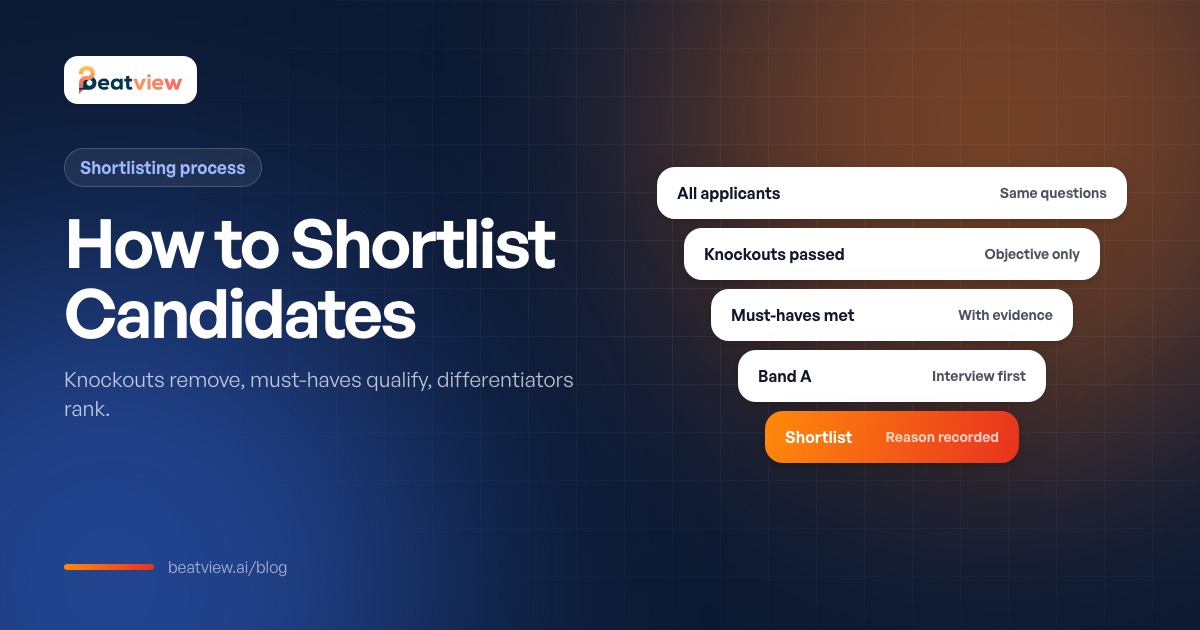
How to Shortlist Candidates: A Step-by-Step Shortlisting Process
How to shortlist candidates after CV or resume screening: knockouts, must-haves and differentiators, a six-step process, a shortlisting matrix template and how many candidates to shortlist.
Candidate Screening Process: 7 Stages, Methods and a Free Checklist
What candidate screening is, the screening methods compared, a seven-stage process with an owner and output for each stage, and a downloadable candidate screening checklist.