Structured Interviews: What They Are, Examples and How to Run One
What a structured interview is, how it compares with unstructured and semi-structured interviews, its advantages and disadvantages, and a seven-step method with a worked example.
By Beatview Team · Published · Updated · 8 min read
Key takeaways
- A structured interview asks every candidate the same job-related questions in the same order and rates each answer against criteria agreed before interviewing.
- Structure has two halves: standardizing what you ask and standardizing how you evaluate. You need both.
- In Sackett et al. (2022), structured interviews had the highest mean validity of common selection methods (about .42) versus about .19 for unstructured interviews.
- Run one in seven steps: job analysis, criteria, questions, anchors, consistent delivery, independent scoring, evidence-based debrief.
- Structure improves comparability and explainability; it does not fix bad criteria or prove a process is fair on its own.
A structured interview is a job interview in which every candidate for a role is asked the same predetermined, job-related questions, in the same order, and each answer is rated against the same scoring criteria agreed before the first interview. That consistency is the whole point: it makes candidates comparable, it makes decisions explainable, and in the research literature it is the single most predictive common interview format. This guide explains what a structured interview is, how it differs from unstructured and semi-structured interviews, its advantages and disadvantages, and how to run one step by step, with a worked example.
What is a structured interview?
Researchers Michael Campion, David Palmer and James Campion catalogued fifteen separate components of interview structure in a widely cited 1997 review. In practice they reduce to two groups — standardizing what you ask and standardizing how you evaluate:
| What you ask | How you evaluate |
|---|---|
| Questions based on a job analysis, not on the interviewer's preferences | Each answer rated on a defined scale, usually 1–5 |
| The same questions for every candidate, in the same order | Anchors that describe what a weak, adequate and strong answer contains |
| Limited, planned follow-up questions | Notes taken during the interview, not reconstructed afterwards |
| No unrelated small talk that drifts into personal topics | Ratings combined by a set rule, and independent scoring before any discussion |
If an interview has the same questions but no scoring anchors, it is only half-structured. If it has a scorecard but interviewers improvise the questions, the scores are not comparable. You need both halves.
Structured vs unstructured vs semi-structured interviews
| Structured | Semi-structured | Unstructured | |
|---|---|---|---|
| Questions | Fixed set, same order for everyone | Core questions fixed, others vary | Chosen by the interviewer on the day |
| Scoring | Anchored rating per answer | Partly anchored, often an overall rating | Overall impression |
| Comparability | High | Medium | Low |
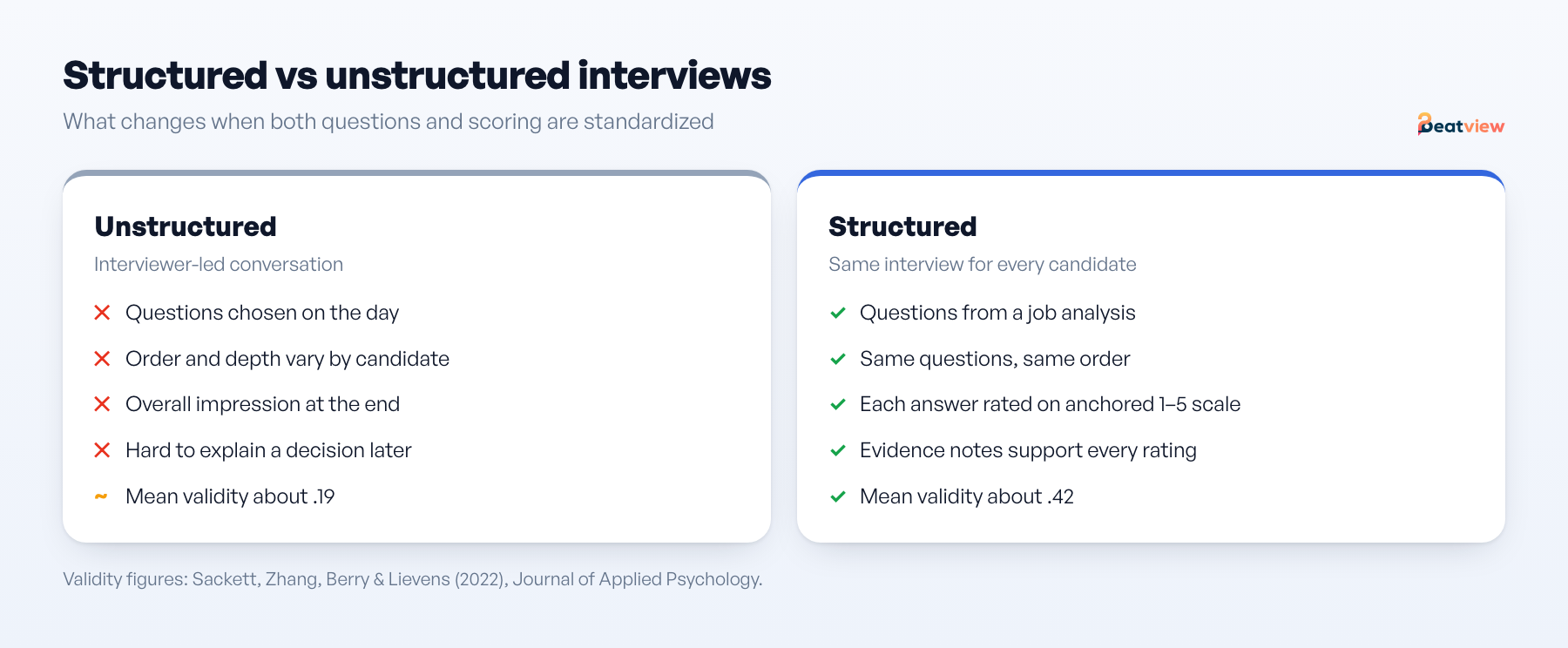
| Predictive validity* | About .42 | Between the two | About .19 |
| Rapport and flexibility | Lower, unless designed in | Good | High |
| Best used for | Screening and any decision you may need to explain | Later rounds with a hiring manager | Informal conversations, not selection decisions |
*Mean operational validity for predicting job performance, from Sackett, Zhang, Berry and Lievens (2022).
Why structured interviews work
They predict performance better. Sackett and colleagues' 2022 re-analysis in the Journal of Applied Psychology corrected earlier methods that had overstated many validity figures. Structured interviews came out as the highest-ranked common selection procedure, at a mean validity of about .42 — ahead of job knowledge tests (.40), work samples (.33) and general cognitive ability tests (.31). Unstructured interviews came out at about .19.
They reduce avoidable inconsistency. When every candidate answers the same question and every rater uses the same anchors, differences in scores are more likely to reflect differences in answers rather than differences in interviewer mood, order effects or small talk. Levashina and colleagues' 2014 review in Personnel Psychology concluded that structure raises validity and constrains — though it does not eliminate — impression management.
They make decisions explainable. A dated record of the questions, criteria, evidence and ratings is what a client, a candidate or an auditor will ask for. Several newer rules on hiring technology expect exactly this kind of documentation; see our summary of AI hiring laws.
Advantages and disadvantages of structured interviews
Advantages
More predictive of job performance than unstructured interviews.
Candidates are compared on the same evidence.
Easier to train new interviewers and to calibrate a panel.
Decisions can be explained and audited afterwards.
Fairer experience: everyone gets the same chance to show the same things.
Disadvantages
Takes preparation: a job analysis, questions and anchors per role.
Can feel rigid if interviewers read questions like a script.
Less room to explore an unexpected strength.
Only as good as the criteria — structure applied to an irrelevant requirement just repeats the mistake consistently.
Most of the disadvantages are design problems. Build rapport in a fixed opening, allow planned follow-ups, and reuse question banks across similar roles so the preparation cost falls with each search.
How to conduct a structured interview in 7 steps
List the outcomes the person must deliver in the first year and the situations they will face. This is the basis for every question.
Describe the work, not the person. Each criterion needs one sentence naming the evidence you would accept.
One or two per criterion, plus one planned follow-up each. Past-behavior questions work best for experienced candidates. Use our 40 structured interview questions as a starting bank.
Describe what a 1, 3 and 5 answer contains for each criterion before anyone is interviewed. The interview scorecard template has the format.
Same introduction, same questions, same order, same time allowance, notes taken live.
Each interviewer rates from notes before speaking to anyone else about the candidate.
Discuss only criteria where ratings differ by two or more points, and record the decision and its reason in a sentence or two.
Structured interview example
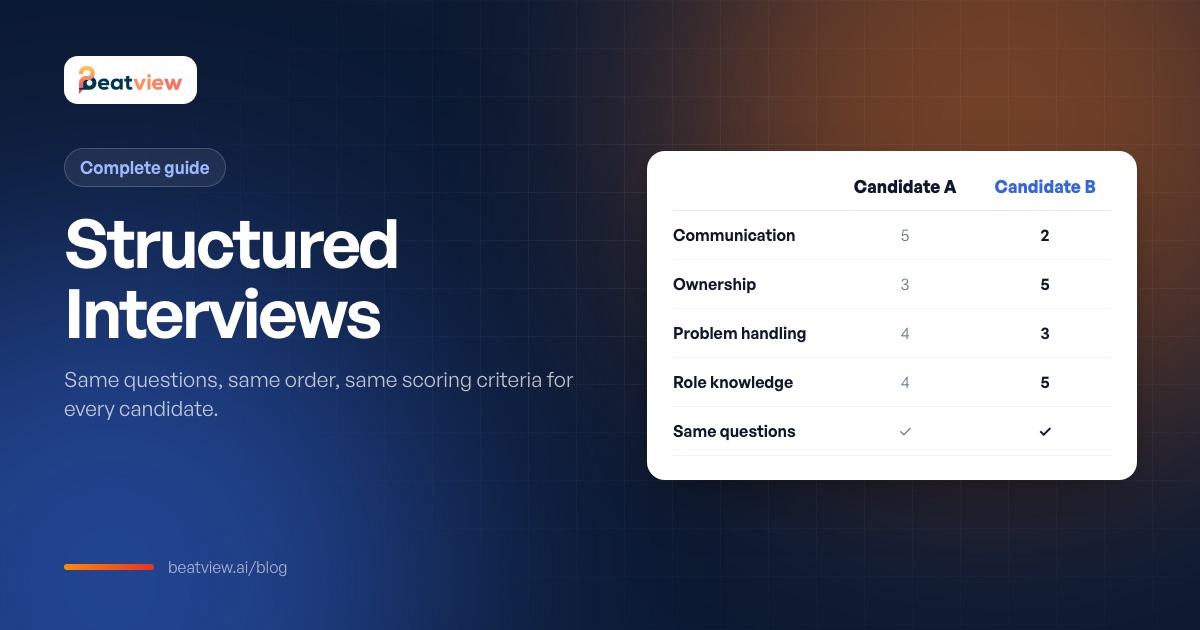
A synthetic example, created for this article. Role: client-facing account coordinator. Two candidates, the same four criteria, the same questions and anchors agreed in advance.
| Criterion | Candidate A — evidence | A | Candidate B — evidence | B |
|---|---|---|---|---|
| Client communication | Rewrote a delivery-delay email after a complaint; quoted the change she made | 5 | Described her communication style in general terms, no incident | 2 |
| Independent ownership | Ran a weekly client report, but her manager approved each send | 3 | Owned onboarding for eight accounts and decided escalations herself | 5 |
| Problem handling | Specific incident, action and outcome | 4 | Specific incident, unclear what she personally did | 3 |
| Role knowledge | Answered the practical question correctly | 4 | Answered correctly with a better-reasoned explanation | 5 |
Totals: A 16, B 15 — close enough that the total should not decide it. The useful output is the difference in shape: A is stronger in client-facing writing, B is stronger at working unsupervised. Which matters more is a decision for the hiring manager against the role, and it should be written down before the second interview. The structure does not choose for you; it makes the disagreement specific.
What a structured interview does not fix
- Bad criteria. Consistently applying an irrelevant requirement only makes the problem reproducible.
- Fairness on its own. Identical questions reduce avoidable inconsistency, but they are not proof of a non-discriminatory process. Review outcomes and take legal advice for your jurisdictions; our guide to reducing bias in hiring covers the practical checks.
- Interviewer effort. Someone still has to listen, take notes and rate.
- A weak shortlist. Structure improves the decision between candidates; it cannot add better candidates to the pool.
Structured interviews in one-way and AI interviews
A recorded first round is a structured interview by construction: every candidate answers the same questions, in the same order, with the same time limit, and nobody can drift into small talk. That makes one-way video and AI interviews a practical way to structure the highest-volume stage of hiring. The scoring half still needs care — you should be able to see which answer produced which score. Read what an AI interview is and how it differs from a one-way video interview.
Where Beatview fits
Beatview runs the structured first round for recruitment agencies. Every candidate for a role answers the same timed video questions, and each completed interview is scored on relevance, clarity, depth of knowledge and an overall rating, with the candidate's answer beside each score so a recruiter can check it. A candidate's overall match score is the plain average of the resume and interview scores — no hidden weighting. Your human scorecard for later rounds stays separate, and your recruiters make every decision. See AI interviews.
Frequently asked questions
What is a structured interview?
A structured interview is a job interview in which every candidate for a role is asked the same predetermined, job-related questions in the same order, and each answer is rated against the same scoring criteria agreed before interviews begin.
What is the difference between a structured and an unstructured interview?
A structured interview fixes the questions, their order and the rating criteria for every candidate. An unstructured interview lets the interviewer choose questions on the day and usually ends with an overall impression rather than anchored ratings.
What is a semi-structured interview?
A semi-structured interview keeps a set of core questions fixed for every candidate but lets the interviewer add or vary other questions. It is common in later-round conversations with hiring managers.
Are structured interviews more effective?
Yes, on average. A 2022 re-analysis by Sackett and colleagues found structured interviews had a mean validity of about .42 for predicting job performance, the highest of the common selection methods reviewed, compared with about .19 for unstructured interviews.
What are the disadvantages of structured interviews?
They take preparation for each role, can feel rigid if read like a script, and leave less room to explore unexpected strengths. Planned follow-ups, a consistent rapport-building opening and reusable question banks reduce these drawbacks.
Is a one-way video interview a structured interview?
It can be. A recorded first round gives every candidate the same questions, order and time limit. It is fully structured only if answers are also rated against defined criteria.
Sources
- Sackett, P. R., Zhang, C., Berry, C. M., & Lievens, F. (2022). Revisiting meta-analytic estimates of validity in personnel selection. Journal of Applied Psychology.
- Levashina, J., Hartwell, C. J., Morgeson, F. P., & Campion, M. A. (2014). The structured employment interview: Narrative and quantitative review of the research literature. Personnel Psychology, 67, 241–293.
- Campion, M. A., Palmer, D. K., & Campion, J. E. (1997). A review of structure in the selection interview. Personnel Psychology, 50, 655–702.