Recruitment Agency Marketing: A Practical Plan for 2026
A practical recruitment agency marketing plan: two audiences, a niche you can own, job pages Google can list, useful content, LinkedIn and email within US and UK rules, referrals, reviews and a 90-day plan.
Beatview Team
· 11 min read
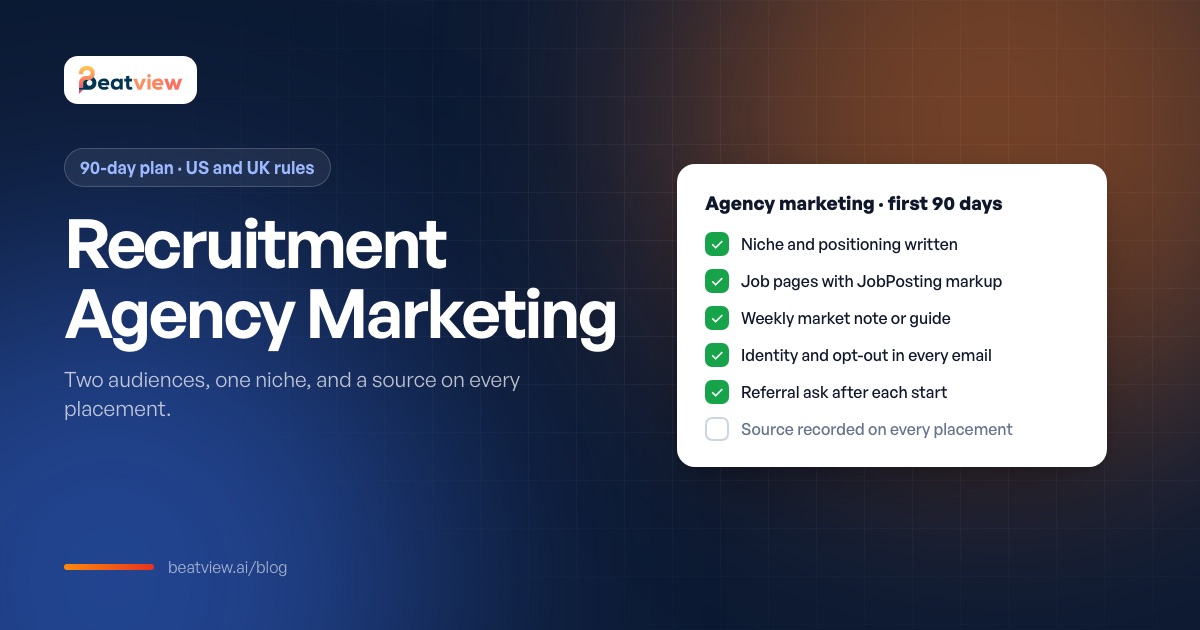
Key takeaways
- Recruitment agency marketing works on two audiences at once: clients who pay the fee and the candidates you place. Give each its own message, pages and proof.
- A narrow niche (roles, employers and location) makes every other marketing choice easier: whom to reach, what to write about and which events to attend.
- Job pages are core marketing: one real vacancy per page with Google’s JobPosting markup, and filled jobs expired promptly.
- In the UK, marketing emails to companies don’t need PECR consent but must identify you and offer an opt-out, while sole traders need consent; in the US, CAN-SPAM covers business-to-business email too.
- Record the source of every new client and every placement, review it monthly, and move time towards the channels that produce placements.
Recruitment agency marketing is everything an agency does to make the right employers and candidates know it, trust it and get in touch before a recruiter picks up the phone. For most small agencies the plan that works is simple: choose a niche you can own, prove your expertise on your website and in useful content, show up consistently on LinkedIn and email within the US and UK rules, and turn every placement into a referral and a review. Then record where every new client and placed candidate came from, so you keep what works and drop what doesn't.
Direct outreach (target accounts, call openers and sales emails) has its own guide: recruitment business development.
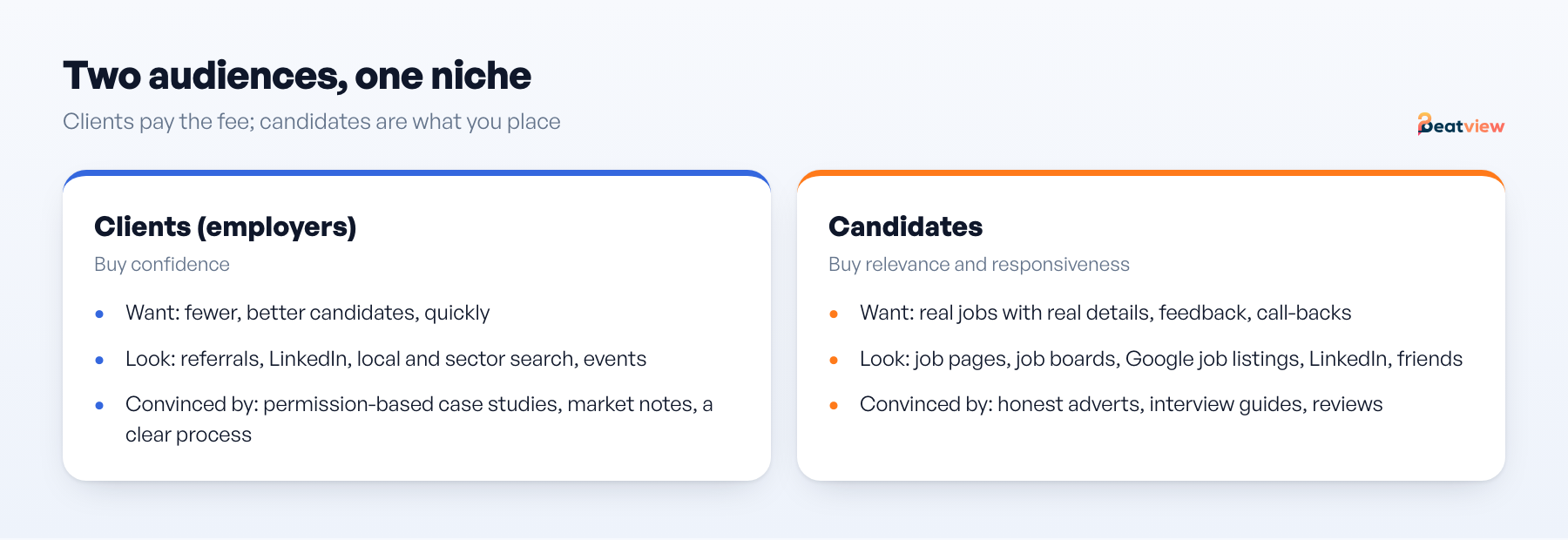
Two audiences: clients who pay and candidates who supply
Clients pay the fee, so most marketing effort chases them, but an agency with no candidates has nothing to sell. Give each audience its own message, pages and proof, and let the niche tie them together. New to the model? Start with how staffing agencies work.
Choose and own a niche
A niche combines the roles you place, the employers you place them with and where: "night-shift warehouse supervisors for logistics firms in the East Midlands" or "registered nurses for home-care providers in Ohio" (both illustrative). The narrower it is, the easier it is to know whom to reach and what to write. Test it:
- Demand: can you list at least 50 employers that hire these roles repeatedly?
- Supply: can you reach candidates without competing against every generalist agency in town?
- Knowledge: do you understand the work well enough to screen for it and write about it every week?
- Model: permanent recruitment, contract and temp staffing and contract-to-hire need different messages. Contractors want the next assignment lined up; permanent candidates want career progress.
Write the niche into your staffing agency business plan. If you are still setting up, see how to start a staffing agency (US) or how to start a recruitment agency in the UK.
Positioning and proof
Positioning is one sentence a client could repeat to a colleague: "We place [roles] for [type of employer] in [area], and [what we do differently]." The last part must be true and checkable, such as "every shortlisted candidate completes the same structured interview". Decide too whether you sell retained or contingency search, and whether you present as a headhunter or a recruiter.
Proof makes the sentence believable. Use only proof you can stand behind:
- Case studies with permission. Get the client's written agreement before you name them, show their logo or describe their hiring. Otherwise write an anonymized case ("a regional care home group") with no detail that identifies the client or the candidate.
- Your own numbers, such as time to first shortlist, from your own records, with the period and number of roles behind them. See recruitment metrics for definitions.
- Your process: how you screen, interview and check references. You could publish the reference check questions you use.
Never invent numbers, testimonials or client logos.
Website essentials and job pages
Both audiences check your website after a referral, a post or a call. Each page has a job:
- Home page stating the niche and positioning on the first screen, with separate paths for employers and candidates.
- Employer page: roles covered, your process, how fees work in general terms (or a link to a neutral explainer such as recruitment agency fees) and a contact or booking link.
- Candidate page: what happens after someone applies and how quickly you respond.
- One page per open job with the full description, location, pay where the client allows it, and a way to apply.
- A privacy notice. The UK Information Commissioner's Office (ICO) says in its draft recruitment guidance that a recruiter must give its name and contact details, explain how it uses and discloses candidates' information, and provide this when it collects the information, for example in the job advert.
Make job pages eligible for Google's job listings
Google can show job pages in its job search results when they carry JobPosting structured data. Its documentation sets these rules:
- Mark up the page for a single job, never job lists or search results pages.
- Include the required properties:
title,description(the full job description),datePosted,hiringOrganizationandjobLocation. Fully remote jobs usejobLocationTypeandapplicantLocationRequirements. - If the client wants to stay anonymous, Google says a staffing agency can use the value
confidentialfor the hiring organization's name. - Expire filled jobs promptly: set
validThroughto a past date, remove the page (404 or 410) or remove the markup. Google warns that not acting on expired jobs may lead to a manual action. - Advertise real vacancies only. Google's policies prohibit fake job postings, including those posted mainly to collect applicant information, and allow resume collection for open positions only.
Content that works for agencies
Content works when it answers a question your niche is asking, using what you already know:
Scroll to compare →
| Format | Audience | Built from | How often |
|---|---|---|---|
| Market notes | Clients and candidates | Your own records: applications per role, offers accepted, notice periods, pay in placements you made (state the period and how many roles) | Monthly or quarterly |
| Hiring guides | Clients | Your process for one role: where candidates come from, what to screen for, a realistic timeline | One per core role |
| Interview questions by role | Clients and candidates | The questions you ask in screening, with what a good answer sounds like | One per core role |
| Candidate guides | Candidates | Resume advice for your niche, interview preparation, the checks employers run | A few evergreen pieces |
Interview question pages serve both audiences: hiring managers want questions to ask, candidates want to prepare. See the interview questions library (for example registered nurse or warehouse associate) and the phone screening questions template for structure.
Every pay or market figure should come from your own records or a named source, with the sample stated: "from the 14 placements we made this year" (illustrative) beats a national average you can't explain. And one useful piece a week beats ten followed by silence.
LinkedIn and email, within the rules
On LinkedIn, post from consultants' own profiles: market notes, real jobs, and placement stories shared with permission. Use email for a newsletter to people who asked for it and for one-to-one follow-ups. When either is used to market your services, the rules differ. In the UK they come from the Privacy and Electronic Communications Regulations (PECR) and UK GDPR:
Scroll to compare →
| Rule | UK (PECR and UK GDPR) | US (CAN-SPAM Act) |
|---|---|---|
| Who it covers | The email consent rule doesn't apply to corporate subscribers: companies, limited liability partnerships, Scottish partnerships and government bodies. Sole traders and some partnerships count as individuals and need consent or the "soft opt-in" (existing customers offered an opt-out). If unsure, the ICO says treat the address as an individual's. | All commercial email. The FTC says the law makes no exception for business-to-business email. |
| Identify yourself | Don't disguise or conceal who is sending | Accurate From, Reply-To and routing details; an honest subject line; a clear statement that the message is an advertisement; your valid physical postal address |
| Opt-out | Give a valid address to opt out or unsubscribe, act on it, and keep a "do not contact" list | A clear opt-out in every message, honored within 10 business days and working for at least 30 days after sending |
| Other duties | UK GDPR applies to addresses that identify a person, such as firstname.lastname@company: you need a lawful basis (often legitimate interests, after the ICO's three-part test), must give privacy information within one month if you got the details elsewhere, and must stop if they object | If another company sends email for you, both the business promoted and the sender can be held liable |
In the UK, LinkedIn messages need the same care. The ICO says the electronic mail rules cover "direct messages via social media", and that when people use professional networking sites in a personal, albeit professional, capacity, marketing messages to them are not business-to-business marketing. Its draft recruitment guidance adds that privately messaging specific people about a vacancy is direct marketing under PECR, while broadcasting a job to all your followers is not. So post jobs openly, keep direct messages one-to-one and relevant, and take advice before any bulk messaging. The same draft says recruiters should not search candidates' personal social media profiles; use recruitment platforms (see Boolean search for recruiters). The ICO's guidance is under review after the Data (Use and Access) Act 2025, so check the current version.
Referrals and alumni
- Ask at set moments: when a candidate completes their first month, when a client's hire passes probation or your guarantee period, and whenever someone thanks you. Ask something specific: "Which other teams in your company are hiring this quarter?"
- Let referrers make the introduction. Ask them to pass your details on, or check the person is happy to hear from you, rather than handing over a friend's contact details. The ICO advises against marketing that relies on people giving you their friends' details.
- Keep in touch with alumni. Placed candidates become hiring managers, and hiring managers move companies. Check in at three, six and twelve months.
Events and communities
- Host a small, regular roundtable or online briefing for hiring managers in your niche, built around your latest market note.
- Speak at sector meetups and trade association events; in candidate communities, contribute answers, not job spam.
- Follow up within a week. The ICO points out that once you add business-card details to a database, UK GDPR applies, so tell people how you will use them.
Reviews
Ask for reviews as a routine, and follow Google's Maps user-generated content policy, which covers reviews of your business on Google:
- Don't offer incentives, such as payment, discounts or free services, for a review.
- Don't discourage negative reviews or selectively ask only happy customers. Ask everyone you worked with.
- Don't ask staff: Google lists current or former employment as a conflict of interest.
- Don't tell people what to write.
Reply to every review briefly, and never confirm a candidate's personal details in a public reply.
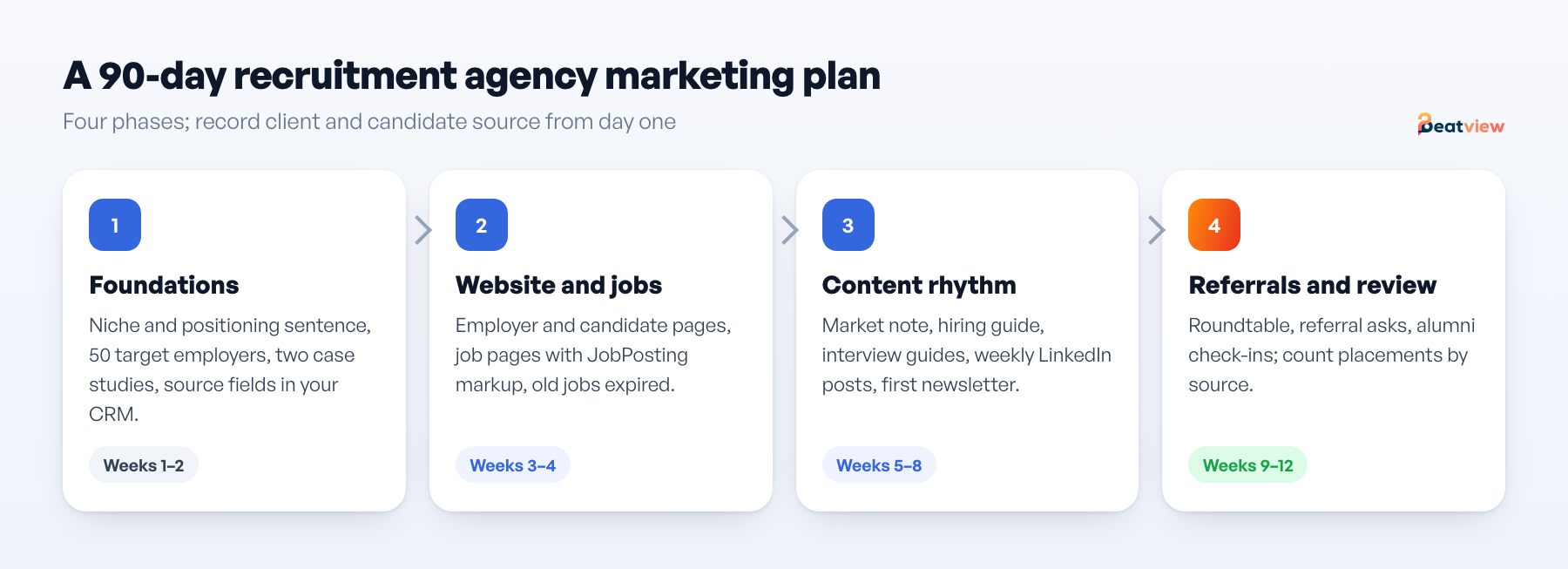
A simple 90-day marketing plan
Scroll to compare →
| Weeks | Clients | Candidates | Measurement |
|---|---|---|---|
| 1–2 | Write the niche and positioning sentence; list 50 target employers; draft two case studies | Audit job adverts; write the candidate page and a response-time promise | Add "client source" and "candidate source" fields to your CRM or ATS |
| 3–4 | Publish the employer page; set up your Google Business Profile; ask past clients for reviews | Rebuild job pages with JobPosting markup; expire old jobs | Tag shared links so enquiries can be traced; note starting numbers |
| 5–8 | Publish a market note and a hiring guide; consultants post weekly; first newsletter to opted-in contacts | Publish two role-specific interview guides and one candidate guide | Check which posts and pages produced enquiries |
| 9–12 | Host one roundtable or briefing; ask every recent client for a referral | Alumni check-ins; referral asks to placed candidates | Count new clients, roles and placements by source; cut the weakest channel |
How to measure what works
Agency marketing is measured in clients and placements, not likes. Record client source (how each new client first found you: referral, LinkedIn, search, event, newsletter or outbound call) and candidate source (where each placed candidate came from). Ask "How did you hear about us?" on every first call.
Scroll to compare →
| Metric | Definition |
|---|---|
| New client conversations by source | First conversations with a potential client in the period, by client source |
| New clients by source | Clients who agreed terms and gave you a first role, by client source |
| Placements by source | Placements in the period, by candidate source and by client source |
| Fee income by source | Fees invoiced in the period, by client source |
| Time per channel | Hours spent on each channel per month |
Review monthly against your own baseline. A channel that brings applicants but no placements is a cost, not an asset.
Where Beatview fits
Good marketing brings more applicants than a small desk can read. Beatview screens every application against the criteria you set for the role and runs structured AI video interviews, so each candidate answers the same questions and you review the evidence before deciding who goes forward. When the shortlist is ready, share it with the client through a password-protected link. The Free plan covers one active job with unlimited candidates; AI interviews are on Pro. See Beatview for recruiting agencies, or compare recruitment agency software and AI recruiting software.
Frequently asked questions
What is recruitment agency marketing?
It is how an agency makes employers and candidates in its niche know it, trust it and get in touch: positioning, a website with real job pages, useful content, LinkedIn and email, referrals, events and reviews. One-to-one sales outreach to prospective clients is usually treated separately as business development.
How do recruitment agencies get clients through marketing?
By owning a niche and proving expertise in it: market notes from their own placement data, hiring guides and interview question pages for the roles they place, case studies published with client permission, and regular LinkedIn posts from consultants. Referrals and reviews from past clients turn that visibility into enquiries.
Can a UK recruitment agency send marketing emails to businesses without consent?
Under PECR, the email consent rule doesn’t apply to corporate subscribers such as companies and limited liability partnerships, but you must identify yourself and give a valid address to opt out. Sole traders and some partnerships need consent or the soft opt-in. UK GDPR still applies to named contacts, and the ICO says its guidance is under review after the Data (Use and Access) Act 2025.
Does CAN-SPAM apply to business-to-business recruiting emails?
Yes. The FTC says the CAN-SPAM Act makes no exception for business-to-business email. Commercial messages need accurate header information, an honest subject line, a clear statement that they are advertisements, your physical postal address and an opt-out honored within 10 business days.
Should agency job pages use JobPosting structured data?
Yes, if you want them eligible for Google’s job search features. Put the markup on single-job pages, include the required properties, use “confidential” as the hiring organization name for clients who want anonymity, and expire filled jobs promptly.
How do you measure recruitment agency marketing?
Record the client source of every new client and the candidate source of every placement, then compare new clients, placements and fee income by source each month against your own baseline.
Sources
- Information Commissioner's Office. Guide to PECR: Electronic mail marketing.
- Information Commissioner's Office. Business-to-business marketing.
- Information Commissioner's Office. Employment practices and data protection: recruitment and selection (draft) — Data protection and recruitment.
- Information Commissioner's Office. Employment practices and data protection: recruitment and selection (draft) — Finding candidates.
- Federal Trade Commission. CAN-SPAM Act: A Compliance Guide for Business.
- Google Search Central. Job posting (JobPosting) structured data.
- Google. Maps user-generated content policy: Prohibited and restricted content.
Move an application from screening to interview
Use your configured workflow and review the completed result.
Start with one active job for free, or explore how Pro adds AI video interviews.
- Application screening
- AI video interviews
- Candidate event log
Related Articles
Recruitment Metrics: 16 KPIs to Track (With Formulas and a Free Tracker)
16 recruitment metrics and KPIs with formulas — speed, funnel, quality and cost — plus agency KPIs, a screening-metrics dictionary, a reporting guide and a free tracker to build your baseline.
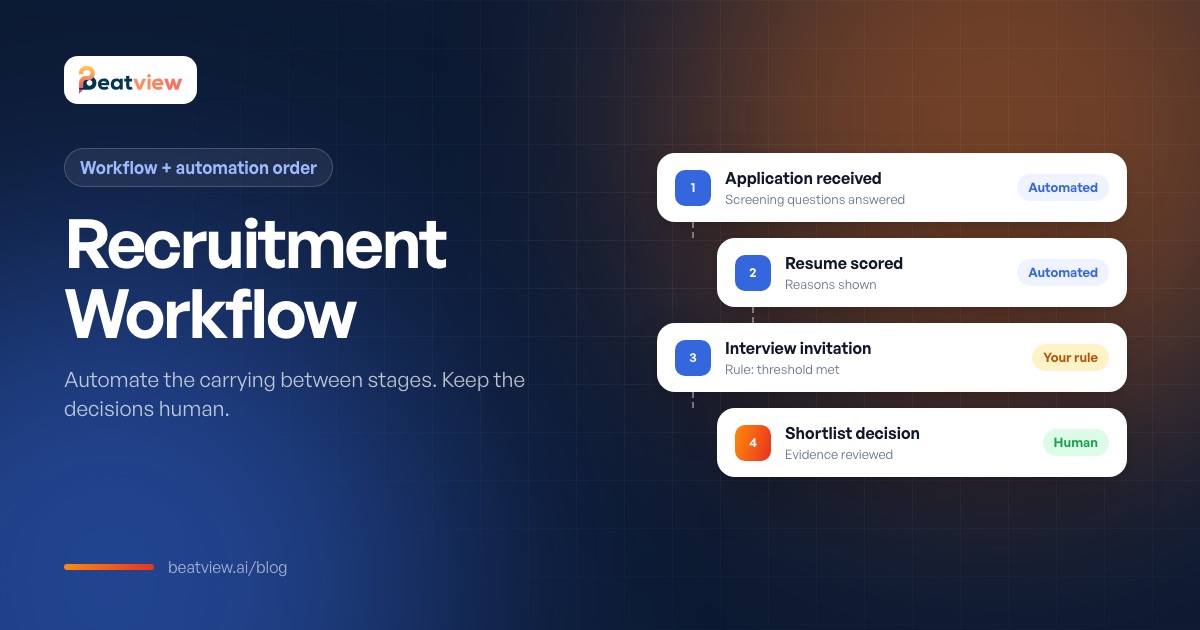
Recruitment Workflow: Stages, What to Automate First and a Setup Checklist
The stages of a recruitment workflow, the order in which to automate them, a trigger-and-action map, what should stay human and a launch checklist for automating your first role.
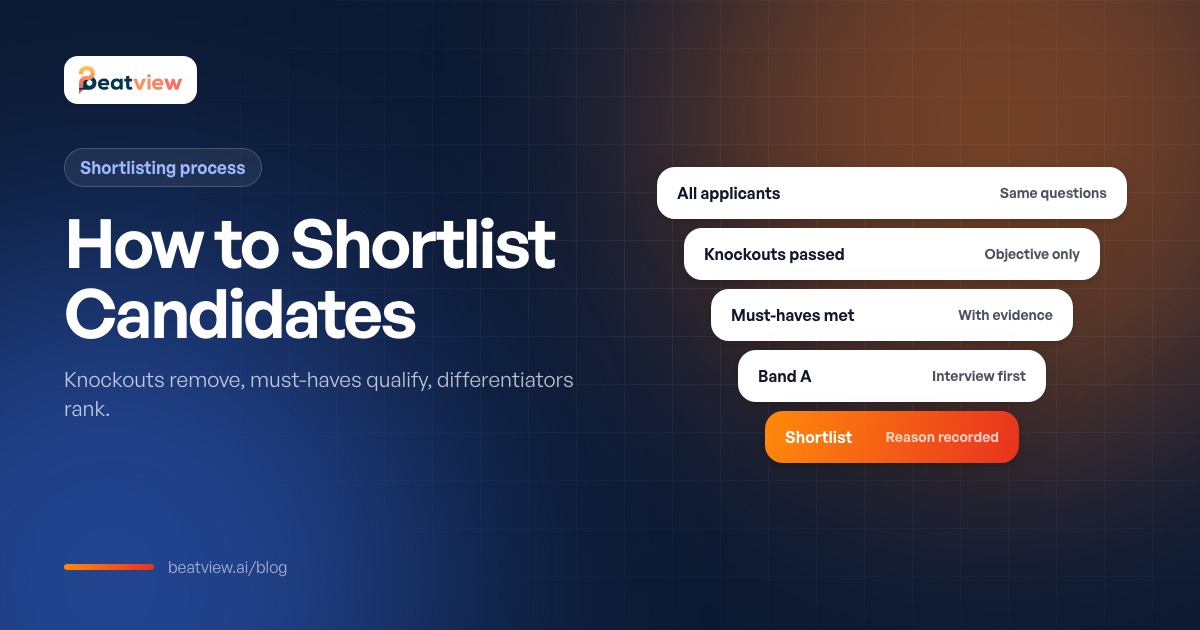
How to Shortlist Candidates: A Step-by-Step Shortlisting Process
How to shortlist candidates after CV or resume screening: knockouts, must-haves and differentiators, a six-step process, a shortlisting matrix template and how many candidates to shortlist.