How Do Staffing Agencies Work? A Guide for Employers (2026)
Staffing agencies find, screen and supply workers, and the employer pays. The four models, who employs the worker in each, how agencies make money, and the questions to ask before you sign.
Beatview Team
· 11 min read
Key takeaways
- A staffing agency finds, screens and supplies workers, and the employer pays: an hourly bill rate for temporary and contract staff, or a placement fee for people you hire directly.
- Who employs the worker depends on the model: the agency employs temporary, contract and temp-to-hire workers; direct-hire and executive search placements join your payroll.
- UK law separates the two: an employment business supplies temporary workers and pays them, while an employment agency introduces people the hirer employs.
- Candidates generally don’t pay. Agencies in Great Britain can’t charge work-seekers for finding them work, and US states such as New York cap job-seeker fees and ban registration fees.
- Using an agency doesn’t remove your responsibilities: EEOC guidance and OSHA both treat the client as a joint employer of temporary workers in many cases.
Staffing agencies work by finding, screening and supplying workers to employers, and the employer, not the worker, pays for the service. For temporary and contract roles, the agency usually hires the worker itself, pays their wages and bills you an hourly rate that covers their pay, the employer's costs and the agency's margin. For permanent roles, it introduces candidates you hire onto your own payroll and charges a placement fee. Below: the models, the steps from brief to placement, who employs the worker, how agencies make money, and what to ask before you sign.
What is a staffing agency?
A staffing agency recruits people for other organizations' jobs. The term covers two quite different services, and US government statistics treat them as separate industries. The Census Bureau's industry classification (NAICS) describes temporary help services as firms that supply workers to clients for limited periods, where the people supplied "are employees of the temporary help services establishment". Employment placement agencies, by contrast, recruit and place applicants who "are not employees of the employment agencies". Executive search services are a third category, focused on executive and senior management positions.
In everyday use, "staffing agency", "temp agency" and "recruitment agency" overlap, and many firms offer every model. What matters is who will employ the worker: that decides who pays them, who runs payroll and what you are billed.
Staffing agency vs recruitment agency in the UK
UK law draws the line explicitly. Government guidance says an employment agency finds work for people who are then employed and paid by the employer, usually in permanent jobs. An employment business engages the worker itself, pays them, and supplies them to work under someone else's supervision: temporary agency work, or "temping". A firm that does both must follow both sets of rules, set out mainly in the Employment Agencies Act 1973 and the Conduct of Employment Agencies and Employment Businesses Regulations 2003. Our guide to starting a recruitment agency in the UK covers the full rulebook.
The four main staffing models
Scroll to compare →
| Model | How it works | Who employs the worker | How the agency is paid |
|---|---|---|---|
| Temporary and contract staffing | The agency hires its own employees and assigns them to your workforce for busy periods, projects, cover or longer contracts | The agency | An hourly or daily bill rate for time worked |
| Temp-to-hire (contract-to-hire) | The agency's employee works for you for a trial period, after which you can hire them directly | The agency during the trial; you after conversion | The bill rate during the trial, then a conversion fee if your contract has one |
| Direct hire (permanent placement) | The agency finds and introduces candidates; you interview, make the offer and employ the hire | You, from day one | A placement fee, usually due only when someone is hired |
| Executive search | A researched search for senior, executive or specialist roles, with closer engagement than contingency work | You, from day one | A retained fee, paid in stages tied to milestones in the search |
The American Staffing Association (ASA) defines temporary to hire as a staffing firm employee working for a client for a trial period while both sides consider a permanent relationship; our guide to contract to hire covers it in detail, and agencies running temporary desks can see contract and temp staffing.
Permanent placement comes in two forms. A UK government buying guide from the Crown Commercial Service describes contingency recruitment as a non-exclusive service paid when a candidate is placed, and retained search, also called executive search, as closer engagement with higher service levels for senior, executive, niche or specialist roles. See retained vs contingency search and headhunter vs recruiter, and, for agencies, permanent recruitment and executive search.
How a staffing agency works, step by step
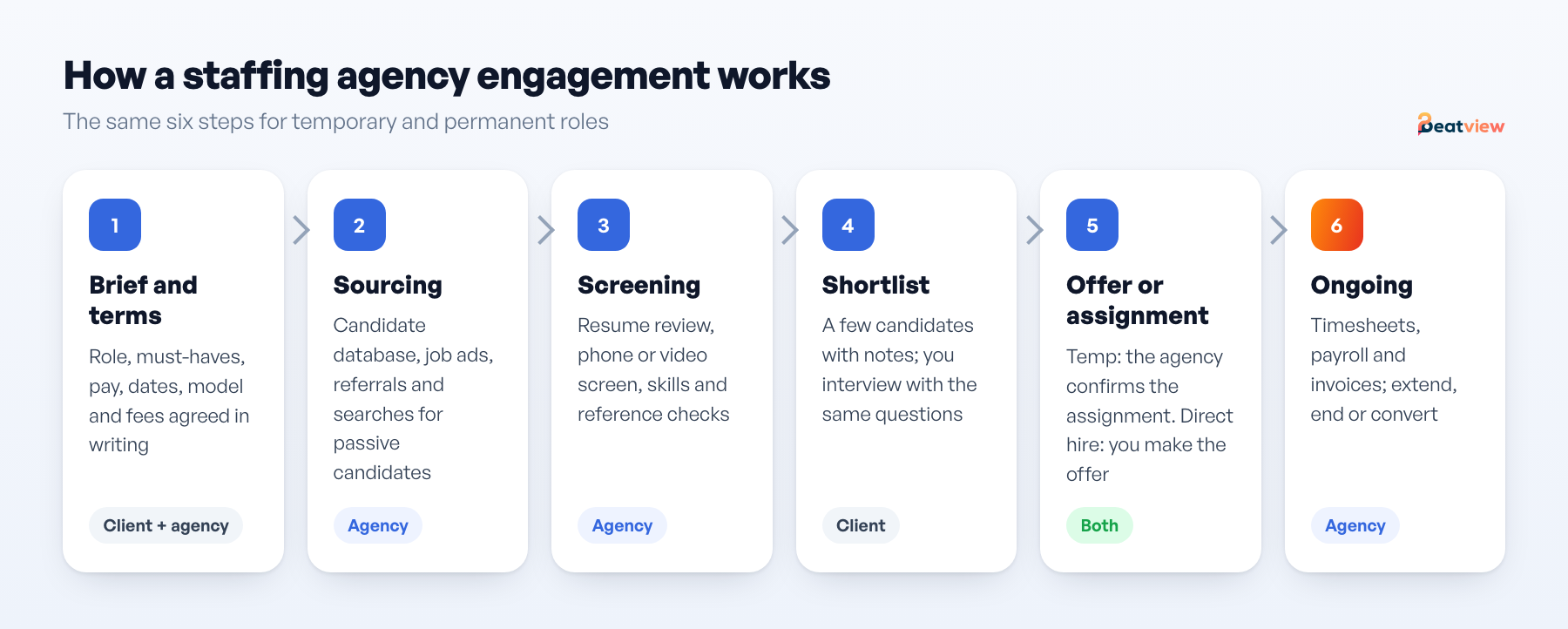
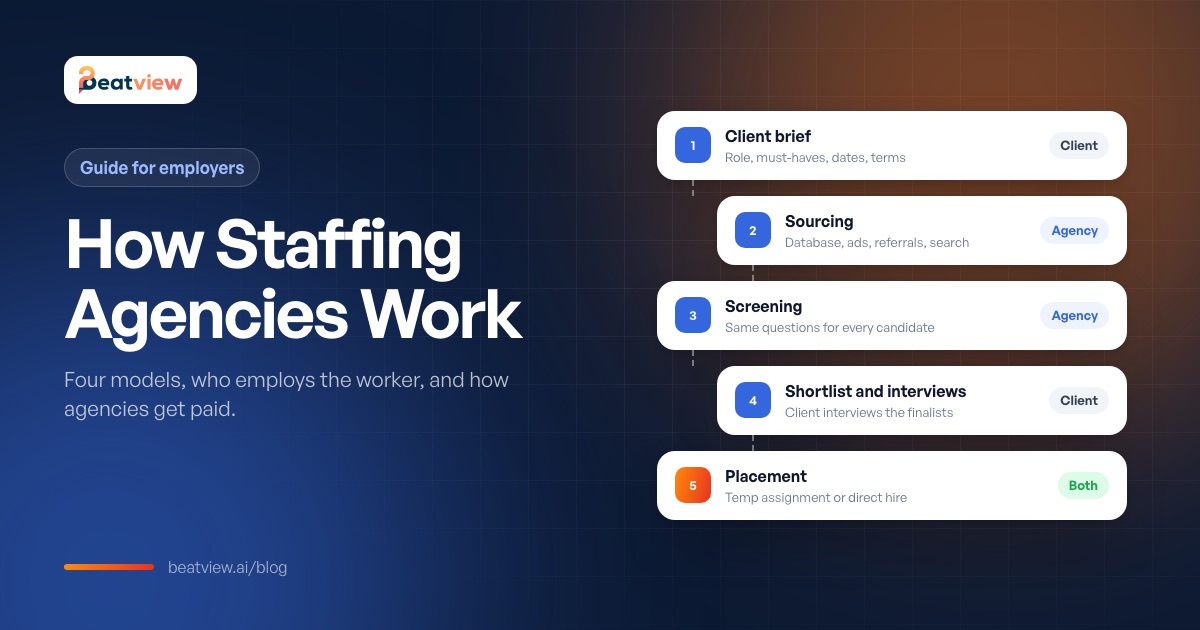
- Brief and terms. You describe the role, must-have skills, schedule, start date, duration and pay, agree the model, and sign terms covering fees, rebates and any conversion fee. In Great Britain, the agency must get key details from you before placing anyone, including the start date and duration, the type of work, hours, health and safety risks, and the experience and qualifications needed.
- Sourcing. The agency checks its database, advertises, asks for referrals and searches for people who aren't actively looking, using tools such as Boolean search.
- Screening. Recruiters review applications against your criteria, run a phone screen or recorded interview, check skills and take references. In Great Britain, if the role needs professional qualifications, the agency must get copies for you, or tell you what steps it took to get them.
- Shortlist and interviews. The agency submits a few candidates with notes on each, and you interview them, ideally with the same structured questions for everyone.
- Offer or assignment. For temporary work, the agency confirms the assignment and the worker reports to you. For direct hire, you make the offer and the agency invoices its fee once the person accepts or starts, depending on your terms.
- During the assignment. For temporary staff, you approve timesheets, the agency pays the worker and invoices you, and you extend, end or convert the assignment. For permanent hires, the agency's role usually ends at the start date, apart from any rebate or replacement guarantee.
Who employs and pays the worker?
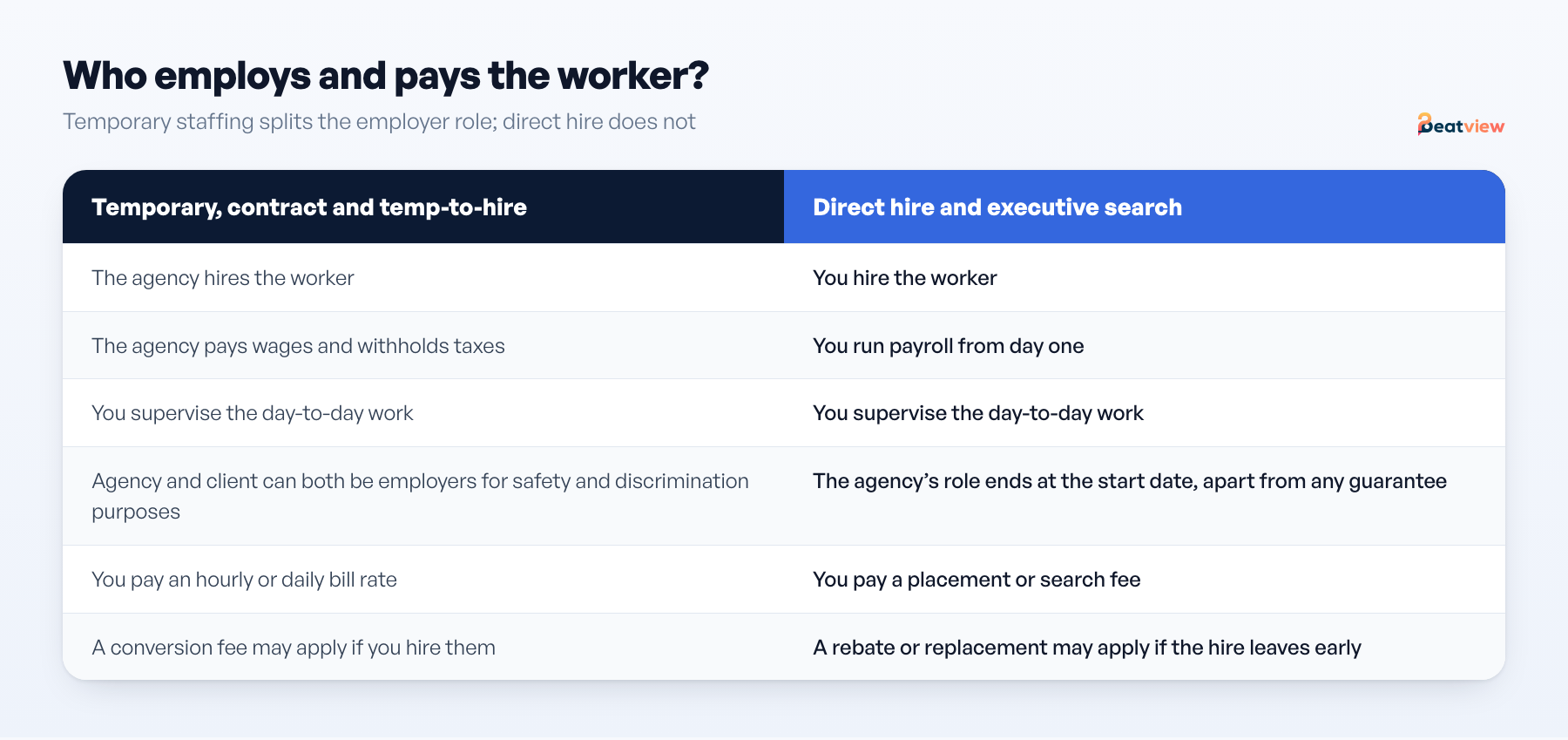
Temporary, contract and temp-to-hire workers are usually the agency's employees. US Equal Employment Opportunity Commission (EEOC) guidance explains why: the staffing firm typically hires the worker, decides when and where they report, pays their wages, withholds taxes and Social Security, provides workers' compensation coverage and can end the employment.
That doesn't take the client out of the picture. The same guidance says a client typically also qualifies as an employer during the assignment, because it usually supervises the work. An agency is liable if it honors a client's discriminatory assignment request, and a client that rejects workers for discriminatory reasons can be liable too. OSHA says the agency and the host employer are joint employers of temporary workers, both responsible for a safe workplace, and recommends that their contract set out who handles which safety duties.
In the UK, an employment business must pay temporary workers for every hour they work, even if the hirer hasn't paid or signed the timesheet. After 12 weeks in the same job, agency workers qualify for equal treatment, including the same pay as a permanent colleague doing the same job.
Direct-hire and executive search placements are your employees from the first day, on your payroll. UK guidance confirms that an employment agency isn't responsible for paying a work-seeker once it has introduced them to the hirer.
How staffing agencies make money
Bill rate and markup on temporary staff
The bill rate for temporary and contract staff has to cover the worker's pay, the costs the law puts on an employer, the agency's overheads and its profit. The ASA's fact sheet Understanding Staffing Profit (2019) gives an example: an hourly pay rate of $17, marked up by 51.5%, gives a bill rate of $25.76. After payroll taxes, workers' compensation and general and administrative costs, the agency keeps $0.85 an hour, or 3.3%, as net profit.
Markup and margin describe the same gap differently: the $8.76 gap is a 51.5% markup on the pay rate but about a 34% gross margin on the bill rate. When you compare quotes, ask which one the agency means and what the rate includes.
Placement fees on permanent hires
For direct hire, the fee is usually a percentage of the new employee's salary or a fixed amount, set by contract: contingency agencies are paid only if you hire someone they introduced, retained firms in stages. No regulator publishes a standard rate, so check what counts as salary, when the invoice is due, and what happens if the hire leaves early. Our guide to recruitment agency fees compares the structures and the published figures.
Conversion fees
If you hire a temporary worker permanently, the contract may require a conversion (temp-to-perm) fee. In Great Britain, an employment business can charge one only if its contract offered you an extended hire period instead, and only if you hire the worker within 8 weeks of the assignment ending or 14 weeks of it starting, whichever is later.
Running an agency? The staffing agency business plan template turns these fees into cash flow, and our guides to starting a staffing agency, business development and agency marketing cover winning clients.
Do candidates pay staffing agencies?
Generally not. In Great Britain, the Employment Agencies Act 1973 bars agencies and employment businesses from charging work-seekers a fee for finding them work, and breaking that rule is a criminal offense. The exceptions mainly cover entertainment and modeling. Agencies can sell extras such as CV writing or training, but must give written details of the fee first, can't make them a condition of finding someone work, and must let the work-seeker cancel.
In the US, some states regulate fees charged to job seekers. New York, for example, sets maximum fees by type of job, bans registration fees, and bars agencies from taking deposits or advance fees from applicants. Where the applicant isn't charged, the employer's fee for domestic, industrial, office and professional jobs is set by agreement between the employer and the agency.
Pros and cons of using a staffing agency
Scroll to compare →
| Advantages for employers | Drawbacks and risks |
|---|---|
| Access to candidates the agency already knows, including people not reading job ads | The hourly bill rate is higher than the worker's pay, because it includes employer costs and the agency's margin |
| Flexible capacity for peaks, projects and cover without permanent headcount | Conversion fees if you hire a temporary worker permanently |
| The agency runs payroll and employer administration for temporary staff | Responsibility is shared: you can still be a joint employer for safety and discrimination purposes |
| Temp-to-hire lets you see someone's work before committing | Screening quality varies, and you don't always see how candidates were assessed |
| Contingency agencies are paid only when you hire | Ownership disputes if two agencies, or your own team, find the same person |
How to choose a staffing agency: questions to ask
- Which roles and locations do you fill most often, and can I speak to a current client?
- Which model do you recommend for this role, and why?
- How do you screen? Does every candidate get the same questions and scoring, and will you share the notes behind each submission? What do you check before submitting someone: references, qualifications, right to work?
- For temporary staff: who is the employer, what does the bill rate include, and what are the overtime, holiday and notice terms? Who provides safety training?
- For permanent hires: what is the fee, what counts as salary, when is it due, and what is the rebate or replacement guarantee?
- What is the conversion fee, and how does it fall over time? In the UK, what extended hire period do you offer instead?
- How long does an introduction last? If we hire a candidate you submitted months later, for a different role, do we owe a fee?
- How quickly will we see a first shortlist, and how will you report progress? (See the agency KPIs in recruitment metrics and how to measure time to fill.)
Where Beatview fits
Beatview is software for agencies, not an agency. It screens every application against the criteria the agency sets with each client and runs structured AI video interviews, so every candidate answers the same questions and recruiters see the evidence behind each score before deciding who to submit. That is the kind of answer to look for in question 3 above. The Free plan covers one active job with unlimited candidates; AI interviews are on the Pro plan. See Beatview for recruiting agencies.
Frequently asked questions
How do staffing agencies get paid?
By the employer. For temporary and contract staff, the agency bills an hourly or daily rate that covers the worker’s pay, employer costs, overheads and profit. For permanent hires, it charges a placement fee, usually a percentage of salary or a fixed fee, due when someone is hired. A conversion fee may apply if you hire a temporary worker permanently.
Who is the employer when you use a staffing agency?
For temporary and contract workers, usually the agency: it hires them, pays their wages and withholds taxes. The client can also count as an employer for some purposes, such as discrimination law and workplace safety, because it supervises the work. For direct-hire placements, the client is the only employer.
What is the difference between a staffing agency and a recruitment agency?
The terms overlap. “Staffing agency” and “temp agency” usually mean a firm that employs workers and supplies them to clients; “recruitment agency” often means a firm that introduces candidates for permanent jobs. UK law calls these an employment business and an employment agency, and a firm that does both must follow both sets of rules.
Do you have to pay a staffing agency to find you a job?
Usually not. In Great Britain, agencies can’t charge work-seekers a fee for finding them work, apart from narrow exceptions such as entertainment and modeling. In the US, some states regulate job-seeker fees: New York caps them by type of job and bans registration fees and advance fees.
Can I hire a temp worker permanently?
Yes, but check your contract for a conversion (temp-to-perm) fee. In Great Britain, the agency can charge it only if it offered you an extended hire period instead, and only if you hire within 8 weeks of the assignment ending or 14 weeks of it starting, whichever is later.
Sources
- US Census Bureau: 2022 NAICS descriptions (561311 Employment Placement Agencies, 561312 Executive Search Services, 561320 Temporary Help Services).
- Gov.uk: Employment agencies and businesses, including before placing a worker with a hirer and transfer fees.
- Gov.uk: Agency workers: fees; equal treatment.
- Legislation.gov.uk: Employment Agencies Act 1973, section 6; Conduct of Employment Agencies and Employment Businesses Regulations 2003, regulation 10.
- American Staffing Association: Staffing services defined; Understanding staffing profit (PDF, 2019).
- Crown Commercial Service: RM6002 permanent recruitment customer FAQ (PDF).
- EEOC: Enforcement guidance on contingent workers placed by staffing firms.
- OSHA: Protecting temporary workers.
- New York State Department of Labor: Employment agency law, General Business Law article 11 (PDF), section 185.
Move an application from screening to interview
Use your configured workflow and review the completed result.
Start with one active job for free, or explore how Pro adds AI video interviews.
- Application screening
- AI video interviews
- Candidate event log
Related Articles
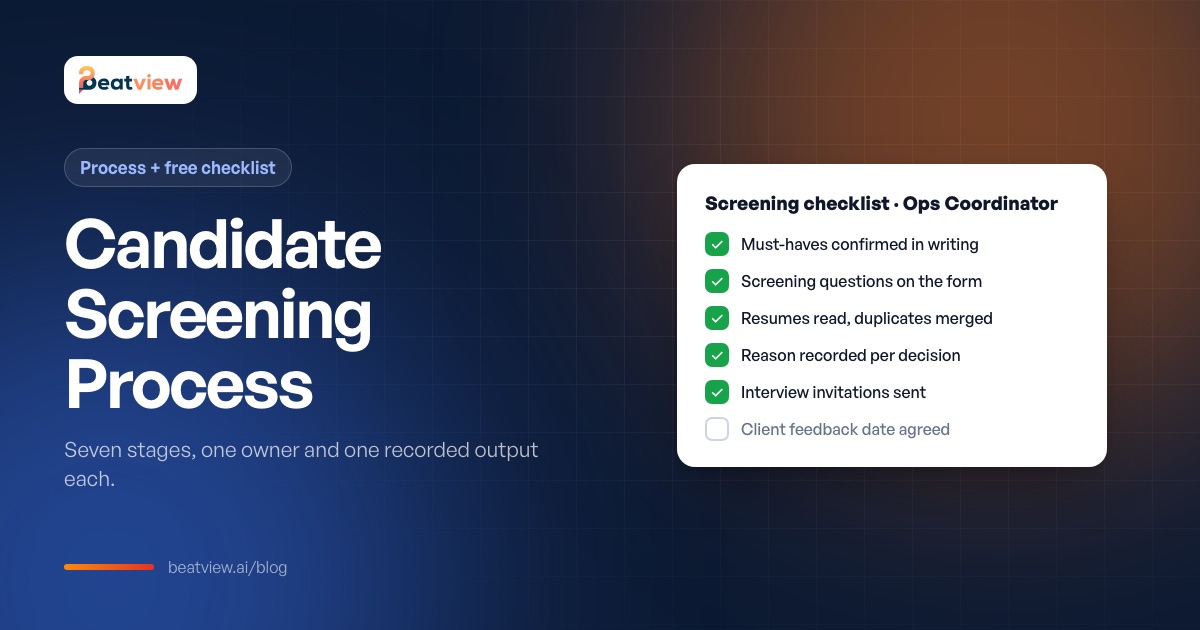
Candidate Screening Process: 7 Stages, Methods and a Free Checklist
What candidate screening is, the screening methods compared, a seven-stage process with an owner and output for each stage, and a downloadable candidate screening checklist.

High-Volume Recruiting: 8 Strategies, a Capacity Plan and Software Checklist
How to run high-volume hiring: eight strategies, a capacity worksheet for deciding how many candidates to invite, handling incomplete interviews, a software requirements checklist and a pilot plan.

Time to Fill: Formula, Benchmarks and How to Reduce It
What time to fill measures, the formula with a worked example, how it differs from time to hire, the SHRM benchmark in context, and the seven intervals that show where the days actually go.