Contract to Hire: How It Works, Conversion Fees and the Rules (2026)
Contract to hire lets you try a worker through an agency before offering a permanent job. How it works, who employs the worker, how conversion fees are structured, and the UK and Illinois rules.
Beatview Team
· 11 min read
Key takeaways
- Contract to hire (temp to hire, or temp to perm in the UK) means a worker employed by a staffing agency works for you for a trial period, after which you can hire them directly.
- During the contract the agency usually employs and pays the worker and bills you a rate per hour or day; after conversion the worker joins your payroll.
- Agencies may charge a conversion fee if you hire the worker; it can be a fixed or salary-based fee, a sliding scale, or weeks of the agency’s own fee. Agree the formula in writing before anyone starts.
- In Great Britain, a temp-to-perm fee applies only if the hirer was offered an extended hire period instead and hires within 8 weeks of the assignment ending or 14 weeks of it starting, whichever is later.
- Illinois caps placement fees for day and temporary laborers and bars agencies from stopping them taking a permanent job with the client.
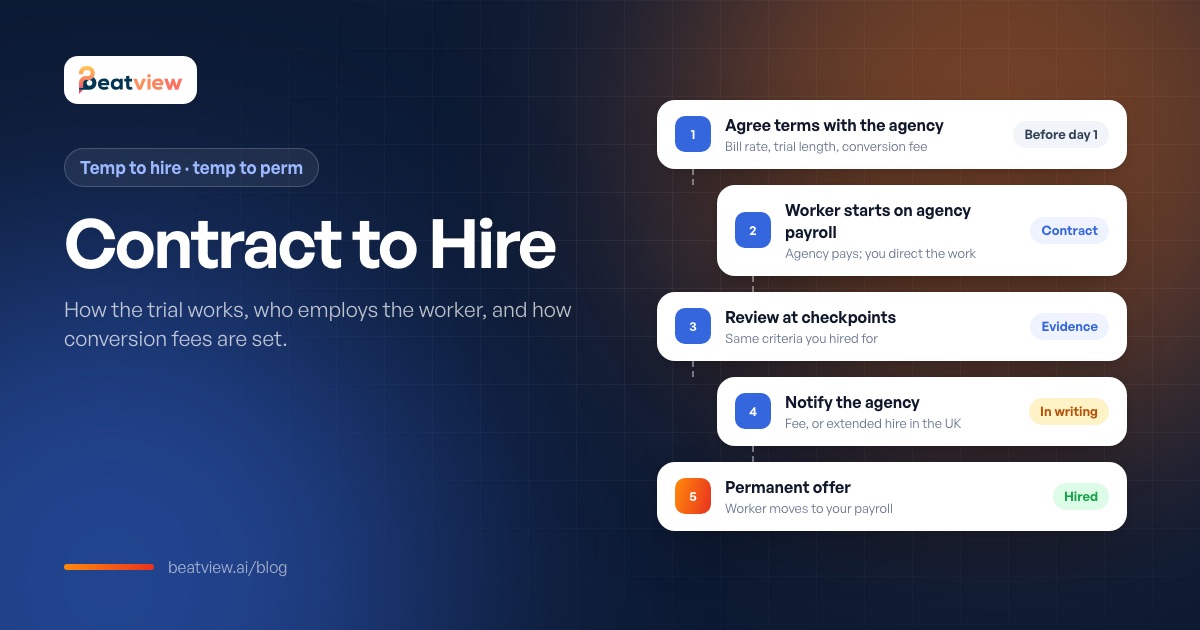
Contract to hire is an arrangement in which a worker is employed by a staffing agency and works in your business for an agreed trial period, after which you can offer them a permanent job on your own payroll. During the contract, the agency pays the worker and bills you an hourly or daily rate. If you then hire the worker directly, the agency may charge a conversion fee, which can be set up to fall the longer the worker has been with you. It is also called temp to hire in the US and temp to perm in the UK. Below: the steps, who employs the worker, how conversion fees are structured, the UK and Illinois rules, and what to agree before anyone starts.
What does contract to hire mean?
The American Staffing Association (ASA) defines temporary to hire as an arrangement in which a staffing firm's employee works for a client for a trial period, during which both the employee and the client consider a permanent employment relationship. The employer sees real work before committing, and the worker sees the team and the job before giving up other options. UK government guidance calls the fee for hiring such a worker a "temp-to-perm" fee.
Some employers also use "contract to hire" for a freelancer they engage directly. That is a different arrangement, and the label doesn't settle the worker's status: for federal anti-discrimination law, EEOC guidance says the label in the contract is not determinative. This article covers the agency model.
How contract to hire works, step by step
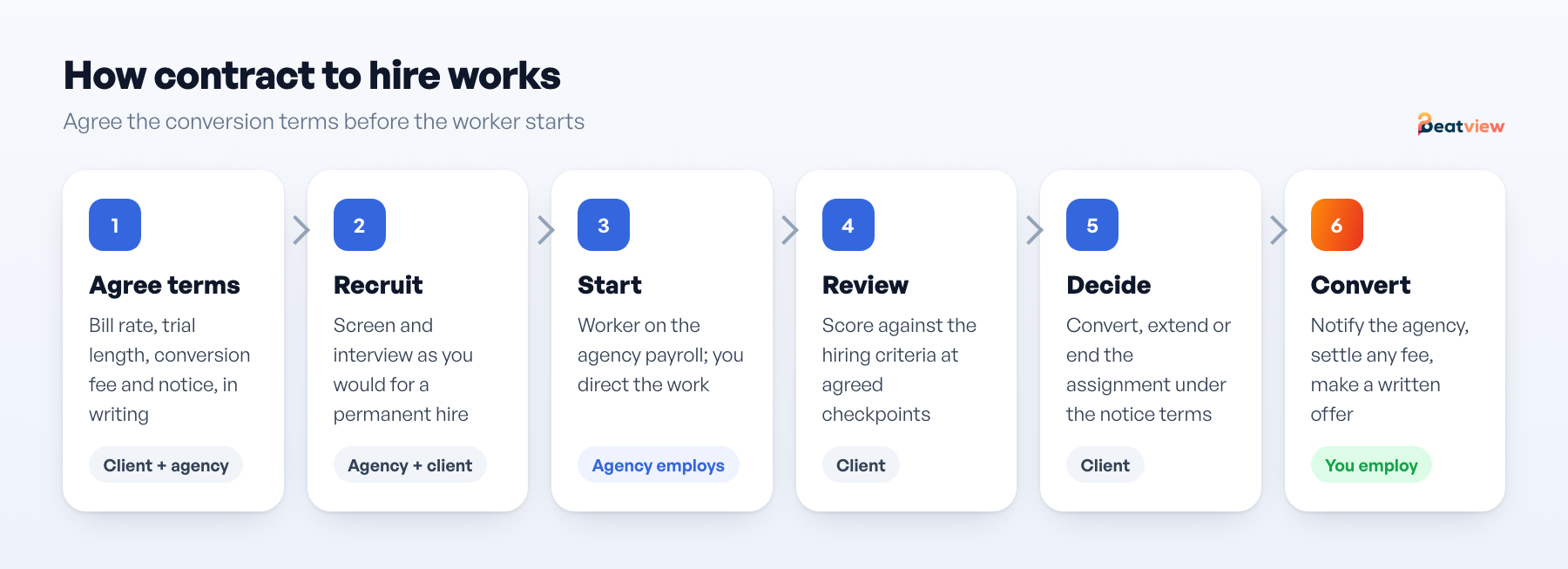
- Agree the terms. Before you brief candidates, agree the bill rate, the expected length of the trial, the conversion fee and how it changes over time, the notice to end the assignment, and the pay range you would offer at conversion.
- Recruit as if it were a permanent hire. The agency sources and screens candidates, for example with a phone screen; you interview the shortlist with structured interview questions, and references are checked. Tell candidates it is a contract-to-hire role.
- The worker starts on the agency's payroll. The agency pays them and handles payroll taxes; you direct the work.
- Review at agreed checkpoints. Score the worker against the criteria you hired for, using an interview scorecard, so the decision rests on evidence rather than impressions.
- Decide. Convert, extend, or end the assignment through the agency under the agreed notice.
- Convert. Notify the agency in writing, settle any fee (or, in Great Britain, take the extended hire period instead), make a written offer, and move the worker onto your payroll.
Who employs the worker during the contract?
Usually the agency. The US Census Bureau's definition of temporary help services says the people supplied "are employees of the temporary help services establishment", and EEOC guidance notes that a staffing firm typically hires the worker, pays wages, withholds taxes, provides workers' compensation coverage and can end the employment.
The client isn't a bystander, though. The same guidance says a client typically also qualifies as an employer during the assignment, because it usually supervises the work. OSHA treats the agency and the host employer as joint employers, both responsible for a safe workplace, and recommends that their contract set out who does what, such as general safety training from the agency and site-specific training from the host.
In the UK, an employment business must pay temporary workers for all the hours they work, even if the hirer hasn't paid. After 12 weeks in the same job, agency workers qualify for equal treatment, including the same pay as a permanent colleague doing the same job; a trial longer than that crosses the line. For who employs whom in each agency model, see how staffing agencies work.
How conversion fees work
A conversion fee is what you pay the agency if you hire its worker directly. The ASA argues that reasonable, negotiated conversion fees stop agencies being used as a free placement service, since they invest in recruiting and onboarding temporary employees and recover that cost over the assignment. There is no standard fee. Structures include:
- A placement-style fee. A fixed amount or a percentage of the salary you offer, like a direct-hire fee.
- A sliding scale. The fee falls as the worker completes more hours or weeks, and may reach zero after an agreed period.
- Weeks of the agency's fee. A number of weeks of the agency's own share of the bill rate, not the whole rate.
- An extended hire period. Instead of a fee, you keep the worker through the agency for a set number of extra weeks, then hire them free. In Great Britain, a transfer fee is enforceable only if the contract offers this option.
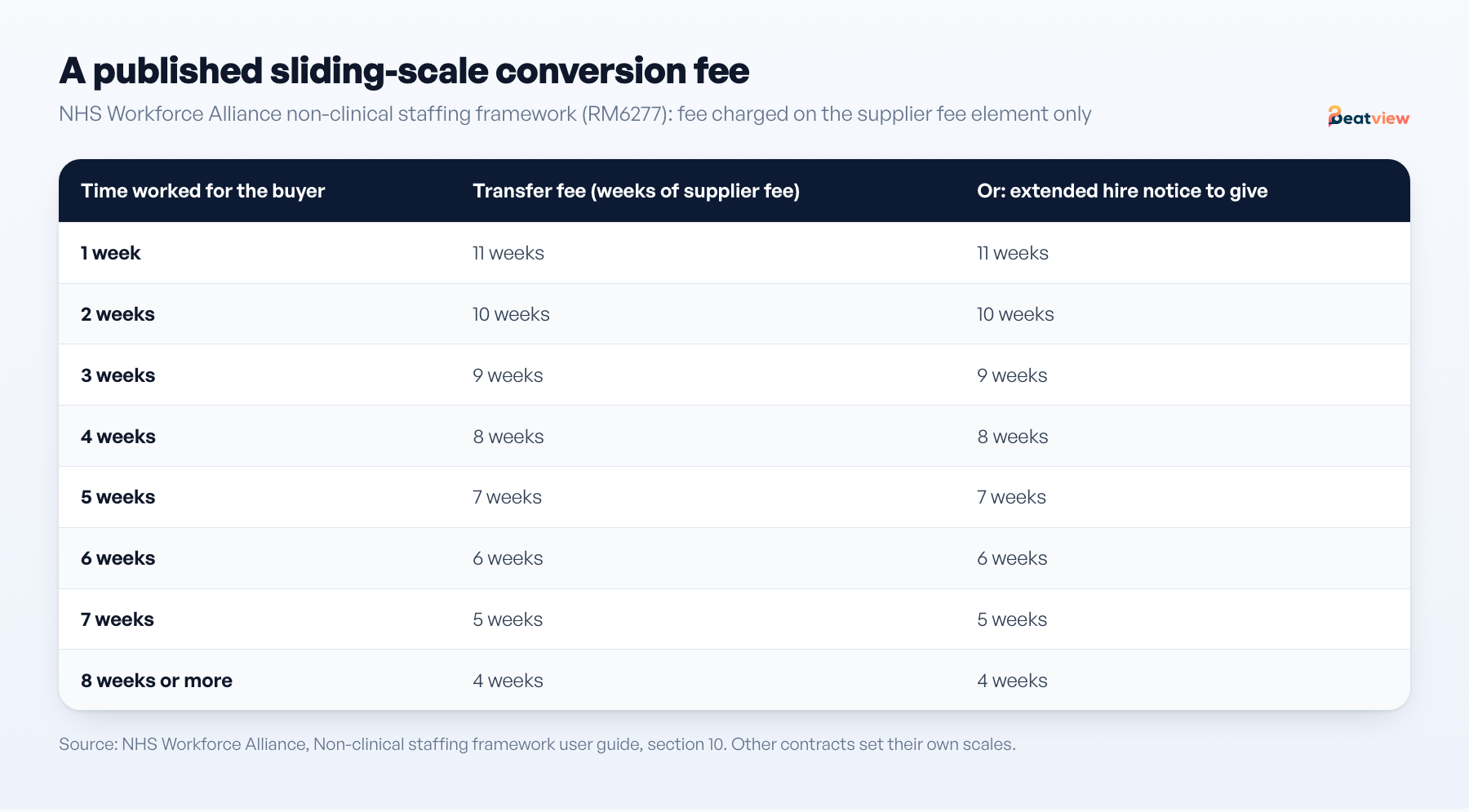
One published example combines the last three. On the NHS Workforce Alliance non-clinical staffing framework (RM6277), the transfer fee is charged only on the supplier's fee element: 11 weeks of it after one week worked, falling by a week for each week worked to 4 weeks after eight weeks or more. In the user guide's example, a supplier fee of £4.50 an hour over a 37.5-hour week is £168.75 a week, so converting after four weeks costs £1,350. Alternatively, the buyer can give notice for an extended hire period, which on that framework takes the assignment to 12 weeks, with at least four weeks' notice, and then transfer the worker with no fee.
Whichever structure you agree, check what the fee is calculated on, whether it falls by hours or weeks, and when it reaches zero. Our guide to recruitment agency fees compares conversion fees with placement fees and temporary markups.
UK temp-to-perm transfer fee rules
In Great Britain, regulation 10 of the Conduct of Employment Agencies and Employment Businesses Regulations 2003 limits transfer fees. Government guidance says an employment business can charge one only if all of these apply:
- its contract with the hirer gives the hirer the option to extend the worker's assignment instead;
- the hirer doesn't take that option; and
- the hirer gives the worker a permanent job less than 8 weeks after the end of the assignment, or less than 14 weeks after it started if that is later.
If more than 42 days passed between two assignments with the same hirer, the later one counts as the first. The extension can't be on worse terms than the original assignment, so the agency can't raise its rates, and it must supply the worker for the whole extension unless it isn't at fault. Similar conditions cover "temp-to-temp" fees (moving to another agency with the worker) and "temp-to-third-party" fees (introducing the worker to someone who hires them), though no extension option is needed for the latter. Hirers can recover fees charged against these rules, and agencies can't stop a worker from working elsewhere.
The government's own example: after a 4-week assignment, a hirer whose contract offers a 6-week extension can pay the fee now, keep hiring the worker through the agency for the extra 6 weeks, or end the assignment and wait 10 weeks before hiring the worker directly. Agency owners will find the wider rules in our guide to starting a recruitment agency in the UK.
Illinois caps conversion fees for day and temporary laborers
Illinois's Day and Temporary Labor Services Act goes further. A covered agency can't stop a day or temporary laborer from accepting a permanent job with the client, or stop the client from offering one. Any placement fee is capped at the agency's daily commission over 60 days, reduced by one day's commission for each day the laborer has already worked for the agency in the previous 12 months. The cap doesn't apply to skilled labor, where the agency runs an advanced application process, screening and a job interview, and the Act excludes professional and clerical work. No fee can be charged if the permanent offer follows the suspension or revocation of the agency's registration. Outside rules like these, the fee is whatever your contract says, so read it before the worker starts. Starting a US agency? See how to start a staffing agency.
Contract to hire vs direct hire vs temporary staffing
Scroll to compare →
| Contract to hire | Direct hire | Temporary staffing | |
|---|---|---|---|
| Who employs the worker at first | The agency | You | The agency |
| How you pay | Bill rate, then any conversion fee | A placement fee | Bill rate for the whole assignment |
| Intended outcome | A permanent hire after the trial | A permanent hire from day one | Cover for a set period or project |
| Best when | You want to see the work first, or the long-term need is uncertain | The role is clearly permanent and well defined | The need is short-term or seasonal |
| Main risk | Candidates who want security may take a direct offer elsewhere | A mis-hire becomes your own exit process | Conversion fees if a temp becomes indispensable |
For senior roles, see retained vs contingency search; agencies can see how Beatview supports permanent recruitment.
Pros and cons of contract to hire
Scroll to compare →
| Advantages | Drawbacks | |
|---|---|---|
| Employer | See real work before committing; the agency runs payroll during the trial; the assignment ends through the agency under agreed notice | A higher hourly cost than direct pay; a possible conversion fee; shared joint-employer responsibilities during the contract |
| Worker | Try the employer and team before committing; paid from day one | No guarantee of an offer; benefits come from the agency during the contract and may differ from permanent staff's |
How to convert a contract worker well
- Put the timeline in writing at the start: trial length, review dates, and the dates on which the conversion fee falls or ends.
- Decide on evidence, at the same checkpoints for every contract-to-hire worker.
- Tell the agency before you make an offer, as your contract requires. In Great Britain, you choose the extended hire period instead of a fee by giving the agency notice, so check the notice period.
- Make a clear written offer: job title, pay, start date as your employee, benefits, and whether a probation period applies given the time already worked. Line up the last day of the assignment with the first day of employment so there is no gap or overlap in pay.
- Do your own onboarding. You are now the employer, so complete your new-hire paperwork and payroll setup as for any other hire.
- If you won't convert, say so early and give the agency feedback it can pass on.
Questions to agree with the agency up front
- What is the bill rate, what does it include, and will it change if we extend?
- Is the conversion fee based on salary, the bill rate or the agency's own fee, and after how many hours or weeks does it reach zero?
- In the UK: what extended hire period do you offer instead, and what notice do we give?
- Does a fee apply if we hire the worker after the assignment ends, or for a different role? For how long?
- What notice ends the assignment, and who provides safety training and equipment?
- Does your contract with the worker leave them free to accept a permanent job with us?
- What pay range will we offer at conversion, and has the candidate been told?
Agencies can use the same list to draft terms of business and in business development conversations; the staffing agency business plan template models what conversion fees are worth.
Where Beatview fits
A contract-to-hire placement is a permanent hire with a trial attached, so the first screen matters as much as for direct hire. Beatview screens every application against the criteria the agency sets with each client and runs structured AI video interviews, so every candidate answers the same questions and recruiters see the evidence behind each score before submitting a shortlist. The Free plan covers one active job with unlimited candidates; AI interviews are on the Pro plan. See contract and temp staffing and Beatview for recruiting agencies.
Frequently asked questions
What does contract to hire mean?
A worker is employed by a staffing agency and works for a client for a trial period, after which the client can offer them a permanent job. The American Staffing Association calls this temporary to hire; UK government guidance calls the fee for converting such a worker a temp-to-perm fee.
How long is a contract-to-hire period?
It is whatever you agree with the agency; neither the UK rules nor the Illinois law covered here set a length. Set it long enough to see the core work done, and check how the length interacts with the conversion fee. In Great Britain, the 8-week and 14-week limits on transfer fees also affect the timing.
Do you have to pay a fee to hire a contract worker permanently?
Only if your contract says so and the law allows it. In Great Britain the agency must have offered an extended hire period instead, and no fee can be charged once the later of the 8-week and 14-week periods has passed. In Illinois, fees for day and temporary laborers are capped. Elsewhere it depends on your terms.
Is contract to hire the same as temp to perm?
Yes, in practice. Both describe a worker supplied by an agency for a trial period with a view to a permanent job. “Contract to hire” and “temp to hire” are the terms used in the US; “temp to perm” is the usual UK term.
Who pays a contract-to-hire worker?
The agency, during the contract. It pays wages, handles payroll taxes and bills the client. In the UK, an employment business must pay the worker for all hours worked even if the client hasn’t paid. Once the client hires the worker directly, the client pays them.
Sources
- American Staffing Association: Staffing services defined; ASA policy agenda (conversion fees).
- Gov.uk: Employment agencies and businesses: transfer fees; overview; Agency workers: equal treatment.
- Legislation.gov.uk: Conduct of Employment Agencies and Employment Businesses Regulations 2003, regulation 10.
- NHS Workforce Alliance: Non-clinical staffing framework (RM6277) user guide (PDF), section 10, transfer fees.
- Illinois General Assembly: Day and Temporary Labor Services Act (820 ILCS 175), sections 5 and 40.
- US Census Bureau: 2022 NAICS descriptions (561320 Temporary Help Services).
- EEOC: Enforcement guidance on contingent workers placed by staffing firms.
- OSHA: Protecting temporary workers.
Move an application from screening to interview
Use your configured workflow and review the completed result.
Start with one active job for free, or explore how Pro adds AI video interviews.
- Application screening
- AI video interviews
- Candidate event log
Related Articles

Interview Scorecard Template: Free Rubric, Rating Scale and Example
A free interview scorecard you can copy or download, with a 1–5 behaviorally anchored rating scale, suggested weights, a filled-in example and the method for comparing candidates fairly.

High-Volume Recruiting: 8 Strategies, a Capacity Plan and Software Checklist
How to run high-volume hiring: eight strategies, a capacity worksheet for deciding how many candidates to invite, handling incomplete interviews, a software requirements checklist and a pilot plan.
How to Reduce Time to Hire: 12 Changes That Remove Waiting Time
The time-to-hire formula, where the days usually go, and twelve specific changes — each with an owner, the bottleneck it removes and the metric that proves it worked.