How to Shortlist Candidates: A Step-by-Step Shortlisting Process
How to shortlist candidates after CV or resume screening: knockouts, must-haves and differentiators, a six-step process, a shortlisting matrix template and how many candidates to shortlist.
By Beatview Team · Published · Updated · 6 min read
Key takeaways
- Shortlisting narrows eligible applicants to the few you will interview first, and records why each person made the list.
- Write knockouts, three to five must-haves and differentiators before reading any applications.
- Knockouts remove, must-haves qualify, differentiators rank — differentiators never reject anyone on their own.
- Sort candidates into A/B/C bands rather than exact ranks; early evidence is too thin for precise ordering.
- Set the shortlist size from interview capacity before you start, and treat "unclear" as a question to ask, not a rejection.
Candidate shortlisting is the step between screening applications and interviewing: you narrow a pool of applicants to the small group who best meet the written criteria for the role, and you record why each one made the list. To shortlist candidates well, set must-have and differentiating criteria before you read a single CV or resume, remove anyone who fails an objective must-have, sort the rest into bands on the same evidence, and choose your shortlist from the top band with a one-line reason for each person. This guide walks through that process, gives you a shortlisting matrix to copy, and covers shortlist size, mistakes to avoid and how agencies turn a shortlist into a client submission.
What is shortlisting in recruitment?
Shortlisting is a selection decision, not an administrative one: whoever misses the shortlist does not get an interview. That is why it needs the same discipline as the interview itself — criteria agreed in advance, applied the same way to everyone, with a record of the decision. Screening asks "is this person eligible and plausibly qualified?"; shortlisting asks "of the qualified people, who should we spend interview time on first?"
| Stage | Question it answers | Typical evidence | Output |
|---|---|---|---|
| Screening | Does the applicant meet the objective must-haves? | Application answers, resume/CV | Eligible or not, with the reason |
| Shortlisting | Who among the eligible should we interview first? | Resume/CV against differentiators, screening answers, sometimes a short recorded interview | A ranked shortlist with reasons |
| Interview selection | Who should get the job (or be submitted to the client)? | Structured interviews, work samples, references | Decision and offer |
Shortlisting criteria: must-haves, differentiators and knockouts
Write three lists before you open the first application:
- Knockouts — objective, factual requirements the job cannot be done without: right to work, a licence, availability for the shift pattern. Only use knockouts that are genuinely necessary, because each one removes people permanently.
- Must-haves — three to five job-related requirements, each with the evidence you would accept ("has managed a client portfolio: named accounts and their size").
- Differentiators — what separates a good candidate from a great one for this particular role. These rank candidates; they never reject anyone on their own.
Leave out proxies that correlate with background rather than ability — specific universities, unexplained employment gaps, "years of experience" beyond what the job needs — and never shortlist on age, family status, health, religion or origin.
How to shortlist candidates: a step-by-step process
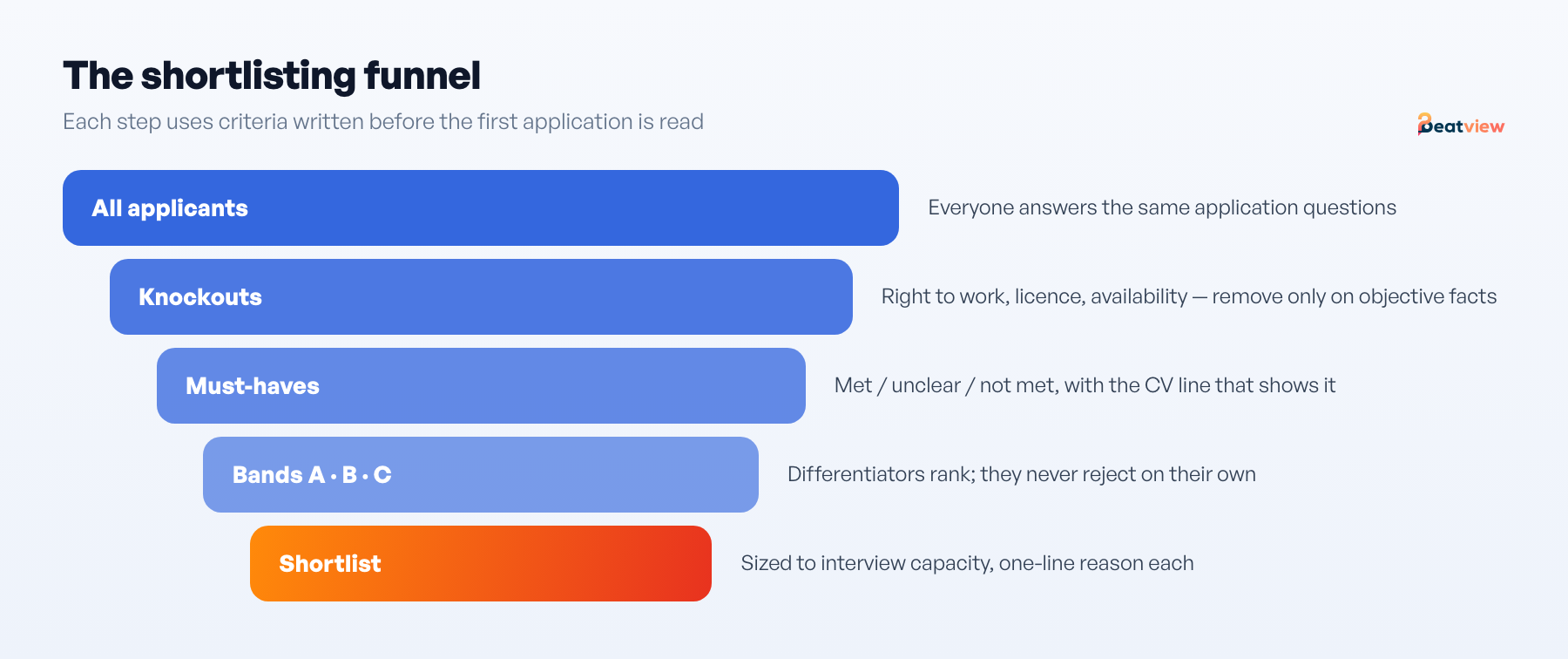
Confirm knockouts, must-haves, differentiators and how many people you will interview. Write it down with the date.
If every applicant answers the same screening questions, this step is fast and consistent. See screening interview questions for wording.
Mark each must-have as met, unclear or not met, with the line of the CV that supports it. "Unclear" means ask, not reject.
Rate each differentiator 1–3 or 1–5 with written anchors. Resist inventing extra criteria mid-pile.
Band A: all must-haves met and strong on differentiators. Band B: must-haves met. Band C: one must-have unclear. Early evidence is too thin for exact positions.
Take the shortlist from band A first. Write one sentence per candidate on why they are in — and keep the reasons for those who are not.
Shortlisting matrix template
A shortlisting matrix keeps the process visible. One row per candidate:
| Candidate | Knockouts passed | Must-have 1 | Must-have 2 | Must-have 3 | Differentiators (1–5) | Band | Reason |
|---|---|---|---|---|---|---|---|
| Candidate 1 | Yes | Met | Met | Met | 4 | A | Ran onboarding for 30+ accounts; client-facing writing samples |
| Candidate 2 | Yes | Met | Unclear | Met | 3 | C | Portfolio size not stated — ask before deciding |
| Candidate 3 | Yes | Met | Met | Met | 2 | B | Meets the bar; little evidence on the differentiators |
These rows are synthetic examples. Keep the matrix with the role record so you can answer "why was I not shortlisted?" weeks later.
How many candidates should you shortlist?
There is no universal number; shortlist size is a capacity decision you make per role. Work backwards from interview capacity: if the hiring manager can do six first interviews this week, shortlist six from band A and keep band B ready. For agency client submissions, many clients expect a small number of well-evidenced candidates rather than a long list — agree the number at intake. What matters is that the size is set before you start, not adjusted to include or exclude a particular person.
Common shortlisting mistakes
- Criteria that appear halfway through the pile. The first 40 applicants were judged on a different standard from the last 40.
- Rejecting "unclear" as "no". Missing information is a question to ask, not evidence of a gap.
- Keyword matching as the only test. Qualified candidates describe the same skill in different words.
- Exact rankings on thin evidence. A resume cannot tell you whether candidate 7 is better than candidate 8. Bands are more honest.
- No written reasons. Without them you cannot explain a decision, spot bias or improve the criteria.
Using a short recorded interview to shortlist faster
When volume is high and resumes are similar, a short structured interview can replace phone screens as the shortlisting evidence. Every candidate who passes the knockouts answers the same three to five questions on video in their own time; you shortlist on answers rather than on how a CV is formatted. That also removes calendar scheduling from the first round — see asynchronous video interviews. After interviews, move from bands to a weighted comparison with how to rank candidates fairly.
For agencies: from shortlist to client submission
An agency shortlist has a second audience: the client. Present each candidate with the criteria they meet, the evidence for each, and anything still unclear. A consistent submission format per client lets them compare candidates across batches and consultants, and makes feedback specific ("rejected on must-have 2") instead of "not quite right".
Where Beatview fits
Beatview prepares the evidence for shortlisting and leaves the decision to your recruiter. Every applicant answers the same screening questions on the application; each resume is scored against the role with the reasons shown; a stage rule can invite candidates above a threshold you set to a structured video interview; and completed interviews are scored on relevance, clarity, depth of knowledge and overall, with the answer beside each score. Candidates are listed by score so you can work down the list, and shortlisted candidates can be shared with a client through a password-protected link. See resume screening or try the screening cost calculator to size the time you spend on this stage today.
Frequently asked questions
What is shortlisting in recruitment?
Shortlisting is the stage after screening where recruiters narrow the eligible applicants to a small group to interview, based on criteria agreed in advance, and record the reason for each decision.
What criteria should be used to shortlist candidates?
Use objective knockouts that the job genuinely requires, three to five job-related must-haves with the evidence you would accept, and differentiators that rank qualified candidates. Avoid proxies such as specific universities or unexplained gaps.
How many candidates should be shortlisted?
There is no universal number. Base it on interview capacity for the role — for example, shortlist six if the hiring manager can run six first interviews that week — and set the number before you start reviewing.
What is the difference between screening and shortlisting?
Screening checks whether applicants meet the objective requirements. Shortlisting chooses, among those who qualify, who should be interviewed first, using differentiating criteria.
Can software shortlist candidates automatically?
Software can apply knockout questions, score resumes against criteria and order candidates, which speeds up shortlisting. A recruiter should still read the evidence and make the shortlisting decision.