Candidate Screening Process: 7 Stages, Methods and a Free Checklist
What candidate screening is, the screening methods compared, a seven-stage process with an owner and output for each stage, and a downloadable candidate screening checklist.
By Beatview Team · Published · Updated · 7 min read
Key takeaways
- Candidate screening checks every applicant against the written requirements of a role to decide who moves forward to interview.
- It is different from pre-employment screening, which covers background, reference and right-to-work checks, usually after an offer.
- A reliable process has seven stages — intake, setup, data quality, resume review, structured interview, evidence review, handoff — each with one owner and one recorded output.
- An unreadable resume or an unfinished interview is a data gap, not a weak candidate.
- Set your own turnaround commitments per stage and measure against them instead of relying on generic benchmarks.
Candidate screening is the stage of recruitment where you check every applicant against the written requirements of a role and decide who moves forward to interview. A good candidate screening process has a small number of stages, and each stage has a named owner, a defined input, one action, a recorded output and a rule for what happens when something goes wrong. Below are the screening methods you can choose from, a seven-stage process you can copy, a complete candidate screening checklist, and the split between what software can handle and what should stay with a recruiter.
What is candidate screening?
Screening sits between sourcing and interviewing. Its job is to answer one question for every applicant: does this person meet the requirements well enough to justify interview time? It is not the hiring decision, and it is not the same as pre-employment screening — background, criminal-record, reference and right-to-work checks that usually happen after an offer is made. This guide is about screening applicants, not background checks.
Screening matters more than its position suggests. Every candidate rejected at this stage never reaches an interviewer, so inconsistent screening is where most good candidates are lost and where most fairness problems start.
Candidate screening methods compared
| Method | What it tells you | Recruiter time per candidate | Watch out for |
|---|---|---|---|
| Application screening questions (knockouts) | Objective eligibility: right to work, licence, location, availability | Near zero once written | Only use questions the job genuinely requires |
| Resume / CV review | Stated experience, skills and history against must-haves | Minutes per resume, more for unusual careers | Keyword matching misses people who describe skills differently |
| Phone screen | Motivation, communication, clarification of the resume | 15–30 minutes plus scheduling | Unstructured calls vary by caller and time of day |
| One-way or AI video interview | Structured answers to the same questions, reviewable later | Review time only; no scheduling | Candidates need clear notice and a fair time allowance |
| Skills test or work sample | Direct evidence of doing part of the job | Setup plus marking | Keep it short and job-relevant, or completion drops |
Most teams combine two or three: knockout questions and resume review for everyone, then a structured first-round interview for those who pass. For how those evidence types compare, see skills-based hiring vs resume screening.
The candidate screening process in 7 stages
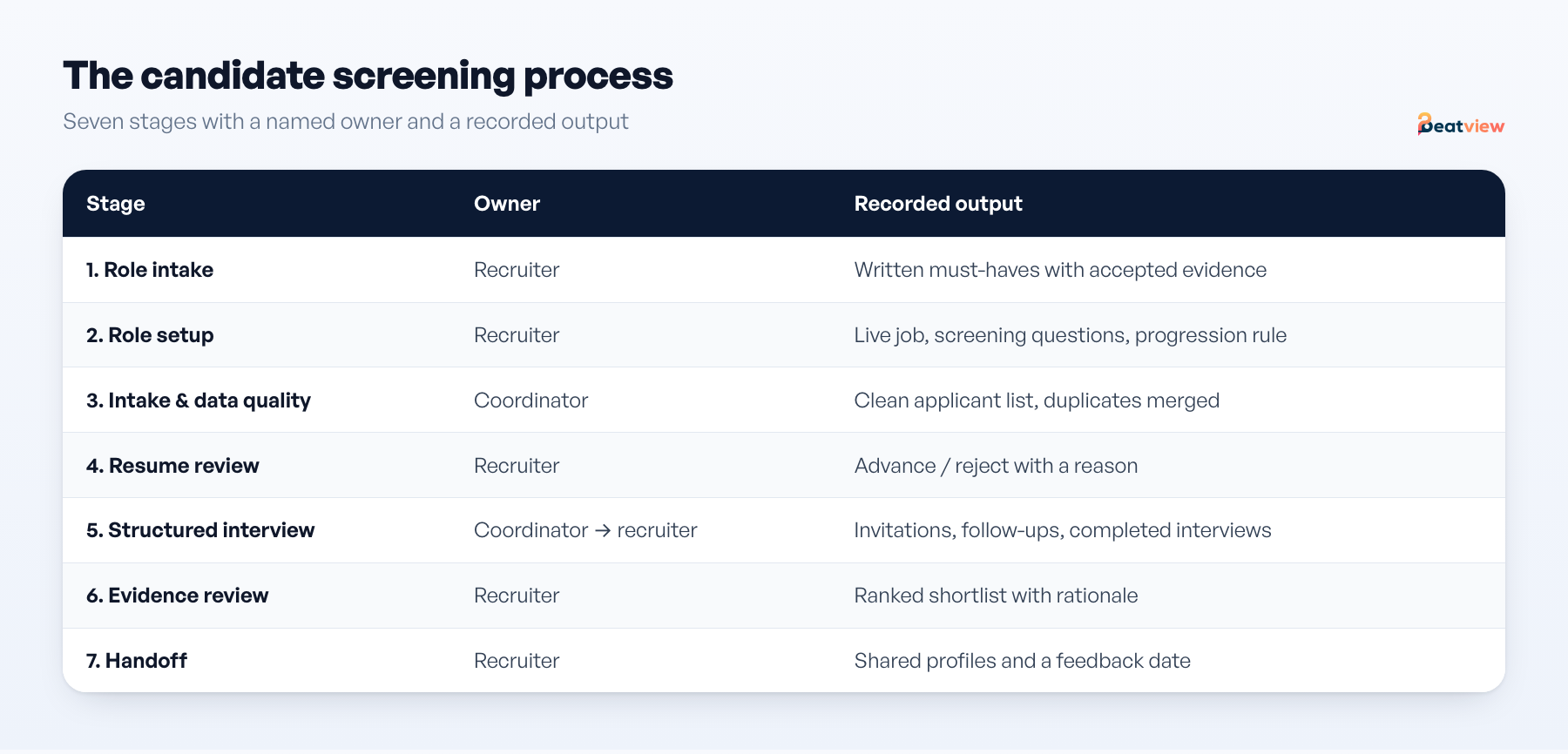
Stage 1 — Role intake
Owner: recruiter. Action: confirm three to five must-have requirements in writing, with the evidence that would prove each one, and the screening questions the application will ask. Exception: if the hiring manager or client will not commit to must-haves in writing, do not open the role — ambiguous criteria produce rejected shortlists later. The wider agreement (outcomes, decision owners, feedback turnaround) is covered in the structured hiring process.
Stage 2 — Role setup
Owner: recruiter. Action: publish the job, add the screening questions, and decide the rule that moves candidates forward (for example, a resume-score threshold that sends an interview invitation). Note: no cutoff is valid across all roles. Pick a level that produces a reviewable volume, write down why, and revisit it after the first feedback.
Stage 3 — Application intake and data quality
Owner: coordinator. Action: check that resumes were read correctly, screening answers are complete and duplicate applications are merged. Exception: a resume that could not be read is a data problem, not a weak candidate — ask for a PDF or DOCX re-upload before any decision.
Stage 4 — Resume review
Owner: recruiter. Action: read each resume against the must-haves, note the two or three requirements it evidences, and record a reason for every advance or reject. Exception: career changers and non-linear histories are the most common false negatives; read those yourself before rejecting. Our guide on how to screen resumes covers this stage in depth.
Stage 5 — Structured first-round interview
Owner: coordinator for invitations, recruiter for review. Action: send the same interview to every advanced candidate and follow up with anyone who has not started. Exception: an unfinished interview is not a low score — chase it, or advance on resume evidence alone and say so.
Stage 6 — Evidence review and shortlist
Owner: recruiter. Action: read the recorded answers, not only the numbers, then order the shortlist with a short rationale per candidate. Candidates within a point or two are effectively tied; break the tie on the evidence that matters for this role. The method is in how to shortlist candidates.
Stage 7 — Handoff to the hiring manager or client
Owner: recruiter. Action: share each shortlisted profile, state what it includes, and agree a feedback date. Exception: no feedback by the agreed date — send one chase, then raise it at the next review rather than quietly re-screening.
Candidate screening checklist
Use one checklist per role, with a named owner for every step. High-volume screening breaks where work changes hands: a resume that never parsed, an invitation nobody followed up, a shortlist sent without a feedback date. Download the checklist as a CSV.
| Section | Step | Owner |
|---|---|---|
| Role setup | Must-have requirements confirmed in writing | Recruiter |
| Role setup | Screening questions agreed for the application form | Recruiter |
| Role setup | Rule for moving candidates forward set and recorded | Recruiter |
| Application quality | Resume files read correctly; duplicates merged | Coordinator |
| Application quality | Screening answers complete | Coordinator |
| Resume review | Score or rating read alongside the resume itself | Recruiter |
| Resume review | Anyone rejected on score alone re-checked | Recruiter |
| Interview | Invitations sent; non-starters followed up | Coordinator |
| Interview | Accessibility or timing adjustments recorded | Recruiter |
| Review | Recorded answers read before ranking | Recruiter |
| Handoff | Summary written per shortlisted candidate | Recruiter |
| Handoff | Feedback deadline agreed | Recruiter |
| Close-out | Every candidate not shortlisted told the outcome | Recruiter |
Set your own turnaround commitments
Published screening "benchmarks" are aggregates from other companies' data and say little about your roles or clients. Set commitments you can keep, write them into the agreement with the hiring manager or client, and measure whether you hit them:
| Commitment | Your target |
|---|---|
| Application to resume review | ____ working days |
| Review to interview invitation | ____ working days |
| Invitation to reminder for non-starters | ____ working days |
| Completed interview to shortlist sent | ____ working days |
| Shortlist sent to feedback received | ____ working days |
For the numbers worth tracking, see recruitment metrics.
Screening high volumes of applicants
When a role attracts hundreds of applications, the process above still holds — what changes is where the time goes. Push every factual question into the application form, let a rule move clearly qualified candidates to a structured interview without waiting for a person, and spend recruiter time on the borderline cases and the final review. The high-volume recruiting guide goes further.
Common candidate screening mistakes
- Criteria that change mid-pile, so early and late applicants are judged differently.
- Rejecting on score alone without opening the resume.
- Unstructured phone screens whose outcome depends on who made the call.
- No reasons recorded, which makes it impossible to explain a decision or improve the criteria.
- Silence to rejected candidates. A clear, prompt outcome costs little and protects your reputation with future applicants.
Consistency is also the basis of fair screening — read how to reduce bias in hiring for the checks to add.
What Beatview handles and what stays with your team
| Handled in Beatview | Stays with your team |
|---|---|
| Application form with screening questions | Agreeing the requirements with the client |
| Resume reading and a match score with reasons | Setting and revising the threshold |
| Stage rules that send structured interview invitations | Chasing candidates who do not start |
| Structured video interview scored on relevance, clarity, depth of knowledge and overall | Reading the answers and deciding |
| Password-protected candidate sharing and external client notes | Writing the client-facing rationale |
| Candidate event log | Explaining a decision when a client or candidate asks |
See the candidate screening software overview or how it fits an agency desk on Beatview for recruitment agencies.
Frequently asked questions
What is candidate screening?
Candidate screening is the recruitment stage where applicants are checked against the requirements of a role — through application questions, resume or CV review and often a short structured interview — to decide who should be interviewed.
What are the steps in the candidate screening process?
A practical process has seven stages: role intake, role setup, application intake and data quality, resume review, a structured first-round interview, evidence review and shortlisting, and handoff to the hiring manager or client.
What is the difference between candidate screening and pre-employment screening?
Candidate screening decides which applicants to interview. Pre-employment screening usually refers to background, criminal-record, reference and right-to-work checks carried out before or after an offer.
What are the most common candidate screening methods?
Application screening questions, resume or CV review, phone screens, one-way or AI video interviews, and skills tests or work samples. Most teams combine knockout questions and resume review with a structured first-round interview.
Does a screening checklist make a process compliant?
No. It makes the process consistent and reviewable, which helps. Compliance obligations depend on where you hire and should be confirmed with your own legal adviser.