Headhunter vs Recruiter: What’s the Difference?
A headhunter approaches people who are not job hunting, usually for senior or specialist roles, on an employer’s behalf. Recruiter is the wider term. How in-house, agency and executive search recruiters differ.
Beatview Team
· 9 min read
Key takeaways
- A headhunter is a recruiter hired by an employer to find and approach people who are not job hunting, mostly for executive, senior or niche roles.
- In-house recruiters are employed by the hiring company; agency recruiters and headhunters work for firms that are paid by client employers.
- Headhunters focus on passive candidates through research and direct approaches; other recruiters work mostly from applicants and active job seekers.
- Candidates should not pay to be put forward: in Great Britain, charging work-seekers for finding them work is an offence, with narrow exceptions.
- Employers get the best from any recruiter with a written brief, terms agreed in writing and the same structured assessment for every candidate.
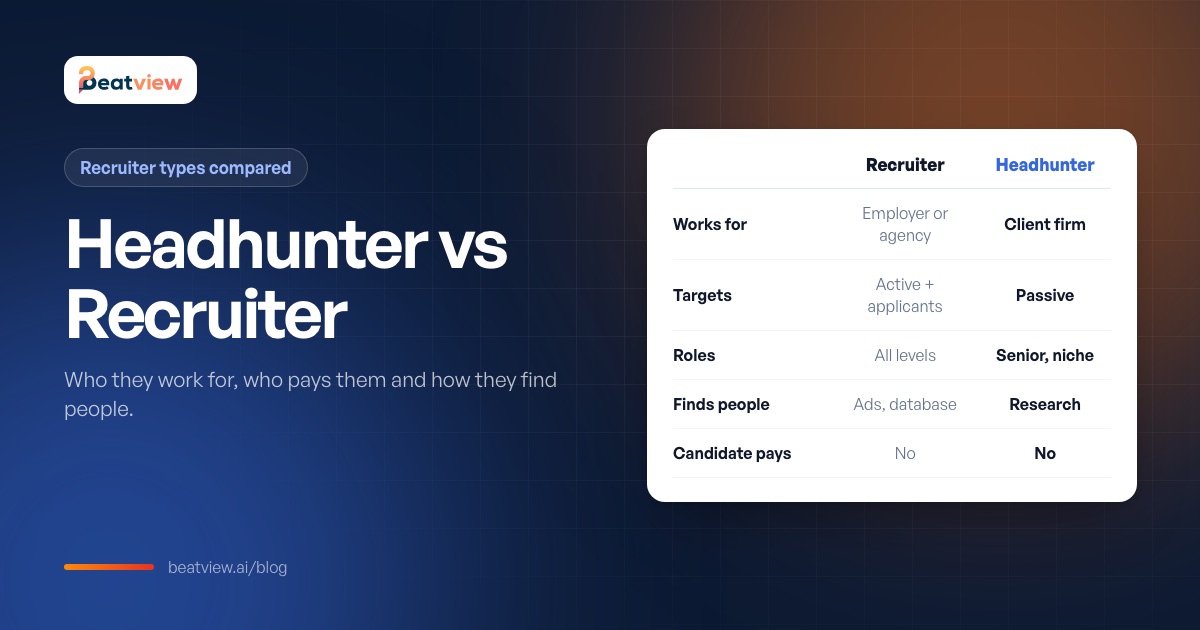
A headhunter is a recruiter hired by an employer to find and approach people who are not looking for a job, usually for executive, senior or specialist roles, and persuade the right one to move. Recruiter is the wider term for anyone whose job is to find, screen and interview candidates, whether they work in-house for the employer or for an agency. Every headhunter is a recruiter, but not every recruiter headhunts: the differences are who they work for, which candidates they target and how they are paid.
Headhunter vs recruiter at a glance
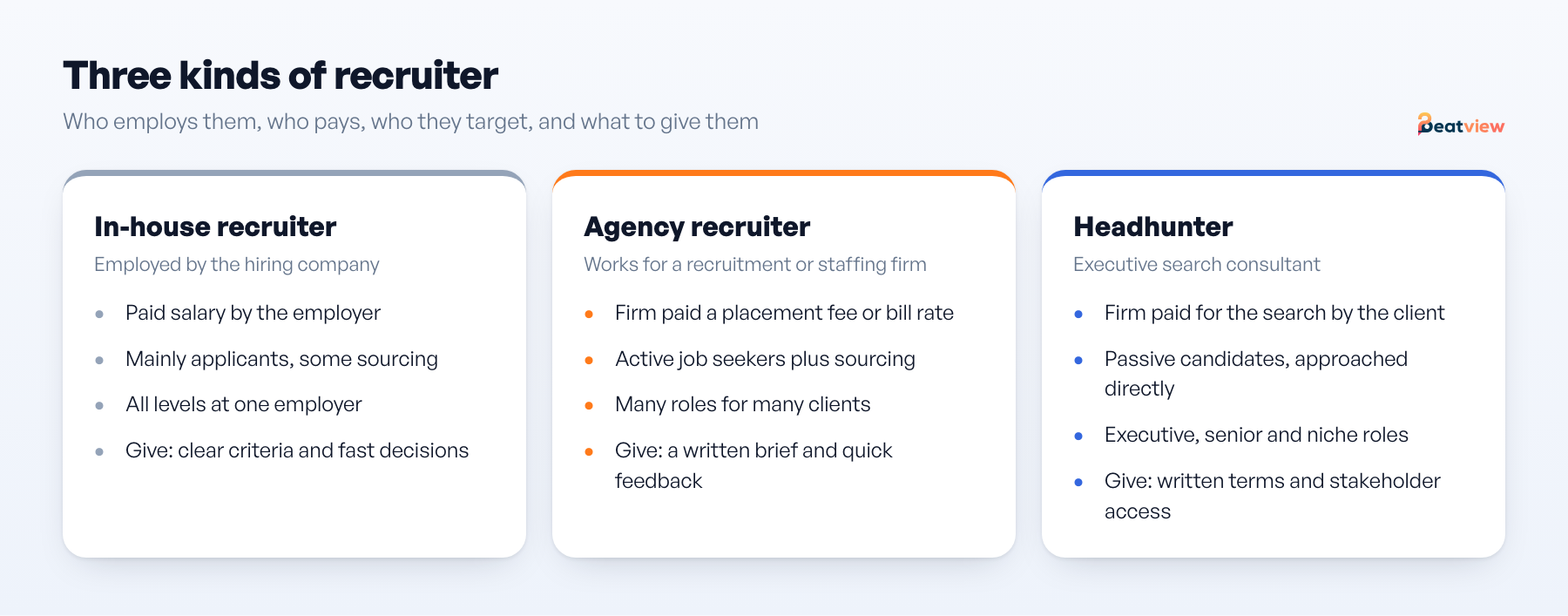
There are really three roles to compare: the in-house recruiter, the agency recruiter and the headhunter, also called an executive search consultant.
Scroll to compare →
| In-house recruiter | Agency recruiter | Headhunter (executive search) | |
|---|---|---|---|
| Works for | The hiring company, as its employee | An agency, filling roles for client employers | A search firm, acting for one client per assignment |
| Who pays | The employer, through salary | The client: a fee on placement, or a bill rate for temporary staff | The client, for the search; AESC members work on retained terms |
| Main candidates | Applicants, plus people they source | Active job seekers in its network, plus people it sources | Passive candidates: people who are not applying |
| Typical roles | All levels, at one employer | Junior to senior; permanent, temporary and contract | Executive, senior management and niche specialist roles |
| Exclusivity | Not applicable | Non-exclusive on contingency terms | Exclusive for AESC members |
| How they find people | Job postings, careers site, referrals, job fairs | Database, job boards, adverts, network, sourcing | Research into target companies and direct, confidential approaches |
What is a headhunter?
The Cambridge Business English Dictionary defines a headhunter as someone a company hires to find a person who is qualified for an important job and willing to leave their current one. The formal name for that work is executive search, which the US Census Bureau classifies as its own industry (NAICS 561312): firms providing search, recruitment and placement for clients with specific executive and senior management requirements.
The same NAICS description lists what that work can include: a search strategy and position specification based on the client's culture and needs; researching, identifying, screening and interviewing candidates; verifying qualifications; and helping with offer negotiations and the new hire's integration. The people placed join the client, not the search firm. Members of the Association of Executive Search and Leadership Consultants (AESC), a global association of search firms, commit to working on a retained and exclusive basis, meaning one firm per assignment, paid for the search. For how that fee model works, see retained vs contingency search and executive search.
In everyday use, "headhunting" also describes a method. Cambridge's general definition is simply a person who tries to persuade someone to leave their job for a better one, so an in-house or agency recruiter who approaches a named person at another company is headhunting too. The NAICS executive search category also covers executive placement services, so an executive recruiter who specializes in senior hires is doing the same kind of work, whether they call it search or placement.
What is a recruiter?
The US Bureau of Labor Statistics describes recruitment specialists, also called recruiters or talent acquisition specialists, as people who find, screen and interview applicants for job openings. They post listings, attend job fairs and visit campuses, and may also test applicants, contact references and extend job offers. That is the in-house recruiter: employed by the organization whose jobs they fill.
BLS also notes that some organizations contract recruitment and placement work to outside firms. Those firms employ agency recruiters, and there are two kinds. Employment placement agencies list vacancies and recruit, refer or place applicants who then work for the client, not the agency (NAICS 561311). Staffing firms supply workers to clients for limited periods. UK guidance draws the same line: an employment agency finds people jobs with employers who then employ and pay them, while an employment business engages temporary workers and supplies them to work under someone else's supervision. See how staffing agencies work and contract-to-hire for the staffing side.
Who they work for and who pays
All three are paid by the employer side, never by the candidate. The in-house recruiter is on the employer's payroll. An agency recruiter's firm earns a placement fee when a candidate it introduced is hired, or bills the client for every hour a temporary worker works. A search firm working on retained terms is paid for the search itself, in stages. Our guide to recruitment agency fees covers the structures and what is publicly known about levels.
That shapes loyalty. A headhunter or agency recruiter may be generous with advice, but their client is the employer, and their job is to fill the employer's role. That is not a reason for candidates to distrust them, just a reason to understand whose brief they are working to.
Passive vs active candidates
An active candidate is looking: applying for jobs, registered with agencies, answering adverts. A passive candidate is not looking but might move for the right role. For senior and specialist roles, the people who could do the job well may be employed and not reading job adverts, so waiting for applications can reach only part of the market. That is why headhunters work from research rather than applications. Agency recruiters work both groups: their database and adverts bring in active candidates, and they source passive ones with tools such as Boolean search. In-house recruiters mostly work from applicants, with sourcing for harder roles.
How each approaches candidates
In-house recruiters
Contact starts with an application or a referral. The recruiter screens it against the role, runs a short screening call or recorded interview (see our phone screening questions), and coordinates interviews with the hiring manager. Because they represent one employer, they can talk in detail about the team, the culture and the process from the first contact.
Agency recruiters
Agency recruiters work several clients' roles at once. They search their database, advertise, and message people whose profiles fit, then screen by phone and submit the strongest candidates to the client with a short summary. With non-exclusive roles, speed matters, because another agency may be working the same vacancy.
Headhunters
A headhunter starts with a target list of organizations and job titles, identifies named people, and approaches them directly and discreetly. AESC notes that first conversations may take place without naming the client. Assessment is deeper: a series of interviews against the position specification, then references and checks for the shortlist, with the final choice always the client's.
What it means for candidates
- You should not pay to be put forward. In Great Britain, section 6 of the Employment Agencies Act 1973 makes it an offence for an employment agency or employment business to charge a work-seeker a fee for finding them work, apart from cases set out in regulations; GOV.UK notes separate rules for entertainment and modeling. Agencies may sell extras such as CV writing, but cannot make them a condition of finding you work. Wherever you are, treat a request for money to submit you to a job as a warning sign.
- Ask a headhunter about the brief. AESC suggests candidates ask whether the firm has an exclusive assignment. Ask too what the role is, why it is open, and when you will learn the employer's name.
- Control where you are submitted. Agree that an agency will ask you before sending your details to any employer, and keep a list, so two agencies do not submit you for the same job.
- Be candid. Tell the recruiter your salary expectations and other processes you are in. They can only negotiate for the client's offer if they know where you stand.
- Know your data choices. AESC says candidates can ask its member firms to remove their name from the firm's database.
What it means for employers
Scroll to compare →
| Situation | Best fit |
|---|---|
| Steady hiring for roles you can advertise well | In-house recruiter |
| Hiring spikes, unfamiliar markets or temporary cover | Agency recruiter, on contingency or staffing terms |
| Executive, board or niche specialist roles | Headhunter, on retained terms |
| Confidential replacement of someone still in post | Headhunter |
| A role adverts and agencies have not filled | Headhunter, or one agency on exclusive terms |
Cost follows the model: an in-house team is a fixed salary cost, a contingency agency is paid only on a hire, and a retained search firm is paid for the work as it is done, with any refund set by its contract.
How to work well with each
- Write the brief down. Must-have criteria, the evidence you will accept for each, the pay range and a date for feedback. Every recruiter works better from a specification than from a job title.
- Agree terms in writing. For a search firm, AESC's standards list what an engagement letter should cover: the lead consultant, scope, timing, fees and payment schedule, deliverables, guarantees, off-limits, conflicts and data handling. For agencies, agree candidate ownership and the rebate period.
- Assess every candidate the same way. Whether a candidate came from an advert, an agency or a headhunter, use the same questions and scoring. See structured interviews, our interview scorecard template and the interview question library.
- Give fast, specific feedback. Recruiters can only improve the next shortlist if they know why the last one missed.
- Check references consistently. Use a fixed set of reference check questions for finalists, however they were found.
If you run or plan an agency, see how to start a recruitment agency in the UK, how to start a staffing agency, recruitment agency marketing and recruitment business development.
Where Beatview fits
Beatview is built for agency recruiters and search consultants, not to replace them. It screens applications against the criteria the agency sets and runs structured AI video interviews, so every candidate answers the same questions and each score sits beside its evidence. Agencies can share a shortlist with the client through a password-protected link instead of emailing CVs. The Free plan covers one active job with unlimited candidates; AI interviews are on Pro. See Beatview for recruitment agencies.
Frequently asked questions
Is a headhunter the same as a recruiter?
A headhunter is a type of recruiter. Recruiter covers anyone who finds, screens and interviews candidates; a headhunter specializes in approaching people who are not looking, usually for executive, senior or niche roles.
Who pays a headhunter?
The employer that hires the search firm. Candidates do not pay; in Great Britain, section 6 of the Employment Agencies Act 1973 makes charging work-seekers for finding them work an offence, apart from cases set out in regulations.
What is the difference between an agency recruiter and an internal recruiter?
An internal (in-house) recruiter is employed by the company whose jobs they fill. An agency recruiter works for a recruitment or staffing firm, fills roles for several client employers, and the firm is paid a fee or a bill rate by those clients.
Should I respond to a headhunter?
If the role might interest you, yes. Ask what the role is, whether the firm has an exclusive assignment, when you will learn the employer’s name and how your details will be used, and never pay to be put forward.
Do headhunters only recruit executives?
Executive search focuses on executive and senior management roles, and retained search is also used for niche and specialist roles. Headhunting as a method, approaching a named person directly, is used by any kind of recruiter.
Sources
- Cambridge University Press. Headhunter: Cambridge Dictionary and Cambridge Business English Dictionary.
- U.S. Census Bureau (2022). 2022 NAICS descriptions: 5613 Employment Services, 561311 Employment Placement Agencies and 561312 Executive Search Services (XLSX).
- U.S. Bureau of Labor Statistics (2026). Occupational Outlook Handbook: Human Resources Specialists.
- UK Parliament. Employment Agencies Act 1973, section 6: restriction on charging persons seeking employment.
- GOV.UK. Employment agencies and businesses.
- Association of Executive Search and Leadership Consultants. AESC Candidate Bill of Rights.
- Association of Executive Search and Leadership Consultants. AESC Client Bill of Rights.
- Association of Executive Search and Leadership Consultants (2025). AESC Professional Practice Standards (PDF).
Move an application from screening to interview
Use your configured workflow and review the completed result.
Start with one active job for free, or explore how Pro adds AI video interviews.
- Application screening
- AI video interviews
- Candidate event log
Related Articles
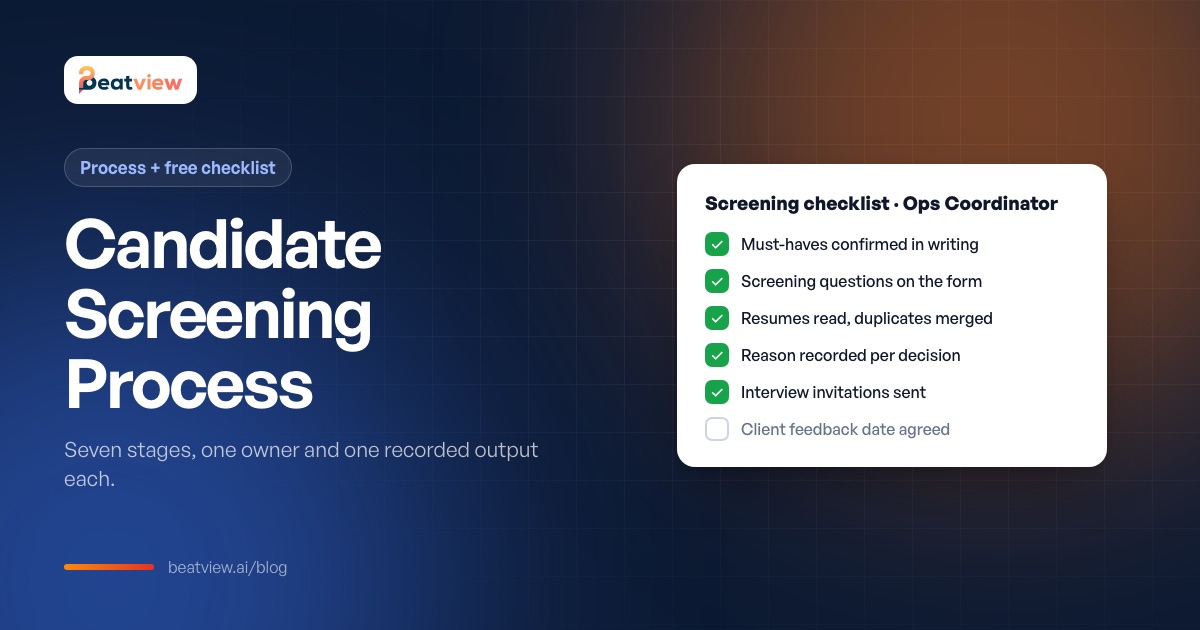
Candidate Screening Process: 7 Stages, Methods and a Free Checklist
What candidate screening is, the screening methods compared, a seven-stage process with an owner and output for each stage, and a downloadable candidate screening checklist.
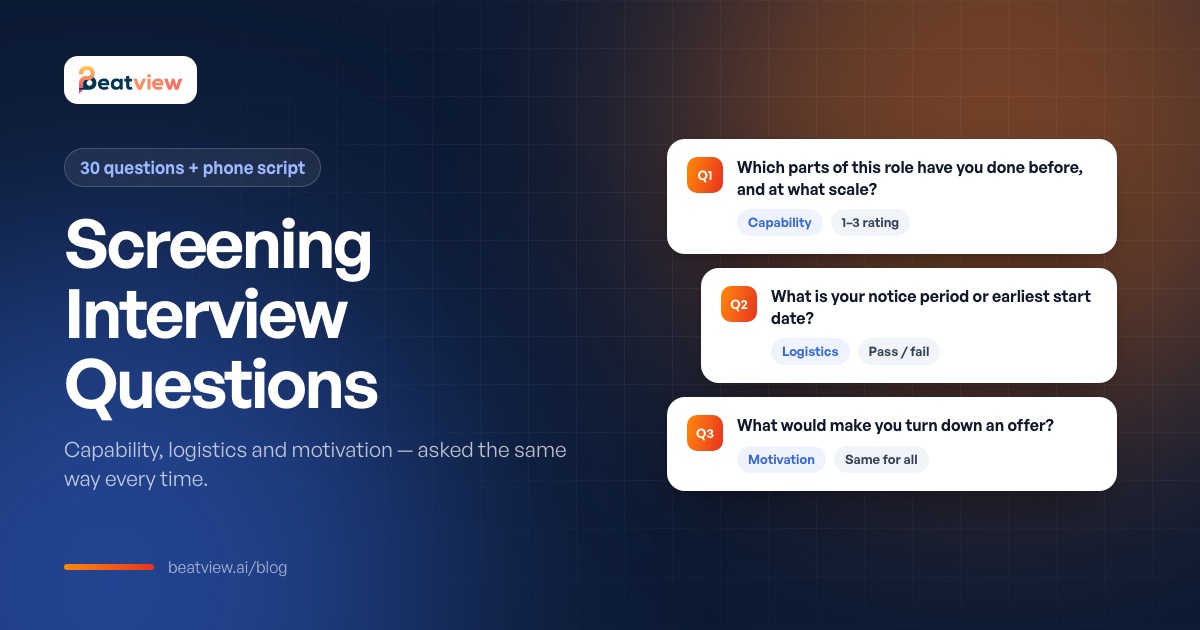
Screening Interview Questions: 30 Questions to Ask Candidates
30 screening interview questions for recruiters, grouped into capability, logistics, motivation and role-specific questions, with what good answers include, a 15-minute phone screen script and questions to avoid.
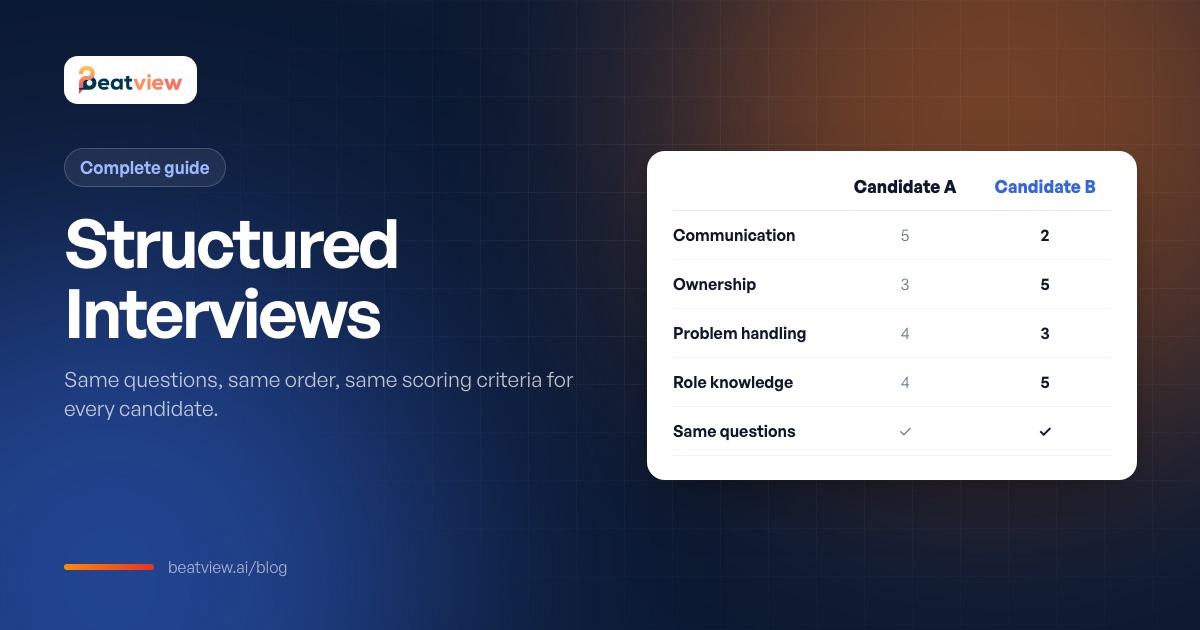
Structured Interviews: What They Are, Examples and How to Run One
What a structured interview is, how it compares with unstructured and semi-structured interviews, its advantages and disadvantages, and a seven-step method with a worked example.