Interview Scorecard Template: Free Rubric, Rating Scale and Example
A free interview scorecard you can copy or download, with a 1–5 behaviorally anchored rating scale, suggested weights, a filled-in example and the method for comparing candidates fairly.
By Beatview Team · Published · Updated · 9 min read
Key takeaways
- An interview scorecard rates every candidate against the same 4–6 job-relevant competencies, on the same scale, with a written evidence note for each rating.
- Use a 1–5 scale with behavioral anchors written for levels 1, 3 and 5 before the first interview.
- Weighted score = sum of (rating × weight); with weights totalling 100% the result stays on the 1–5 scale.
- Interviewers should score independently before any debrief, then discuss only gaps of two points or more.
- Structured interviews, which scorecards make possible, had the highest average validity (about .42) in the 2022 Sackett et al. review, versus about .19 for unstructured interviews.
An interview scorecard is a one-page form that every interviewer uses to rate each candidate against the same job-relevant criteria, on the same rating scale, with written evidence for every score. It turns "I liked her" into "she scored 4 on client communication because she described rewriting a delayed-delivery email and what changed afterwards". Below is a free interview scorecard template you can copy or download as a CSV, a 1–5 rating scale with behavioral anchors, a filled-in example, and the method for turning ratings into a fair comparison.
What is an interview scorecard?
A scorecard is the written half of a structured interview. Before the first candidate is interviewed, the hiring team agrees four to six competencies the job actually requires, the questions that will test each one, and what a weak, acceptable and strong answer sounds like. During the interview, each interviewer records what the candidate said and rates it. After the interview, ratings are compared competency by competency instead of by gut feel.
You will see the same tool called by several names. They overlap, but the differences matter when you build one:
| Term | What it usually means | When you need it |
|---|---|---|
| Interview scorecard | The full form: competencies, weights, questions, ratings and evidence notes for one candidate | Every structured interview |
| Interview rubric (hiring rubric) | The rating definitions only — what a 1, 3 or 5 looks like for each competency | Writing the scorecard; calibrating interviewers |
| Interview evaluation form | A general post-interview form, often with an overall recommendation box | HR record-keeping; less structured teams |
| Candidate evaluation form | An evaluation across several stages (resume, interview, references) | Final comparison and hiring decision |
In practice, a good interview scorecard contains the rubric, and a good candidate evaluation form is built from several scorecards. That is how this template is organized.
Free interview scorecard template
Copy this table into a document, or use the downloadable CSV version that opens in Excel, Google Sheets or Numbers. Replace the competencies and weights with the ones your role needs before the first interview — never after.
| Competency | Weight | Question or evidence prompt | Rating (1–5) | Evidence notes |
|---|---|---|---|---|
| Role knowledge | 25% | What evidence shows the knowledge this job requires on day one? | Quote or paraphrase what the candidate said | |
| Problem solving | 20% | How did the candidate structure a real problem from their past work? | ||
| Communication | 15% | Was the answer clear, specific and relevant to the question asked? | ||
| Collaboration | 15% | Which example shows how they worked with others to reach a result? | ||
| Execution | 15% | How did they turn a decision into a delivered outcome? | ||
| Motivation for this role | 10% | What specifically draws them to this role and its conditions? | ||
| Weighted score (sum of rating × weight) | Recommendation: advance / hold / decline, plus one sentence why | |||
Add a header row for the candidate, role, interview date and interviewer name. If you run the scorecard for a client as a recruitment agency, add the client name and the stage (for example "agency first round") so the client can see exactly which evidence you are presenting.
The interview rating scale: 1–5 with behavioral anchors
An unanchored scale is a feeling with a number attached. Two interviewers who hear the same answer will only land within a point of each other if they share a definition of each number. That definition is the behaviorally anchored rating scale (BARS): a short description of the evidence that earns each score.
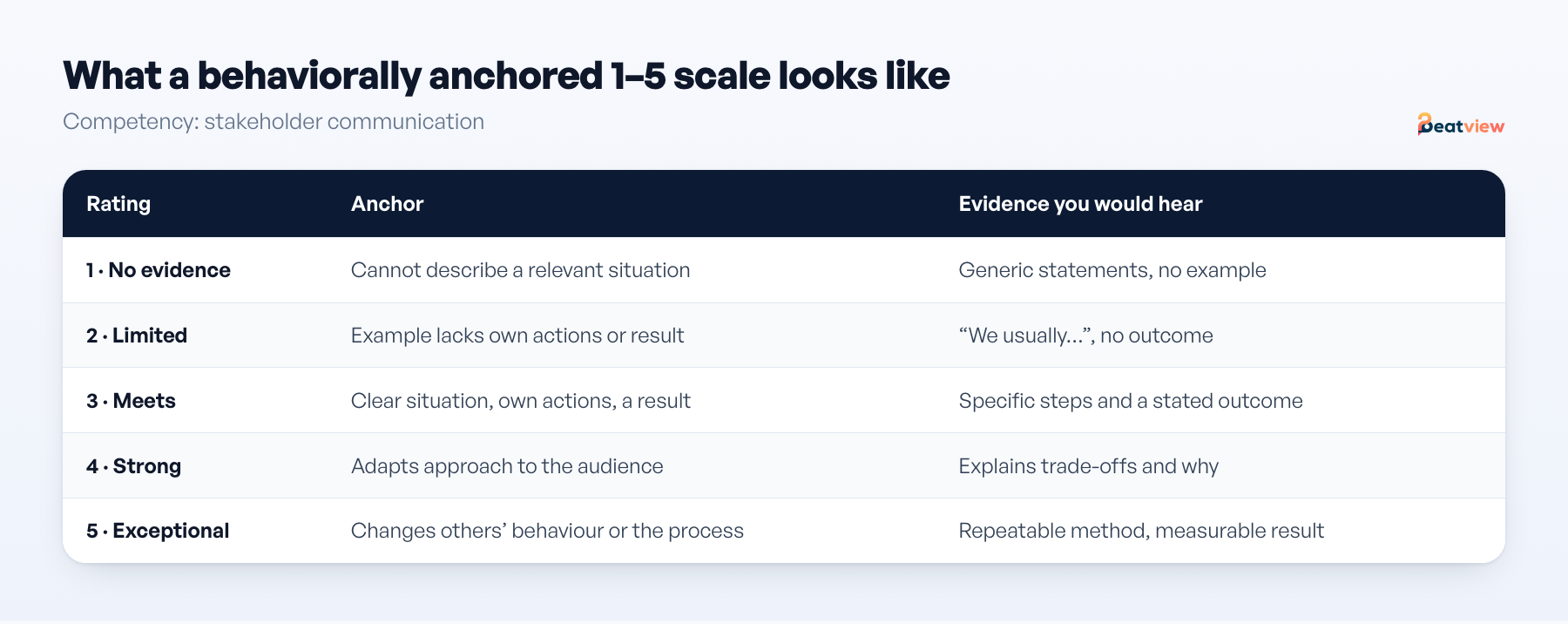
Use this general guide, then rewrite the anchors in the words of each competency:
| Rating | Label | What the answer contains |
|---|---|---|
| 1 | Well below | No relevant example, or an answer that contradicts the requirement |
| 2 | Below | A partial example with important gaps — no personal actions, or no result |
| 3 | Meets | A specific situation, the candidate's own actions and a stated result at the level the job needs |
| 4 | Above | Everything in a 3, plus clear reasoning about trade-offs or adapting to the audience |
| 5 | Exceptional | Repeated, specific evidence with measurable impact, or a method others adopted |
1–5 or 1–10? Use 1–5. Interviewers cannot reliably tell a 6 from a 7, and a longer scale mostly adds noise. If you want to avoid a "safe" middle score, a 1–4 scale forces a lean either way, but you lose the natural "meets the bar" point, which is the most useful anchor for screening.
How to build an interview scorecard in six steps
Write what the person must achieve in the first six to twelve months. Competencies come from outcomes, not from a generic list.
Beyond six, interviewers stop reading the anchors. Delete "culture fit" — if it means something real, name the behavior instead (for example "gives direct feedback to peers").
Weight the competencies the job depends on most. Agree weights with the hiring manager (or client) before interviews start, and write them on the form.
Prefer past-behavior questions ("Tell me about a time…") and add one planned follow-up. Our structured interview questions give you 40 ready examples.
Describe the evidence, not the personality. "Named the stakeholders and changed the message for each" is an anchor; "good communicator" is not.
Each interviewer submits ratings before any discussion, so the first person to speak does not set the score for everyone else.
Filled-in interview scorecard example
This is a fictional example created for this article — not a real candidate or customer record. Role: Senior Account Manager at a B2B services firm. Notice that every rating has an evidence note that someone else could check.
| Competency | Weight | Rating | Evidence note |
|---|---|---|---|
| Role knowledge | 25% | 4 | Walked through a quarterly account plan with renewal-risk signals and two expansion plays. |
| Problem solving | 20% | 3 | Found the root cause of a churn risk and named two options, but did not compare their costs. |
| Communication | 15% | 4 | Concise situation–action–result answers; adjusted the explanation when asked a follow-up. |
| Collaboration | 15% | 3 | Named the support and finance partners involved and described a shared weekly check-in. |
| Execution | 15% | 4 | Set milestones and owners for an onboarding recovery and reported progress weekly. |
| Motivation | 10% | 3 | Linked interest to client growth work; little that was specific to this company. |
How to calculate a weighted interview score
Multiply each rating by its weight and add the results. Because the weights total 100%, the result stays on the same 1–5 scale. For the example above:
(4 × 0.25) + (3 × 0.20) + (4 × 0.15) + (3 × 0.15) + (4 × 0.15) + (3 × 0.10) = 3.55
Treat the weighted score as a comparison aid, not a verdict. Two candidates at 3.55 and 3.45 are effectively tied; what separates them is the shape of their scores. If one is strong on role knowledge and the other on execution, the decision belongs to the hiring manager, against the outcomes you listed in step 1. For combining interview scores with resume and assessment evidence across a whole shortlist, see how to rank candidates fairly.
Rule of thumb: discuss only the competencies where interviewers differ by two or more points, and settle them by going back to the evidence notes — not by averaging the disagreement away.
Why interview scorecards improve hiring decisions
The case for scorecards is not just tidiness. In the most comprehensive recent review of selection research, Sackett and colleagues re-estimated the validity of common hiring methods and found that structured interviews had the highest average validity for predicting job performance (about .42), versus roughly .19 for unstructured interviews. A scorecard with anchored ratings is what makes an interview "structured" in the sense those studies measured: the same questions, the same criteria and a consistent way of rating answers.
Scorecards also make decisions explainable. When a client or candidate asks why someone was not progressed, you have a dated record of the criteria, the evidence and the rating — which also supports the documentation expectations in newer rules on hiring technology (see our overview of AI hiring laws).
Common interview scorecard mistakes
- Changing criteria mid-search. If you add a competency after three interviews, those three candidates are no longer comparable. Note the date and treat them as a separate batch.
- Rating personality instead of evidence. "Confident" and "polished" are impressions. Record what the candidate said or did.
- Filling the form after the debrief. Ratings written after a group conversation mostly record the loudest opinion.
- A single overall score. An overall number without competency ratings hides exactly the information you need to break a tie.
- Too many competencies. Ten criteria on one form means none of them gets real attention.
- Questions that probe protected characteristics. Never improvise questions about age, family, health, religion or origin, and check local rules on salary-history questions.
Interview scorecards for recruitment agencies
Agencies use scorecards twice: once to decide who to put forward, and again to show the client why. Agree the competencies and weights with the client at intake (our structured hiring process guide includes a kickoff worksheet), run the first round against them, then send the scorecard with the shortlist. Clients stop asking "why this person?" when the answer is already on the page — and your submissions become comparable across roles and consultants.
Using this scorecard with Beatview
Beatview runs the first-round interview for you: every candidate for a role answers the same timed video questions, and each completed interview is scored on relevance, clarity, depth of knowledge and an overall rating, with the candidate's answer shown beside each score so a recruiter can check it. Those AI scores are evidence for your scorecard, not a replacement for it — your recruiter still records their own ratings and makes the call. You can share a candidate with a client through a password-protected link. See how AI interviews work, or start with the free template on your next role.
Frequently asked questions
What should be on an interview scorecard?
Candidate and role details, four to six competencies with weights, the question used for each competency, a 1–5 rating with behavioral anchors, an evidence note for every rating, a weighted score and a one-line recommendation with the reason.
How do you score a candidate in an interview?
Rate each competency separately against written anchors, record the evidence that justifies the rating, multiply each rating by its weight and add the results. Score before discussing the candidate with other interviewers.
Is a 1–5 or 1–10 interview rating scale better?
A 1–5 scale is usually better. Interviewers cannot reliably distinguish ten levels, so a longer scale adds noise rather than precision. Anchor at least levels 1, 3 and 5.
What is the difference between an interview scorecard and an interview rubric?
A rubric defines what each rating means for each competency. A scorecard is the complete form an interviewer fills in for one candidate, and it contains the rubric plus questions, weights, ratings and evidence notes.
Should interviewers see each other’s scores before the debrief?
No. Each interviewer should submit ratings independently first. Otherwise the first opinion voiced tends to anchor everyone else.
Can AI fill in an interview scorecard?
AI can score recorded answers against fixed criteria and show the evidence behind each score, which is useful input. A person should still review the evidence, record their own judgement and make the hiring decision.
Sources
- Sackett, P. R., Zhang, C., Berry, C. M., & Lievens, F. (2022). Revisiting meta-analytic estimates of validity in personnel selection. Journal of Applied Psychology.
- Society for Industrial and Organizational Psychology: Is cognitive ability the best predictor of job performance? (summary of the revised validity estimates).