Screening Interview Questions: 30 Questions to Ask Candidates
30 screening interview questions for recruiters, grouped into capability, logistics, motivation and role-specific questions, with what good answers include, a 15-minute phone screen script and questions to avoid.
By Beatview Team · Published · Updated · 7 min read
Key takeaways
- A screening interview checks capability, logistics and motivation before the main interviews — usually in 15–30 minutes.
- Ask every candidate for a role the same questions in the same order, and write down the answer rather than your impression.
- Move factual logistics questions (start date, hours, location, right to work) onto the application form as pre-screening questions.
- Treat logistics as pass/fail and rate capability on a simple 1–3 scale; screening filters, it does not rank.
- Never ask about age, family, health, religion or origin, or salary history where local law restricts it.
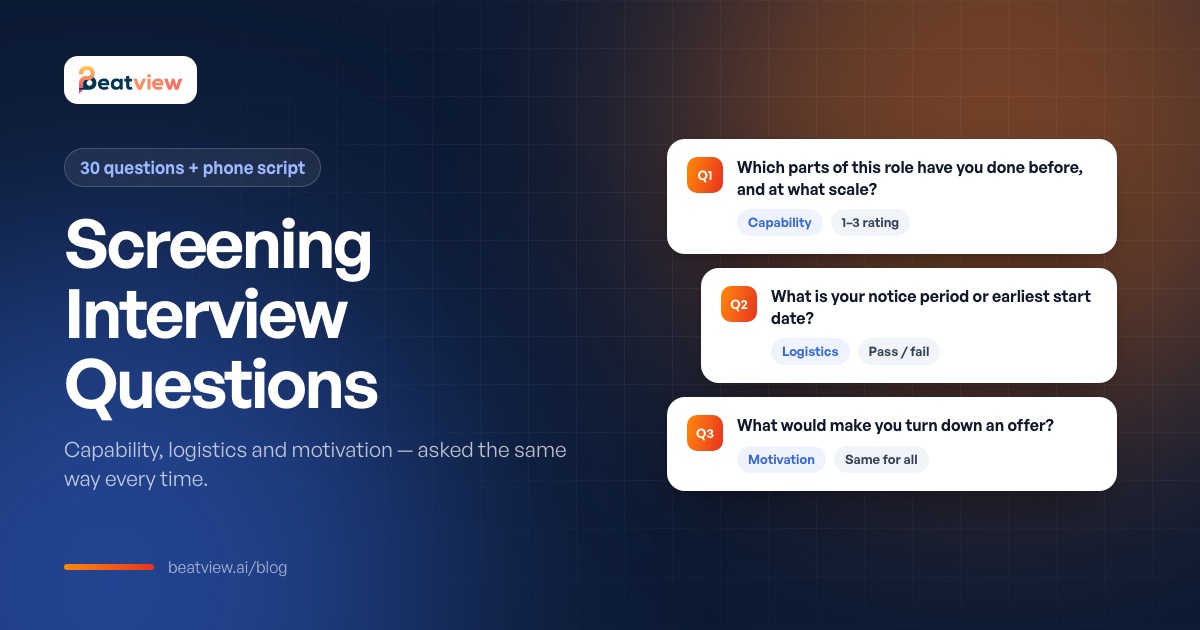
Screening interview questions are the short, standard questions a recruiter asks every applicant before the main interviews — on a phone screen, in a pre-screening form or in a recorded first round — to confirm the person can do the core work, can take the job as offered, and genuinely wants it. The best screening questions are the same for every candidate, take under 20 minutes in total, and produce answers you can write down as evidence. Below are 30 screening interview questions to ask candidates, grouped by purpose, with what a good answer sounds like, a 15-minute phone screen script, and the questions you should never ask. The full bank is also available as a CSV download.
What is a screening interview?
A screening interview is a short first conversation — traditionally a 15–30 minute phone screen with a recruiter — that decides whether an applicant goes on to the full interview process. It checks three things: capability (have they done the core of this work?), logistics (can they take the job as it is: hours, location, salary range, start date?) and motivation (why this role, and what would make them leave?). It is not the place to assess everything; that is what the structured interviews later are for.
30 screening interview questions to ask candidates
Role capability (pick 2–4)
| # | Question | A good answer includes |
|---|---|---|
| 1 | Which parts of this role have you done before, and at what scale? | Specific tasks plus a number: volume, budget, team size |
| 2 | Walk me through the recent piece of work closest to this role. | What they personally owned versus what the team owned |
| 3 | Which tools or systems in the job description do you use regularly? | Daily use, with what for, not one-off exposure |
| 4 | What part of this role would be new to you? | An honest gap and how they learned something comparable |
| 5 | How do you check your own work before it goes out? | A repeatable habit and a time it caught a problem |
| 6 | What is the biggest result you are responsible for in your current role? | A measurable outcome and their part in it |
| 7 | Tell me about a typical week in your current job. | Work that overlaps with the core of this role |
| 8 | What would your manager say you are best at — and what you should improve? | Self-awareness; a development point with evidence of action |
Logistics and availability (ask all that apply)
| # | Question | A good answer includes |
|---|---|---|
| 9 | What is your notice period or earliest start date? | A firm date, or what it depends on |
| 10 | Can you work the hours and location this role requires? | A clear yes, or the adjustment they need |
| 11 | Is your salary expectation within the range for this role? | Yes / no, and what the expectation is based on |
| 12 | Are you legally able to work in this role's location? | Yes / no — no documents needed at this stage |
| 13 | Are you in other hiring processes, and when do you expect decisions? | Timelines you can plan the shortlist around |
| 14 | Does this role require a licence or certification you hold? | Which one, and when it expires |
| 15 | How much travel can you commit to? | A realistic figure against what the role needs |
| 16 | What working arrangement do you need to do this role well? | Needs you can check against the role as offered |
Motivation and fit for the role (pick 2–3)
| # | Question | A good answer includes |
|---|---|---|
| 17 | What made you apply for this role specifically? | Something specific from the job description, not "I need a change" |
| 18 | What are you looking for that your current role does not give you? | Something this role actually offers |
| 19 | Why are you leaving, or why did you leave, your last role? | A clear, non-defensive reason |
| 20 | What kind of work do you want more of in the next year? | Alignment with the role's direction |
| 21 | What would make you turn down an offer? | Honest deal-breakers you can check early |
| 22 | How do you prefer to receive direction and feedback? | An example of feedback they acted on |
| 23 | What do you know about the company or client? | Evidence they looked beyond the job ad |
Role-specific screening questions (adapt per job)
| # | Role | Question |
|---|---|---|
| 24 | Sales | What was your quota last year and how did you finish against it? |
| 25 | Customer service | Tell me about a complaint you resolved that could have escalated. |
| 26 | Operations | What process did you improve most recently, and how did you measure it? |
| 27 | Manager | How many people do you manage, and what is one decision you made about the team this year? |
| 28 | Technical | Which part of your current stack could you explain to us in detail tomorrow? |
| 29 | Recruiter | How many open roles do you carry, and how do you decide which candidates to call first? |
| 30 | Any role | Is there anything in your background we should know to assess you fairly for this role? |
A 15-minute phone screen script
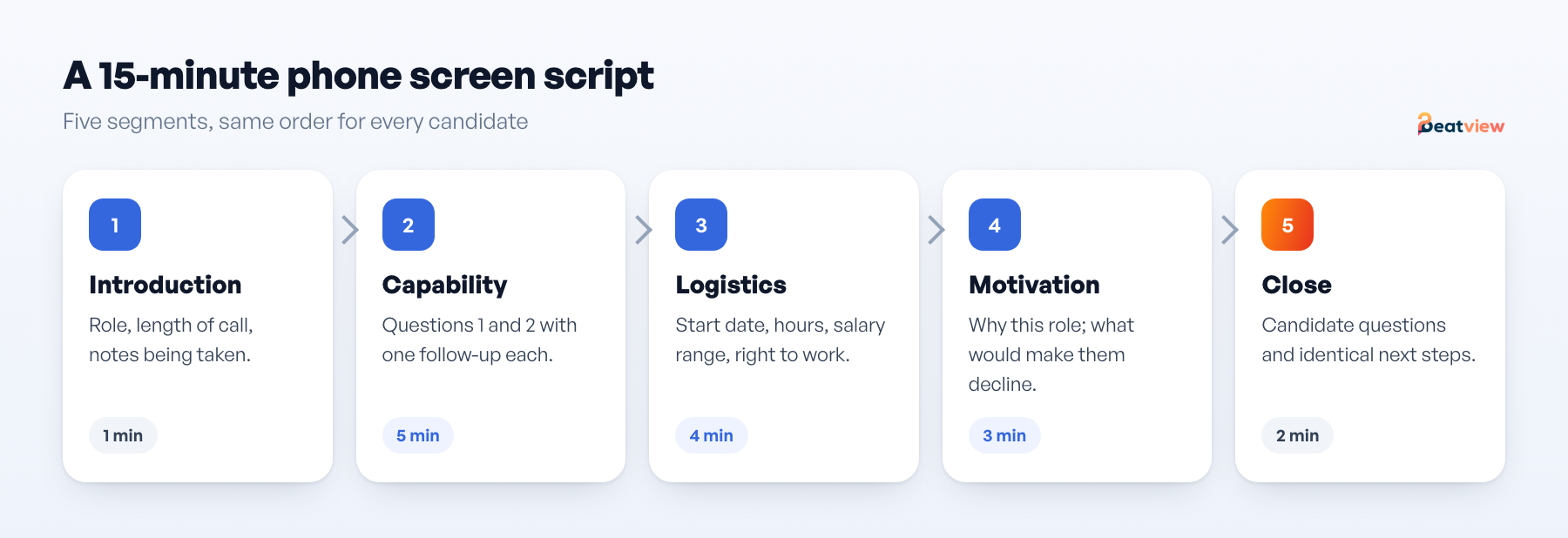
- Introduction (1 minute). Who you are, the role, that the call takes 15 minutes and you will take notes.
- Capability (5 minutes). Questions 1 and 2, with one follow-up each.
- Logistics (4 minutes). Questions 9–12, plus 14 if the role needs a licence.
- Motivation (3 minutes). Questions 17 and 21.
- Close (2 minutes). The candidate's questions; the same explanation of next steps and timing for everyone.
Write the answer, not your impression of it, and rate capability on a simple 1–3 scale straight after the call. If you want a fuller interview later, move to structured interview questions with anchored ratings.
Turn logistics questions into pre-screening questions
Every logistics question with a factual answer — start date, hours, location, right to work, licence — belongs on the application form, not the phone. That way every applicant answers the same set before anyone spends time on a call, and knockouts are applied consistently. Keep the form to three to six questions; longer forms increase drop-off without adding comparable evidence, and anything the resume already shows does not need a question. Score form questions only where the answer is genuinely pass or fail, such as availability for required hours.
Screening questions to avoid
- Age, date of birth or graduation year used as a proxy for age.
- Marital or family status, pregnancy or plans to have children.
- Health, disability or medical history — ask only whether the candidate can perform the essential functions, with or without adjustments.
- Religion, national origin, ethnicity or accent.
- Current or past salary, where local law restricts salary-history questions (several US states and cities do).
- Brain teasers and questions you would not ask every candidate for the same role.
Rules differ by country and state; use wording approved by your own employment adviser for the places you recruit.
How to score screening interview answers
Screening answers are a filter, not a ranking. Treat logistics as pass/fail, rate capability 1–3 (no evidence / some evidence / clear evidence) and note one piece of evidence per must-have requirement. Two candidates can clear every screening question and still be very different — use a structured interview to compare them. For the full stage, see the candidate screening process.
Replace phone screens with a recorded screening interview
Phone screens are consistent only if the same person asks the same questions the same way — hard when you are running 20 roles. A recorded screening interview asks every candidate the same questions with the same time limits, whenever the candidate is free, and removes calendar back-and-forth from the first round. For how to phrase questions for that format, see video interview questions.
In Beatview, screening questions live on the application form, so every applicant answers the same set. When the answers and the resume score satisfy the rule you configure, the candidate can be invited automatically to a structured video interview; every candidate answers the same timed questions and each answer is scored on relevance, clarity, depth of knowledge and overall, with the answer beside each score. Recruiters review and decide. See one-way video interviews.
Frequently asked questions
What questions are asked in a screening interview?
Questions about capability (which parts of the role the candidate has done and at what scale), logistics (start date, hours, location, salary range, right to work) and motivation (why this role, what would make them decline an offer).
How long should a phone screen be?
About 15 minutes is enough for a structured phone screen: a one-minute introduction, five minutes on capability, four on logistics, three on motivation and two for the candidate’s questions and next steps.
What are pre-screening questions?
Pre-screening questions are short questions on the application form — such as right to work, availability or a required licence — that every applicant answers before any interview, so objective requirements are checked consistently.
What questions should recruiters not ask in a screening interview?
Questions about age, marital or family status, pregnancy, health or disability, religion, national origin or ethnicity, and — where local law restricts it — salary history. Only ask what you would ask every candidate for the role.
Can a screening interview be done without a phone call?
Yes. A recorded one-way or AI video interview asks every candidate the same screening questions with the same time limits, and the recruiter reviews the answers later without scheduling a call.