Structured Hiring Process: 8 Hiring Process Steps That Make Decisions Repeatable
The eight steps of a structured hiring process, the written output and owner of each, and — for recruitment agencies — how to agree criteria, decision ownership and handoff with a client.
By Beatview Team · Published · Updated · 7 min read
Key takeaways
- A structured hiring process applies the same written criteria, stages, questions and decision rules to every candidate for a role.
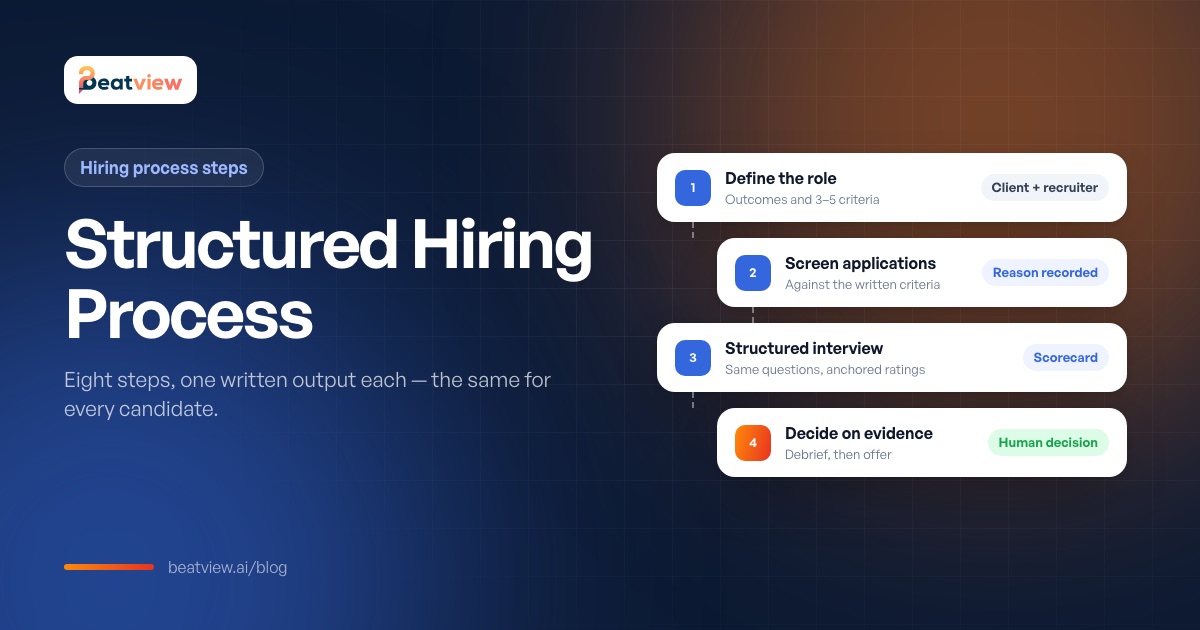
- The eight steps: define the role, write the ad and screening questions, collect applications, screen resumes, structured first interview, hiring manager interviews, debrief and decision, offer and feedback.
- Every step should produce a written output; a step without one is not yet structured.
- Agencies should agree outcomes, criteria, decision owners and the shortlist handoff with the client before screening starts.
- Repeated rejections for the same reason mean the written criteria have drifted from the client’s real criteria — fix the brief, not the sourcing.
A structured hiring process is a hiring process in which every step — from defining the role to making the offer — follows a written plan: the same criteria, stages, questions and decision rules apply to every candidate for the role, and each decision is recorded with its reason. Most teams already have hiring process steps; what makes them structured is that the steps are agreed before the first application arrives and do not change from candidate to candidate. Below are the eight hiring process steps, what each one should produce, who owns it, and — for recruitment agencies — how to agree the process with a client in one kickoff call.
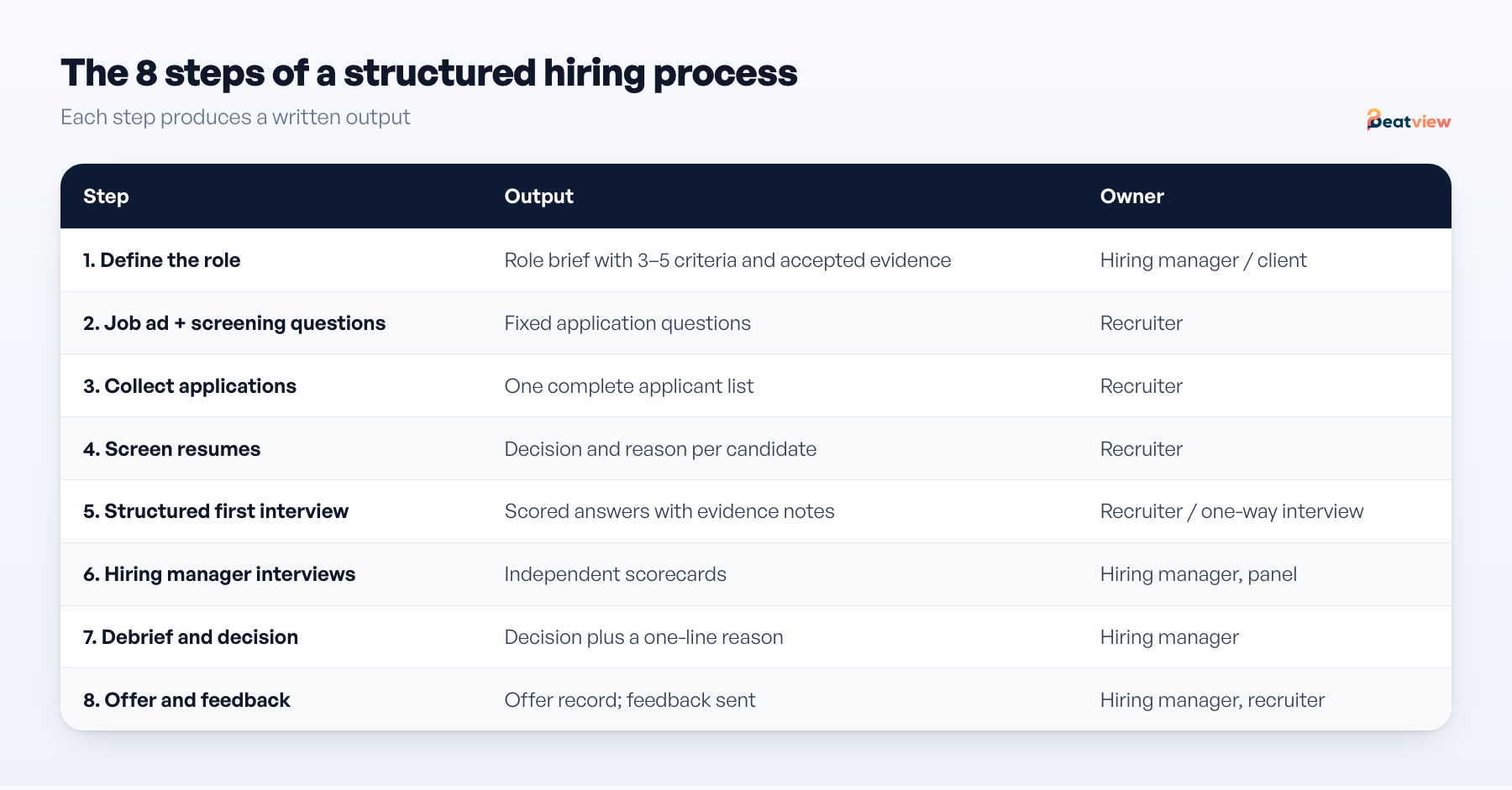
The 8 steps of a structured hiring process
| Step | What happens | Written output | Owner |
|---|---|---|---|
| 1. Define the role | Agree outcomes, must-have criteria and disqualifiers | Role brief with 3–5 criteria and accepted evidence | Hiring manager (or client) with recruiter |
| 2. Write the job ad and screening questions | Publish the role with the questions every applicant answers | Job ad; fixed application questions | Recruiter |
| 3. Collect applications | Candidates apply through one route per role | One list of applicants with complete data | Recruiter |
| 4. Screen resumes | Compare each application with the written criteria | Screening decision and reason per candidate | Recruiter (software can prepare evidence) |
| 5. Structured first-round interview | Same questions, same order, anchored ratings | Scored interview with evidence notes | Recruiter or one-way/AI interview |
| 6. Hiring manager interviews | Deeper interviews against the same scorecard | Independent scorecards per interviewer | Hiring manager and panel |
| 7. Debrief and decision | Discuss evidence where ratings differ; decide | Decision and reason in one or two sentences | Hiring manager |
| 8. Offer, references and feedback | Offer, checks, and feedback to unsuccessful candidates | Offer record; candidate feedback sent | Hiring manager and recruiter |
Step 1 — Define the role by outcomes, not a wish list
Ask what the hire must have delivered by day 90 and by month 12. Outcomes are easier to answer than a requirements list, and they expose disagreement between stakeholders early. Turn the outcomes into three to five must-haves, each with the evidence you would accept, and keep nice-to-haves on a separate list that never blocks a shortlist.
| Criterion type | Rule |
|---|---|
| Must-have | Three to five only, each with the evidence that proves it |
| Nice-to-have | Listed separately; never a rejection reason on its own |
| Disqualifier | Objective and factual: licence, work authorization, location limits |
| Screening question | Anything you would otherwise ask on a first call — put it on the application form |
Step 2 — Write the job ad and the screening questions together
The ad should state the must-haves in plain words so candidates can self-select. Every question you would otherwise ask on a screening call — right to work, notice period, location, a licence — goes on the application form, so every applicant answers the same set. Our screening interview questions list has examples.
Step 3 — Collect applications through one route
Post the same application link on your careers page and job boards so every applicant arrives with the same data. Applications scattered across inboxes are the most common reason a process stops being consistent.
Step 4 — Screen resumes against the written criteria
Read each application against the must-haves, record the decision and the criterion behind it, and set a stop rule for large volumes (for example, review in score order until you have a shortlist of eight). The candidate screening process guide covers this stage in detail.
Step 5 — Run a structured first-round interview
Ask every shortlisted candidate the same questions in the same order and rate each answer on anchored 1–5 scales. A recorded one-way or AI interview makes this step consistent by design and removes calendar scheduling from the first round. See structured interviews for the method.
Step 6 — Hiring manager interviews with the same scorecard
Later rounds go deeper, but on the same criteria. Each interviewer fills in their own interview scorecard before talking to the others.
Step 7 — Debrief and decide on the evidence
Discuss only criteria where ratings differ by two or more points and settle them by returning to the notes. Record the decision and the reason — you will need it when a candidate, client or auditor asks. For comparing a full shortlist, see how to rank candidates.
Step 8 — Offer, references and candidate feedback
Run the same reference questions for every finalist, and send unsuccessful candidates a clear outcome. A structured process makes this easy: the reason is already written down.
Structured vs unstructured hiring process
| Without structure | With a structured hiring process |
|---|---|
| Criteria live in a call nobody minuted | Written must-haves with accepted evidence |
| Each interviewer asks their favourite questions | A fixed question set and scorecard per stage |
| Candidates rejected as "not quite right" | Every rejection mapped to a named criterion |
| Feedback arrives when it arrives | An agreed turnaround for each decision |
| Decisions are hard to explain later | A dated record of criteria, evidence and reasons |
The payoff is not only fairness. Structured interviews are the most predictive common selection method in the research literature (a mean validity of about .42 versus about .19 for unstructured interviews in Sackett and colleagues' 2022 review), and a structured process is what lets you use them consistently.
For recruitment agencies: agree the process with the client
In an agency, the structured hiring process starts as an agreement with your client, not a configuration in a tool. Before any resume arrives you need four things in writing: the outcomes the hire must deliver, the criteria you will screen against, who decides what, and how shortlists are handed over. Run through the client kickoff worksheet in one call and fill it in live.
Decision ownership
Most stalled searches are ownership problems. Name a person for each decision before the role opens:
| Decision | Owner |
|---|---|
| Approves the job description and criteria | Client |
| Sets the screening threshold and shortlist size | Recruiter |
| Approves or rejects each shortlisted candidate | Client hiring manager |
| Makes the final offer decision | Client |
| Can change the criteria mid-search | Client, in writing, with a dated note |
Agree a feedback turnaround in working days as well. It is a commercial commitment between you and the client, so pick a number you can both hold to.
Handoff format
Decide what a shortlist looks like before you send the first one: how many candidates per batch, what each profile contains, who receives it and how feedback comes back. One format per client makes submissions comparable across consultants.
The standing review meeting
Book a recurring 30 minutes per active search with a fixed agenda: shortlists sent and feedback received; candidates rejected and the recorded reason; requirements the market is not producing; changes to criteria, threshold or shortlist size; actions with owners and dates. The second item is the valuable one — repeated rejections for the same reason mean the written criteria and the client's real criteria have drifted apart. Fix the document, not the sourcing.
How to measure whether the process works
Track a small set of numbers per role: time to first shortlist, shortlist-to-interview rate, interview-to-offer rate, and the share of rejections that cite a named criterion. Our guide to recruitment metrics gives formulas and a tracker, and how to reduce time to hire shows where the days usually go.
Where Beatview fits
Beatview structures steps 3 to 5 and the client handoff. Candidates apply through your branded career page or job-board links and answer the same screening questions; each resume is scored against the role with the reasons shown; a stage rule can send the structured interview invitation when a resume score clears the threshold you set; and every candidate answers the same timed video questions, scored on relevance, clarity, depth of knowledge and overall. Shortlists go to clients through password-protected candidate links, with client comments captured as external notes. Who is submitted and who is hired stays with your team. See Beatview for recruitment agencies.
Frequently asked questions
What are the steps of the hiring process?
A typical structured hiring process has eight steps: define the role and criteria, write the job ad and screening questions, collect applications, screen resumes, run a structured first-round interview, hold hiring manager interviews, debrief and decide, then make the offer, check references and send feedback.
What is structured hiring?
Structured hiring means agreeing the criteria, stages, interview questions and scoring rules before candidates apply, and applying them identically to every candidate so decisions are comparable and explainable.
How long should a hiring process take?
It depends on the role and market. SHRM benchmarking puts median time-to-fill at roughly a month and a half. Measure your own baseline per stage and remove waiting time between steps rather than shortening the evaluation itself.
What if a client will not sit through a kickoff call?
Send the kickoff worksheet and ask for written answers to the must-have criteria and decision-ownership sections at minimum. Those two sections cause the most rework when they are missing.
Can the criteria change during a search?
Yes, and sometimes they should. Record the change in writing with a date so you know which candidates were screened under which version, and do not compare candidates across versions as if they were the same.
Sources
- Sackett, P. R., Zhang, C., Berry, C. M., & Lievens, F. (2022). Revisiting meta-analytic estimates of validity in personnel selection. Journal of Applied Psychology.