Skills-Based Hiring vs Resume Screening: How to Combine Both
What skills-based hiring is, how it compares with resume screening, what the research says about each type of evidence, and a staged model and decision tree for using both.
By Beatview Team · Published · Updated · 6 min read
Key takeaways
- Skills-based hiring selects on evidence of job skills rather than proxies such as degrees, titles or years of experience.
- Resume screening scales to the whole pool; skills evidence costs candidates time, so use it after the pool is narrowed.
- In Sackett et al. (2022), job-specific evidence ranked highest: structured interviews .42, job knowledge tests .40, work samples .33.
- A practical sequence: resume and application questions for everyone, structured questions for the shortlist, a work sample for finalists.
- Keep tasks short, identical for everyone at a stage and marked against criteria written in advance.
Skills-based hiring means selecting candidates on evidence of the skills a job actually requires, rather than on proxies such as degrees, job titles or years of experience. Resume screening tells you what a candidate says they have done; skills-based screening shows you what they can do now. Neither replaces the other. The practical question is which evidence you need at which stage — because skills evidence costs candidates time, and asking for it too early loses applicants. This guide compares the two, summarises what the research says about each type of evidence, and gives a staged model and decision tree for combining them.
What is skills-based hiring?
A skills-based approach starts from the work: list the skills the job needs, decide how you will see evidence of each one, and remove requirements that are only proxies. A degree requirement for a role that does not need one, "five years of experience" when two would do, or a specific previous job title all narrow the pool without measuring the skill. Skills-based hiring does not mean ignoring experience — it means treating experience as one source of evidence rather than the gate.
Skills-based hiring vs resume screening
| Resume screening | Skills-based screening | |
|---|---|---|
| Evidence collected | Claimed history: roles, tenure, tools, qualifications | Observed performance on a job-related task, or structured answers about how the candidate works |
| Candidate effort | Minutes — the resume already exists | A few minutes for recorded questions; 20 minutes to several hours for a work sample |
| Scales to hundreds of applicants | Yes | Only in light forms, such as short recorded answers |
| Main weakness | Rewards people who write well about themselves and follow conventional paths | Drop-off, and tasks that are not genuinely job-related |
| Best stage | First pass on the whole pool | After the pool has been narrowed |
What the research says about each kind of evidence
Sackett, Zhang, Berry and Lievens' 2022 re-analysis in the Journal of Applied Psychology revised the validity estimates that hiring advice has relied on for decades. The mean operational validities for predicting job performance include:
| Selection method | Mean validity (Sackett et al., 2022) |
|---|---|
| Structured interviews | .42 |
| Job knowledge tests | .40 |
| Empirically keyed biographical data | .38 |
| Work sample tests | .33 |
| General cognitive ability tests | .31 |
| Unstructured interviews | .19 |
Two practical conclusions follow. First, job-specific evidence — structured interviews, job knowledge and work samples — ranks at the top, which supports a skills-based approach. Second, the most predictive tool on the list, the structured interview, is also one of the easiest to run at scale, especially as a recorded first round. Validity varies by role and by how well a method is designed, so treat these as averages, not guarantees.
How to combine resume screening and skills-based screening
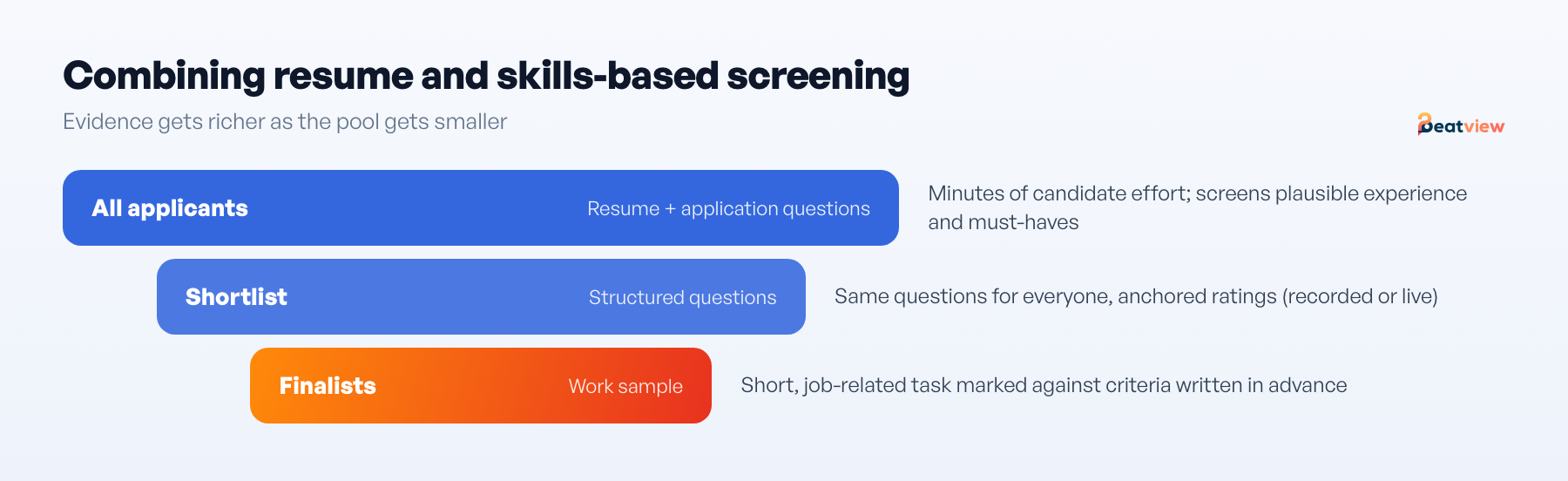
- Whole pool — resume and application questions. Low effort for candidates; screens for plausible experience and objective must-haves.
- Shortlist — structured questions. A short recorded or live interview with the same questions for everyone, rated on anchored scales.
- Finalists — a work sample. A short, job-related task marked against criteria written in advance.
Worked example: warehouse team leader
This example is illustrative — the candidate is not real.
1. Resume evidence (whole pool). Four years in warehouse operations, two as a shift lead, a named inventory system, no formal safety qualification listed. This settles whether the person has plausibly done the work. It does not settle whether they can run a shift when two people call in sick.
2. Structured question (shortlist). "Describe a shift where you were short-staffed. What did you change, who did you tell, and what happened?" A strong answer names a real shift, a reprioritisation decision and an escalation. Rate it against anchors — see structured interview questions.
3. Work sample (final two or three). A 30-minute exercise: a shift roster, an order backlog and two absences — produce a plan and a short note to the client. Written criteria, same task and time for everyone.
Decision tree: which evidence at which stage?
- More than about 50 applicants? Start with resume screening. Do not ask a large pool for a work sample.
- High-volume role where resumes already show capability? Add a short recorded question set, not a task.
- Does the role depend on a skill a resume cannot show — writing, calculation, a tool, customer handling? Add a job-related task at shortlist stage only.
- Small, in-demand pool? Keep candidate effort minimal; a task at this stage costs you candidates.
- Client insists on a test? Agree who sets it, who marks it, how long it takes and how it affects the decision — in writing, at kickoff.
How to move to skills-based hiring in 5 steps
Remove degree, tenure and title requirements the job does not need, and state the skills instead.
Describe each as observable behavior, for example "writes a clear client update when a delivery slips".
Resume, structured question or task — whichever is the cheapest reliable source.
Light evidence for everyone, heavier evidence only for the shortlist.
Anchors for questions, a rubric for tasks, agreed before anyone is assessed.
Rules that keep skills-based screening fair
- Every candidate at a stage gets the same task, the same instructions and the same time.
- Keep tasks short and never ask for work the employer would otherwise pay for.
- Tell candidates how long each step takes before they start, and offer adjustments on request.
- Check that tasks do not disadvantage groups for reasons unrelated to the job. See bias in hiring.
Where Beatview fits
Beatview covers the first two stages: it reads resumes and scores them against the role with the reasons shown, and runs structured recorded interviews in which every candidate answers the same timed questions, scored on relevance, clarity, depth of knowledge and overall. An optional Work Style assessment adds separate evidence. The resume and interview scores are averaged into one match score. Beatview does not host or grade work samples — keep those with your team or your client, and record the result as your own judgement. See resume screening and Work Style assessment.
Frequently asked questions
What is skills-based hiring?
Skills-based hiring is selecting candidates on evidence of the skills a job requires — from structured questions, work samples or relevant experience — instead of relying on proxies such as degrees, job titles or years of experience.
Is skills-based hiring better than resume screening?
They answer different questions. Resume screening efficiently checks claimed experience across a large pool; skills-based methods observe ability but cost candidates more time. Most teams get the best results by using both at different stages.
Which hiring method best predicts job performance?
In Sackett and colleagues’ 2022 re-analysis, structured interviews had the highest mean validity (.42), followed by job knowledge tests (.40) and empirically keyed biodata (.38); work samples were .33 and unstructured interviews .19.
When should I use a work sample test?
At shortlist or finalist stage, when the role depends on a skill a resume cannot show, such as writing, calculation or a specific tool. Keep it short, job-related and identical for every candidate.
Does skills-based hiring mean removing degree requirements?
Often, where the job does not genuinely need a degree. The point is to state the skills required and measure them directly rather than using a degree as a proxy.
Sources
- Sackett, P. R., Zhang, C., Berry, C. M., & Lievens, F. (2022). Revisiting meta-analytic estimates of validity in personnel selection. Journal of Applied Psychology. Summary: SIOP.