Bias in Hiring: Types, Evidence and 4 Steps to Reduce It in Screening
The common types of hiring bias, what research shows about bias in screening, a four-step method to reduce it, blind hiring and training in context, and the specific risks of AI.
By Beatview Team · Published · Updated · 6 min read
Key takeaways
- Bias in hiring means judging candidates on factors unrelated to the job; it enters through people, process and technology.
- Evidence is strong: identical resumes with white-sounding names got about 50% more callbacks in Bertrand and Mullainathan’s field experiment.
- Reduce bias with process: job-related criteria, identical questions, evidence-based decisions with independent scoring, and outcome monitoring.
- Training and blind resumes help at the margins; structured process acts on every decision.
- AI can standardise screening or scale bias — require reasons for every score, avoid auto-rejection and follow local audit and notice rules.
Bias in hiring is any systematic tendency to judge candidates on factors unrelated to the job — their name, age, background, appearance or similarity to the interviewer — instead of on evidence of their ability to do the work. It enters through people (unconscious bias in recruiters and interviewers), through process (vague criteria, unstructured interviews) and increasingly through technology (AI trained on biased data). You cannot remove it with a training course; you reduce it by changing the process: job-related criteria, the same questions for everyone, evidence-based decisions and monitoring of outcomes. This guide covers the common types of hiring bias, what the evidence shows, a four-step method to reduce bias in screening, AI-specific risks and the limits of each fix.
Common types of bias in hiring
| Bias | What it looks like in recruitment | Process fix |
|---|---|---|
| Affinity bias | Favouring candidates who share your background, school or interests | Criteria written from the job; delete "culture fit" |
| Halo and horns effect | One strong (or weak) trait colours every other rating | Rate each competency separately with anchors |
| Confirmation bias | Forming a view from the resume, then seeking evidence for it in the interview | Same questions for all; score answers, not impressions |
| First-impression bias | The first minutes decide the outcome | Structured questions across the whole interview |
| Contrast effect | Judging a candidate against the previous one, not the standard | Anchored ratings against written criteria |
| Name and demographic bias | Different treatment of identical resumes with different names | Job-related criteria, consistent review, outcome monitoring |
| Conformity bias | Panel members change their view to match the loudest voice | Independent scoring before the debrief |
What the evidence shows
Bias in screening is measurable. In a landmark field experiment, economists Marianne Bertrand and Sendhil Mullainathan sent otherwise identical resumes to real job ads in Boston and Chicago; resumes with white-sounding names received about 50% more callbacks than those with African-American-sounding names. More recently, a 2024 University of Washington study found that language models used to rank resumes preferred white-associated names 85% of the time when only the names were changed. And the research on interviews is clear that structure matters: in Sackett and colleagues' 2022 re-analysis, structured interviews had a mean validity of about .42 for predicting performance, versus about .19 for unstructured interviews — a gap that reflects how much noise unstructured judgement adds.
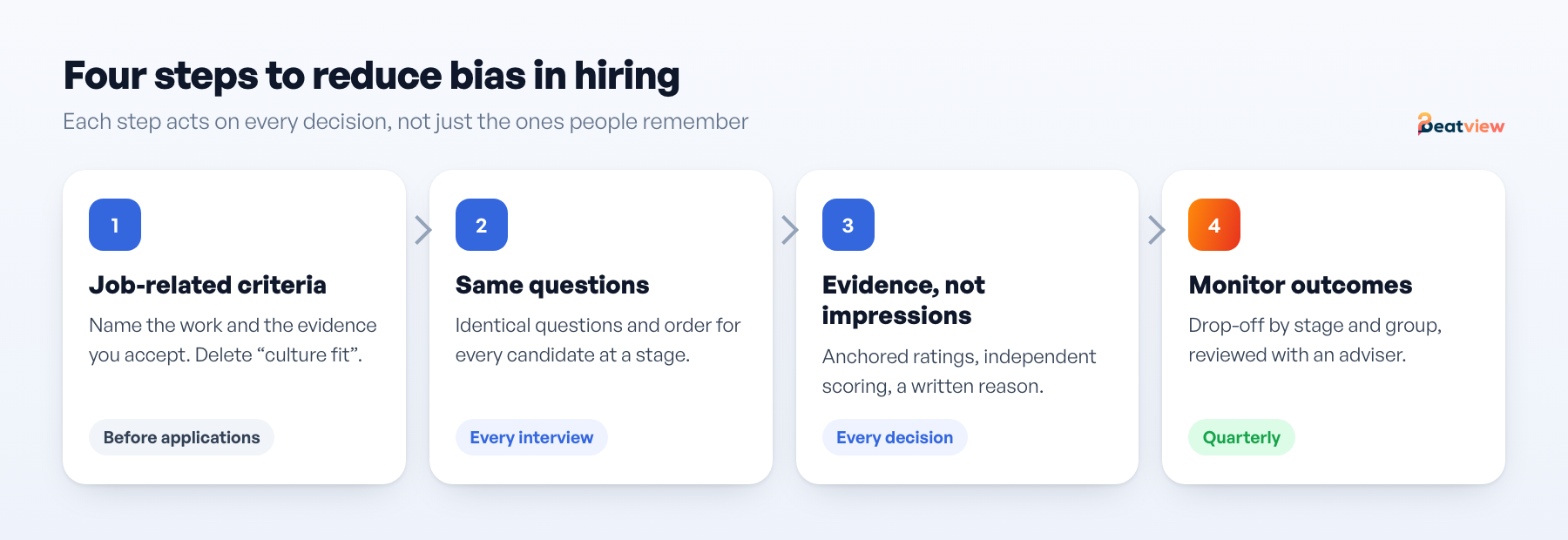
How to reduce bias in hiring: 4 steps
Step 1 — Write criteria that relate to the job
Most inconsistency starts before anyone applies, in vague requirements. Rewrite each one to name the work and the evidence you would accept:
| Vague requirement | Job-related version |
|---|---|
| Strong communicator | Can explain a technical decision in writing to a non-technical client — evidence: a written example or an interview answer describing one |
| Culture fit | Delete. Name the behavior you need, such as working without daily supervision |
| Top-tier university | Delete unless a specific qualification is legally required |
| 7+ years of experience | Has independently owned the responsibility this role carries — evidence: a described example |
Under the US Uniform Guidelines on Employee Selection Procedures, any procedure used to make employment decisions must be job-related if it has adverse impact — the primary text to read before defending a criterion.
Step 2 — Ask every candidate the same questions
Ad-hoc phone screens produce answers you cannot compare. Fix the question set per role and stage, keep the order, and record the answers. If you add a question mid-search, note the date and treat earlier candidates as a separate batch. Never ask about family plans, health, age, origin or religion, and check local rules on salary history. Use our structured interview questions as a starting set.
Step 3 — Decide on evidence, not impressions
Record what each decision rests on — requirement, evidence, rating, decision — using an interview scorecard. Score independently before any group discussion. Written reasons make patterns visible and decisions explainable; they do not remove the reviewer's judgement.
Step 4 — Monitor outcomes, and know what the numbers do not tell you
Look at where candidates drop out by stage and by any demographic data you lawfully hold. The US "four-fifths rule" (a group's selection rate below 80% of the highest group's rate) is a rule of thumb for spotting adverse impact, not a safe harbour. Agency batch sizes are often too small for stage-by-stage ratios to mean much; read them across a quarter or a year and involve a qualified adviser before drawing conclusions.
Unconscious bias training vs process change
Awareness training is popular, but evidence that it changes hiring decisions on its own is weak. Process changes — structured criteria, identical questions, anchored ratings, independent scoring and monitoring — act on every decision without relying on each interviewer remembering a workshop. If you run training, pair it with these changes.
Blind hiring: does anonymising resumes help?
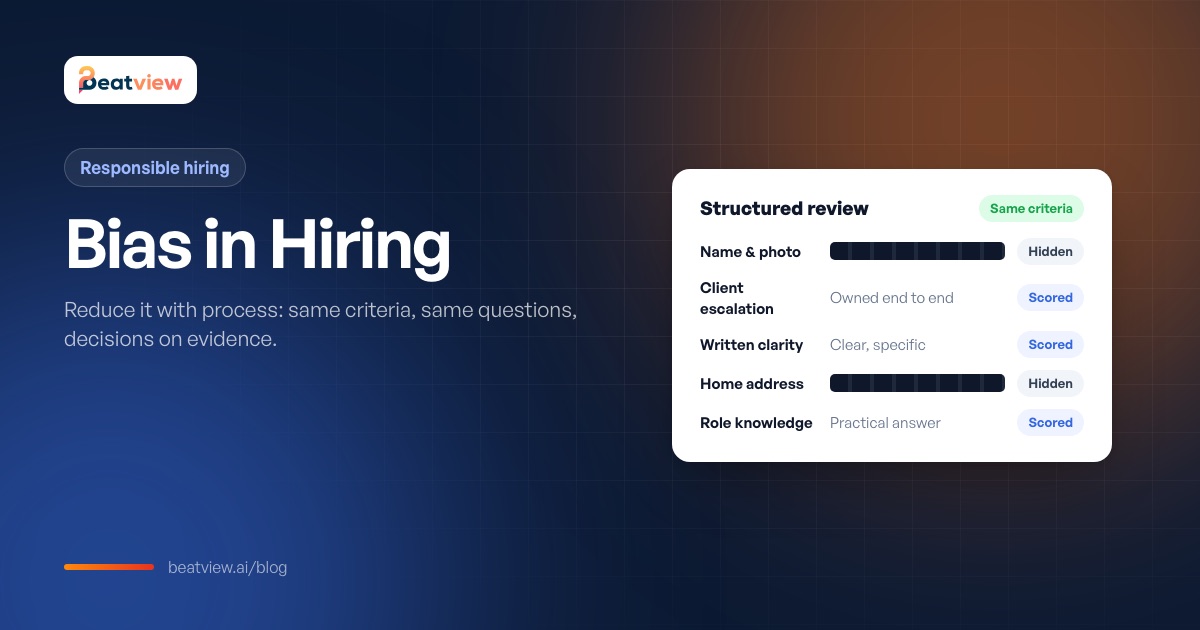
Removing names, photos and addresses from resumes can reduce name-based bias at the screening stage, and it is a reasonable practice. It has limits: employers, dates, schools and even writing style can still signal background, and anonymity ends at the interview. Treat it as one tool alongside structured criteria, not a complete fix.
AI and bias in hiring
AI can make screening more consistent — the same criteria applied to every application — and it can also scale bias. Reuters reported in 2018 that Amazon abandoned an experimental recruiting model after finding it penalised resumes mentioning "women's". To reduce AI bias in hiring: score only job-related criteria, require visible reasons for every score, never auto-reject on score alone, monitor outcomes, and ask vendors for bias-audit information. In New York City, automated employment decision tools need an independent bias audit and candidate notice under Local Law 144; the EU AI Act treats recruitment AI as high-risk. See AI hiring laws and explainable AI in recruiting.
What Beatview does and does not do
| What the platform does | What it does not do |
|---|---|
| Asks every candidate for a role the same structured interview questions with the same time limits | Mask names, photos or other details on resumes |
| Scores answer content per dimension — relevance, clarity, depth of knowledge, overall — with the answer beside each score | Score appearance, expressions or anything visual |
| Shows the evidence behind resume scores | Provide a bias dashboard or demographic analytics |
| Records every stage change in an event log | Audit your process for adverse impact or replace legal review |
Nothing here is legal advice; discrimination law is jurisdiction-specific. See our security page for data handling.
Frequently asked questions
What is bias in hiring?
Bias in hiring is a systematic tendency to evaluate candidates on factors unrelated to the job — such as name, age, background or similarity to the interviewer — rather than on evidence of their ability to do the work.
What are the most common types of hiring bias?
Affinity bias, the halo and horns effect, confirmation bias, first-impression bias, the contrast effect, name and demographic bias, and conformity bias in panels.
How can you reduce bias in hiring?
Write job-related criteria with the evidence you would accept, ask every candidate the same questions, rate answers independently against anchors, record the reason for each decision and monitor outcomes by stage.
Does unconscious bias training work?
Evidence that awareness training alone changes hiring decisions is weak. Pair it with process changes such as structured interviews and independent scoring, which act on every decision.
Can AI reduce bias in hiring?
AI can apply the same criteria consistently, but it can also reproduce or scale bias from its training data or criteria. Use job-related criteria, require visible reasons, keep humans in decisions and monitor outcomes.
Sources
- Bertrand, M., & Mullainathan, S. (2004). Are Emily and Greg more employable than Lakisha and Jamal? A field experiment on labor market discrimination. American Economic Review, 94(4).
- Wilson, K., & Caliskan, A. (2024). Gender, race, and intersectional bias in resume screening via language model retrieval.
- Sackett, P. R., et al. (2022). Revisiting meta-analytic estimates of validity in personnel selection.
- 29 CFR Part 1607: Uniform Guidelines on Employee Selection Procedures.
- NYC Department of Consumer and Worker Protection: Automated Employment Decision Tools.