How to Reduce Time to Hire: 12 Changes That Remove Waiting Time
The time-to-hire formula, where the days usually go, and twelve specific changes — each with an owner, the bottleneck it removes and the metric that proves it worked.
By Beatview Team · Published · Updated · 5 min read
Key takeaways
- Time to hire = offer accepted date − date the hired candidate applied or was sourced.
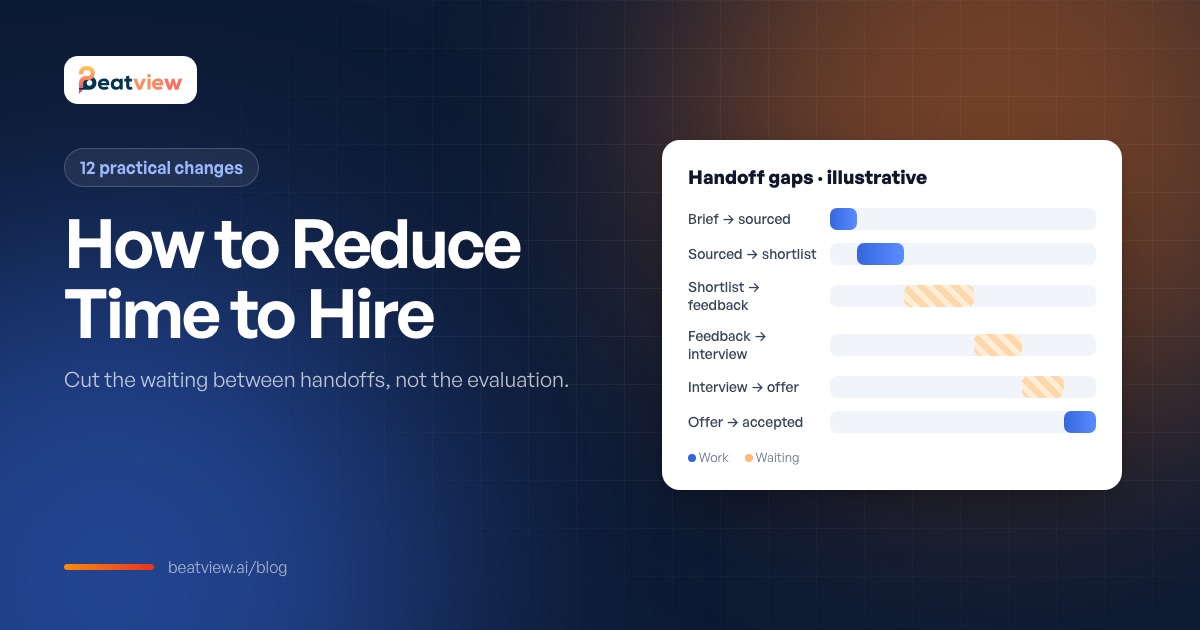
- Most delay is waiting between handoffs, and several of the longest gaps belong to the hiring manager or client.
- Measure the gaps for ten hires first, then fix the largest one you control.
- Removing calendar scheduling from the first round is often the fastest single change.
- Cut waiting time, not structure: keep written criteria, structured interviews and independent scoring.
To reduce time to hire, measure the gaps between each handoff in your process, then remove waiting time from the largest gap you control — rather than asking interviewers to evaluate faster. Time to hire is not one delay; it is six or seven handoffs, and most of them sit outside your screening tool: client feedback, interview scheduling, decision meetings and offers. Below is the time-to-hire formula, where the days usually go, and twelve specific changes, each with an owner, the bottleneck it removes and the number that proves it worked.
What is time to hire?
Time to hire = date the offer is accepted − date the hired candidate applied (or was first contacted, for sourced candidates). It measures how quickly your process moves a candidate once they are in it. It differs from time to fill, which starts when the requisition opens and includes sourcing and approvals. Report the median per role type, and count calendar or working days consistently.
Where the time actually goes
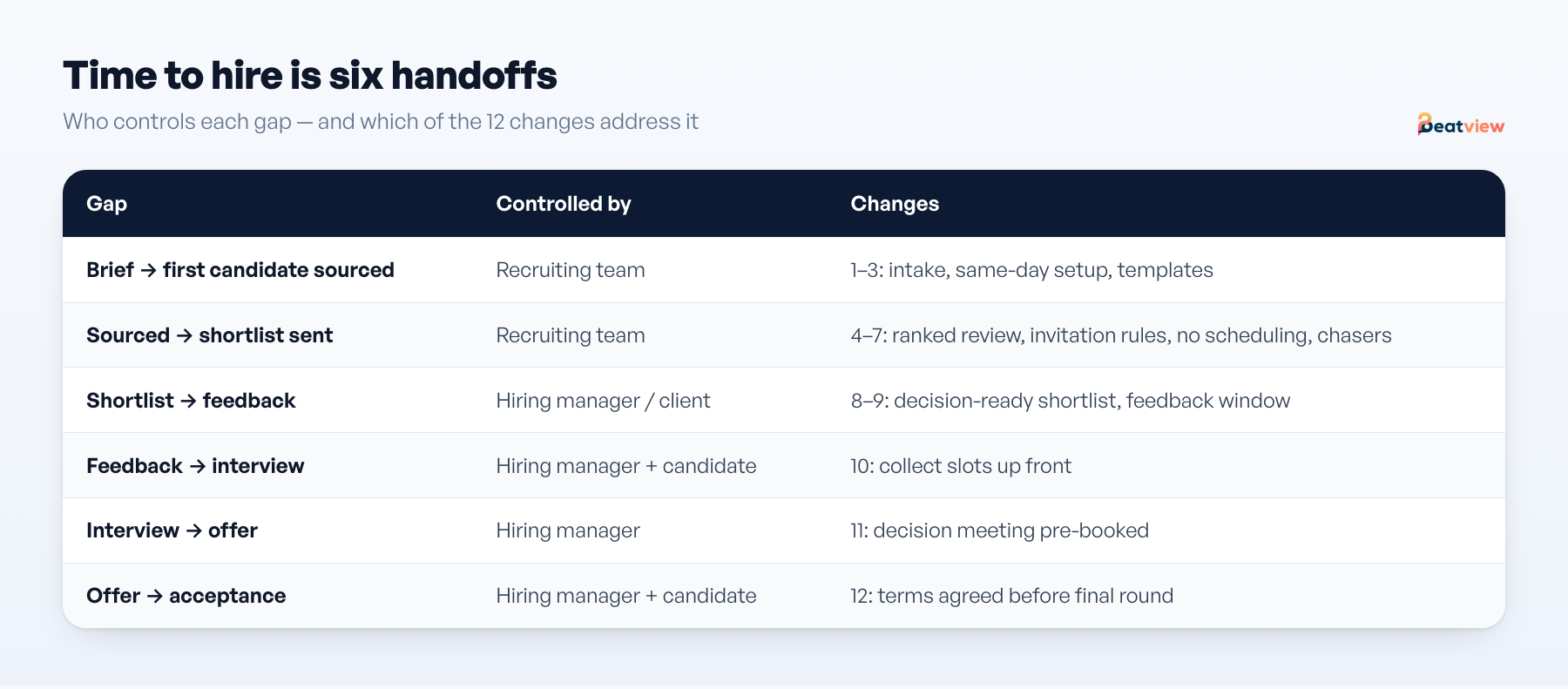
| Gap | Who controls it | Changes below |
|---|---|---|
| Brief received → first candidate sourced | Recruiting team | 1–3 |
| First candidate sourced → shortlist sent | Recruiting team | 4–7 |
| Shortlist sent → hiring manager or client feedback | Hiring manager / client | 8–9 |
| Feedback → interview held | Hiring manager and candidate | 10 |
| Interview → offer | Hiring manager | 11 |
| Offer → acceptance | Hiring manager and candidate | 12 |
Teams that only optimise screening plateau quickly, because the decision-side gaps are usually the longest. Measure the timestamps for your next ten hires with the baseline worksheet before choosing where to start.
12 ways to reduce time to hire
Intake and sourcing
1. Take a decision-ready brief at kickoff. Owner: recruiter or account owner. Bottleneck: rework when criteria change after the first shortlist. Agree must-haves, deal-breakers, who signs off and the shortlist format in writing — the structured hiring process includes a kickoff worksheet. Metric: roles where criteria changed after the first submission.
2. Publish the role and its criteria the same day. Owner: recruiter. Bottleneck: dead time between brief and first application. Set up the role, screening questions and interview questions in one sitting. Metric: hours from brief to role live.
3. Reuse templates for repeat roles. Owner: recruiter. Bottleneck: rebuilding criteria and questions you have written before. Keep a library per client or role family. Metric: setup minutes per role.
Screening and first round
4. Screen in ranked order with a written stop rule. Owner: recruiter. Bottleneck: reviewing every application at equal depth. Stop at the number you agreed to shortlist. Metric: time to first review. See how to screen resumes.
5. Automate the invitation, not the decision. Owner: recruiter. Bottleneck: someone deciding one by one who gets an interview. Set a rule — for example, everyone meeting the must-haves is invited — so invitations go out without a queue. Metric: sourced-to-shortlist gap.
6. Remove calendar coordination from the first round. Owner: recruiter. Bottleneck: email back-and-forth before a 20-minute screen. A recorded, structured interview lets candidates answer the same questions when it suits them. Metric: invitation-to-completion gap. This is often the fastest single change — see asynchronous video interviews.
7. Chase incomplete interviews on a schedule. Owner: recruiter. Bottleneck: candidates who start and never finish. Set one reminder and one cut-off. Metric: interview completion rate.
Feedback and decisions
8. Send a shortlist the decision-maker can act on alone. Owner: recruiter. Bottleneck: a shortlist that needs a call before anyone can decide. Use a fixed format: criteria, evidence per candidate, what the scores mean and your recommendation. Metric: shortlist-to-feedback gap.
9. Agree a feedback window — and what happens if it is missed. Owner: account owner. Bottleneck: shortlists sitting unread. Agree "feedback within N working days" at kickoff, and that strong candidates may take other offers if it slips. Metric: median feedback days per hiring manager or client.
10. Collect interview slots before sending the shortlist. Owner: account owner. Bottleneck: a week lost finding availability once someone is liked. Ask for two or three provisional windows up front. Metric: feedback-to-interview gap.
11. Book the decision meeting in advance. Owner: hiring manager. Bottleneck: "we need to sync as a team". Put the decision conversation in the diary for the day after the final interview, with the named decision-maker present. Metric: interview-to-offer gap.
12. Pre-agree offer terms and prepare the candidate. Owner: recruiter and hiring manager. Bottleneck: offers negotiated from scratch under time pressure. Confirm range, start date and notice period with both sides before the final interview. Metric: offer-to-acceptance gap and offer acceptance rate.
What is a good time to hire?
There is no universal figure worth copying. Time to hire depends on role type, seniority, market and how many interview rounds you run. Compare against your own median by role type, change one thing, and re-measure after the next five hires. The one widely cited external benchmark — SHRM's data putting median time-to-fill at roughly a month and a half — describes the whole requisition, not your process speed.
Don't cut the wrong things
Speed gained by removing structure costs you later. Keep the structured interview, the written criteria and the independent scoring; cut the waiting between steps instead. A faster process that makes worse decisions shows up in quality-of-hire and retention metrics a few months later.
Which of these Beatview supports
Beatview supports changes 2 to 8: role and criteria setup, resume screening with scores and reasons, ranked review, stage rules that send interview invitations automatically, recorded first-round interviews without scheduling, visibility of who has and has not completed, and client sharing through password-protected links. Changes 1, 9, 10, 11 and 12 are team and client behaviours — no tool fixes them, and you should be wary of any vendor, including us, that claims all twelve. See recruitment automation.
Frequently asked questions
How do you calculate time to hire?
Subtract the date the hired candidate applied (or was first contacted) from the date they accepted the offer. Report the median per role type and use calendar or working days consistently.
What is the fastest way to reduce time to hire?
Usually removing calendar coordination from the first interview round with a recorded structured interview, and agreeing a feedback window with the hiring manager or client at kickoff.
What is the difference between time to hire and time to fill?
Time to fill starts when the requisition opens; time to hire starts when the hired candidate enters the process. Time to fill therefore includes sourcing and approval delays.
What is a good time to hire?
It depends on role, seniority and market. Compare with your own median by role type rather than a generic benchmark, and track whether each change shortens the gap it targets.
Can software reduce time to hire on its own?
Software can shorten screening, invitation and scheduling gaps. Feedback, decision and offer gaps depend on people and agreements, and are often the longest.