AI in Recruitment: Uses, Benefits, Risks and How to Adopt It in 2026
How AI is used across the recruitment process, assistance vs automation, the real benefits and risks, the rules that apply and a five-phase plan for adopting AI without disrupting delivery.
By Beatview Team · Published · Updated · 6 min read
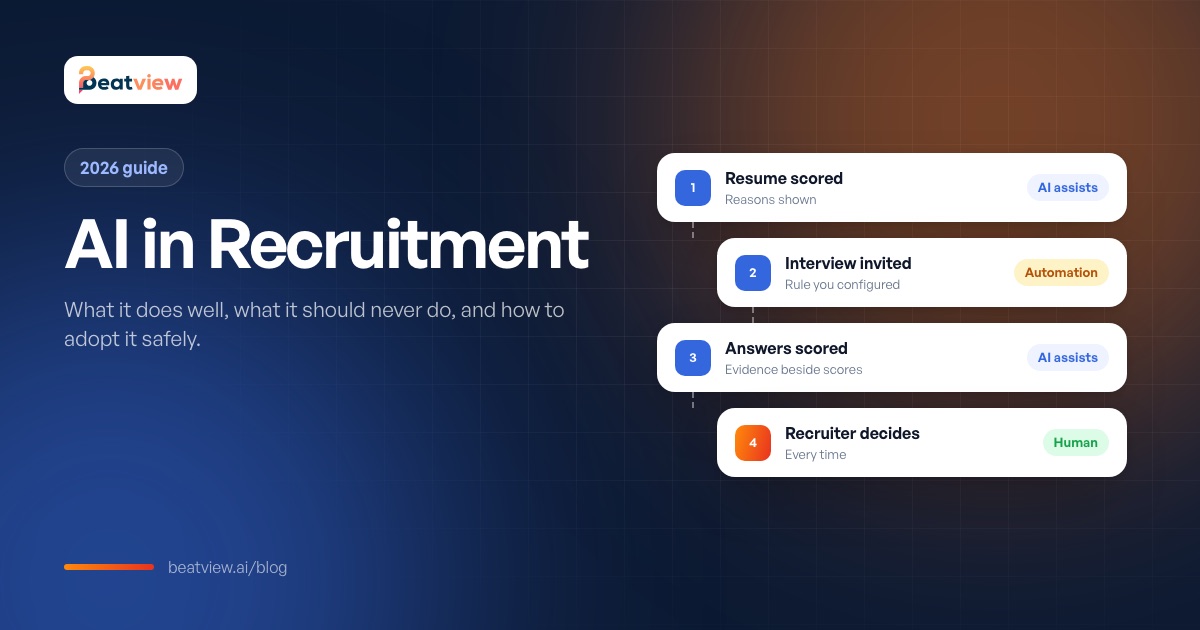
Key takeaways
- AI in recruitment mainly scores resumes, orders candidates, runs structured first-round interviews and drafts text; it does not predict success or make the hiring decision.
- SHRM reports AI use for HR tasks rose to 43% of organisations in 2025 from 26% in 2024, with recruiting the leading use.
- Separate assistance (output a person reads) from configured automation (rules that act without a person).
- Main risks: bias at scale, opaque scores, over-automation, legal exposure and poor candidate experience.
- Adopt in phases: baseline, assistance on one role, add interviews, add one automation rule, then widen.
AI in recruitment is the use of artificial intelligence to carry out or support hiring tasks — writing job ads, sourcing candidates, screening and ranking applications, running and scoring first-round interviews, scheduling and answering candidate questions. In practice it mostly does four things well: reading and scoring resumes against role criteria, ordering candidates for review, running a structured first-round interview without scheduling, and drafting text. It does not predict who will succeed in a job, and it does not remove the recruiter's responsibility for the decision. This guide covers how AI is used across the recruitment process, the benefits and risks, the rules that apply, and a phased plan for adopting it without disrupting delivery.
How widely is AI used in recruitment?
Adoption is growing quickly. SHRM's 2025 Talent Trends research reports that the share of organisations using AI for HR tasks rose to 43% in 2025, from 26% in 2024, and that recruiting is the HR area where AI is used most. Much of that use is assistive — drafting and summarising — rather than automated decision-making.
How AI is used across the recruitment process
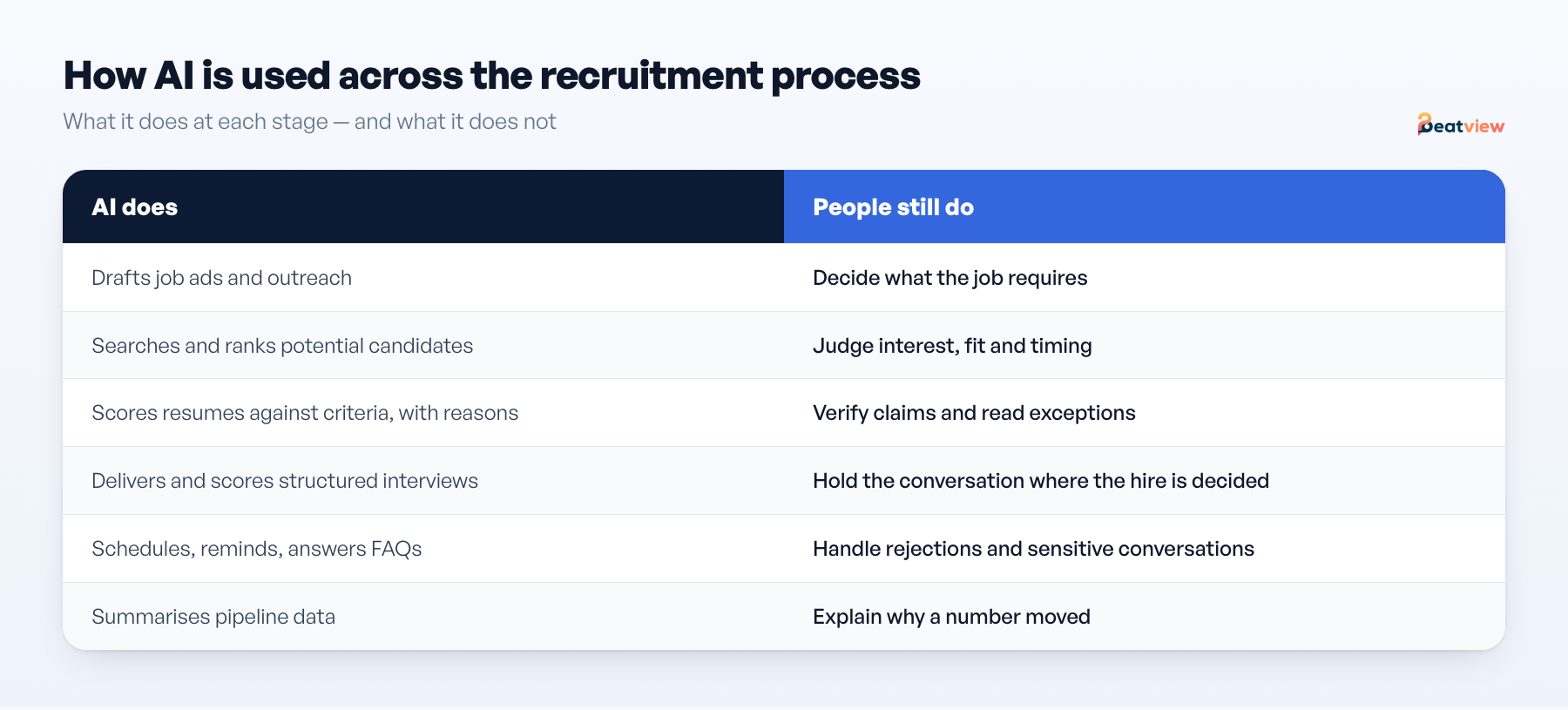
| Stage | What AI does | What it does not do |
|---|---|---|
| Job ads | Drafts and rewrites job descriptions, suggests inclusive wording | Decide what the job actually requires |
| Sourcing | Searches profiles and ranks potential matches; drafts outreach | Know whether a candidate is interested or available |
| Screening | Reads resumes and scores them against criteria, with reasons | Verify claims, or see what a resume leaves out |
| Interviews | Delivers structured questions, records and scores answers | Replace the conversation where the hire is decided |
| Scheduling | Books later interviews and sends reminders | Resolve a hiring manager's competing priorities |
| Candidate communication | Answers FAQs, sends status updates | Handle sensitive conversations such as rejections well |
| Analytics | Summarises pipeline data and time in stage | Tell you why a number moved |
For the stage-by-stage mechanics, see AI resume screening, AI interviews and recruitment workflow automation.
Assistance vs configured automation
The distinction that matters operationally is not "AI or not" but "does this run without a person?"
- Assistance — output a person reads and acts on: a score, a summary, a draft. Nothing moves unless someone moves it.
- Configured automation — a rule you set that fires without a person, for example "when a resume score clears the threshold, send an interview invitation". It does exactly what you configured, nothing more.
Ask any vendor which of their features are which, and which decisions remain human — and get the answer in writing.
Benefits of AI in recruitment
- Consistency. Every applicant is assessed against the same criteria; every interviewee gets the same questions.
- Speed at the front of the funnel. Large application piles arrive scored and ordered, and the first interview round no longer needs a calendar.
- Recorded evidence. Shortlists and rejections rest on reasons you can show a client or candidate months later.
- Recruiter time moves to judgement. Less time reading every resume in arrival order, more time on borderline cases and client conversations.
Be sceptical of percentage time savings, throughput multipliers or bias-reduction figures without a method, sample and period. Measure your own before and after — recruitment metrics defines what to count.
Risks of AI in recruitment
| Risk | Example | Mitigation |
|---|---|---|
| Bias at scale | Amazon abandoned an experimental model in 2018 that penalised resumes mentioning "women's"; a 2024 University of Washington study found language models preferred white-associated names 85% of the time | Job-related criteria, visible reasons, outcome monitoring. See bias in hiring |
| Opaque scores | A number nobody can explain to a rejected candidate | Require evidence behind every score. See explainable AI |
| Over-automation | Automatic rejection on a threshold nobody reviewed | Keep rejection with a named person |
| Legal exposure | Missing candidate notice, consent or bias audit; litigation such as Mobley v. Workday | Scope rules by candidate and job location. See AI hiring laws |
| Candidate experience | Long recorded interviews, no alternative route | Short question sets, clear notice, adjustments on request |
| Data protection | Recordings kept indefinitely; data used to train shared models | Retention limits, deletion on request, contractual terms on training |
A phased plan for adopting AI in recruitment
| Phase | What you do | Move on when |
|---|---|---|
| 1. Baseline | Measure time to first shortlist and reviewer minutes per shortlisted candidate on ten roles | You have your own numbers written down |
| 2. One role, assistance only | Screen and rank a real role; no automation; recruiters read everything | Someone can explain one candidate's score to a colleague |
| 3. Add the interview stage | Invite candidates to a structured recorded interview and review the results | A client accepts the shortlist format |
| 4. Add one automation rule | Invitation on a score threshold — nothing else | A week passes with no surprises in the candidate history |
| 5. Widen carefully | Second and third roles with the same setup | The review backlog returns to zero each week |
Never start at phase 4: most bad outcomes come from configuring automation before anyone can explain what a score means. Before changing a client workflow, agree which decisions remain human and who owns each, what candidates and clients are told, and who reviews a rejection if a candidate asks why. Choosing tools is covered in how to choose AI hiring software.
AI in recruitment agencies
Agencies feel the benefits and risks more sharply: more roles in parallel, clients who expect speed, and a reputation that rides on every shortlist. The practical wins are screening large applicant pools consistently, removing scheduling from first rounds, and sending clients evidence rather than opinions. The practical duties are telling candidates how they are assessed, keeping client data separate and making sure a recruiter — not a score — decides who is submitted. See AI for recruitment agencies.
What Beatview does, end to end
- A candidate applies; the resume is read and scored against the role, with reasons.
- If you configured a stage rule, candidates above your threshold are invited to an interview automatically.
- The candidate answers a fixed set of timed video questions in their own time.
- Answers are scored on relevance, clarity, depth of knowledge and overall, with evidence beside each score; an optional Work Style assessment reports six dimensions and flags separately.
- The overall match score is the plain average of the resume and interview scores.
- A recruiter reads the evidence and decides who is submitted to the client. Every time.
Not in that list: configurable scoring weights, bias dashboards, prediction of job performance or automatic client recommendations. See features.
Frequently asked questions
How is AI used in recruitment?
To draft job ads, source and rank potential candidates, screen and score resumes, run and score structured first-round interviews, schedule later interviews, answer candidate questions and summarise pipeline data.
What are the benefits of AI in recruitment?
Consistent assessment against the same criteria, faster handling of large application volumes, first-round interviews without scheduling, recorded reasons for decisions, and more recruiter time for judgement and client work.
What are the risks of AI in recruitment?
Bias reproduced at scale, scores nobody can explain, automatic rejections without review, legal duties such as notice and bias audits, poor candidate experience and data-protection issues around recordings and model training.
Will AI replace recruiters?
Not for the parts that matter most. AI removes clerical work and orders evidence, but recruiters still set criteria, judge borderline cases, build client and candidate relationships and make decisions.
Is AI in recruitment legal?
Yes, with conditions that depend on location: NYC requires bias audits and notice for automated tools, Illinois regulates AI video interviews, the EU AI Act treats recruitment AI as high-risk and GDPR limits solely automated decisions.
How should a recruitment agency start using AI?
Measure a baseline, use AI as assistance on one role first, add a structured interview stage, then add a single automation rule once the team can explain the scores, and widen gradually.
Sources
- SHRM: The Role of AI in HR Continues to Expand (2025 Talent Trends).
- Reuters (2018): Amazon scraps secret AI recruiting tool that showed bias against women.
- University of Washington (2024): AI tools show biases in ranking job applicants' names.