What Is an AI Interview? How AI Interviews Work (and How to Prepare)
What an AI interview is, the main types, how they work step by step, what should and should not be scored, how candidates can prepare and the rules employers must follow.
By Beatview Team · Published · Updated · 6 min read
Key takeaways
- An AI interview uses software to deliver the questions and evaluate or summarise the answers; most are recorded and completed in the candidate’s own time.
- Types include structured recorded interviews with AI scoring, conversational AI interviewers, chat-based screening and AI note-takers for live interviews.
- Good AI interviews score answer content — relevance, clarity, depth — not appearance, expressions or accent.
- Candidates should test their setup, answer the exact question with specific examples and watch the time limit.
- Rules apply: Illinois requires notice, explanation, consent and deletion on request; NYC requires bias audits; the EU treats recruitment AI as high-risk.
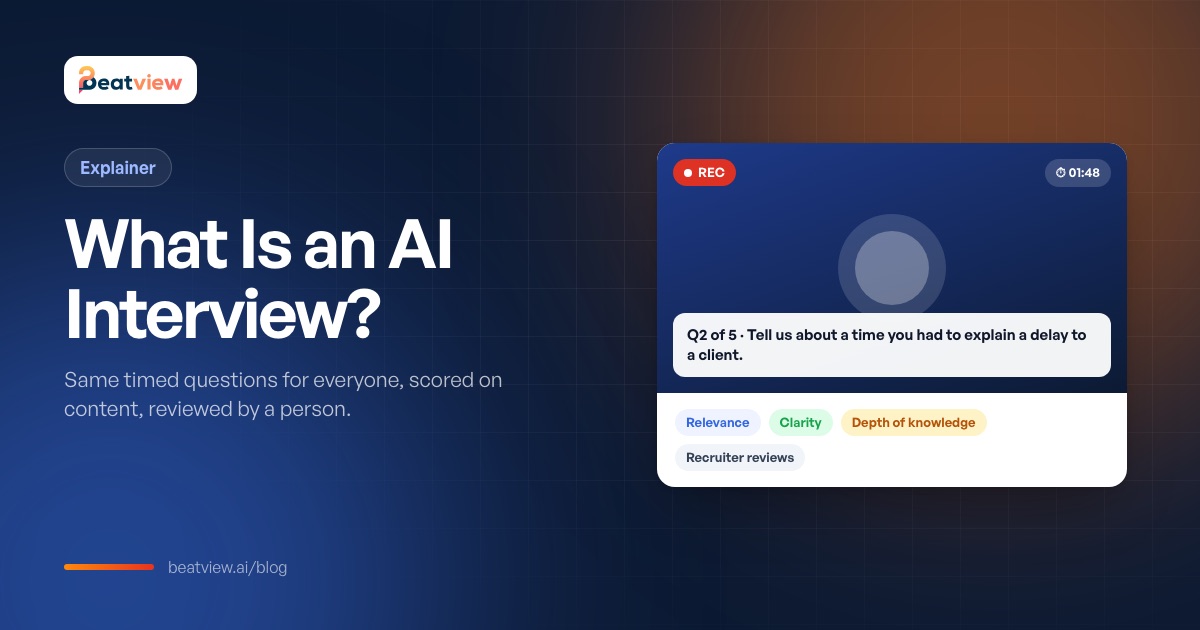
An AI interview is a job interview in which software, rather than a person, delivers the questions and evaluates or summarises the answers. Most AI interviews are asynchronous: the candidate opens a link, answers a fixed set of timed questions on video, voice or text in their own time, and a recruiter later reviews the recordings alongside the scores. Some newer tools act as a conversational "AI interviewer" that asks follow-up questions in real time. This guide explains the types of AI interview, how they work step by step, what is (and should not be) scored, how candidates can prepare, and the rules employers must follow.
Types of AI interview
| Type | How it works | Typical use |
|---|---|---|
| Structured recorded interview with AI scoring | Same timed questions for every candidate; answers recorded; software scores the content and a recruiter reviews | First-round screening, especially at volume |
| Conversational AI interviewer | A voice or chat agent asks questions and adapts follow-ups to the answers | Screening calls, high-volume hourly hiring |
| Chat-based screening | A text assistant asks eligibility and availability questions | Pre-screening before any interview |
| AI note-takers for live interviews | Software transcribes and summarises a human-led interview | Later rounds — not an AI interview in the strict sense |
A one-way video interview is the same format as the first type without the scoring: candidates record answers and a person watches them. For how the two compare, see one-way video interview vs AI interviewer.
How AI interviews work, step by step
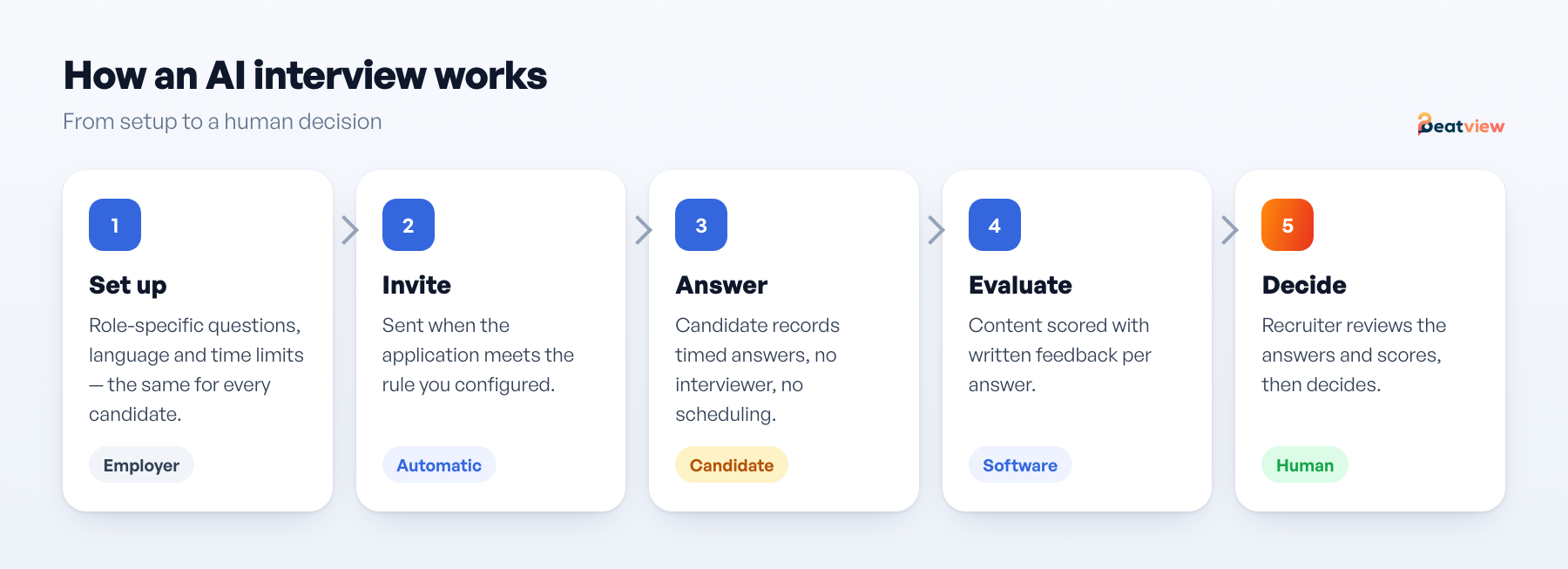
- The employer sets up the interview. Questions tied to the role, the language, the answer format and a time limit per question — the same for every candidate on that role.
- The candidate is invited. Usually automatically, once their application meets a rule the employer set (for example, a resume score above a threshold).
- The candidate answers in their own time. No interviewer is present and there is no scheduling. Questions appear one at a time, often with a short preparation period.
- The software evaluates the answers. It transcribes the recording and scores what was said against the question and criteria, typically with written feedback per answer.
- A recruiter reviews and decides. They read the scores, watch the answers that matter and decide who moves forward. The AI output is evidence, not the decision.
What an AI interview should score — and what it should not
A well-designed AI interview evaluates the content of answers against the question asked: relevance, clarity, the depth of knowledge shown and whether the answer contains specific evidence. It should not score appearance, facial expressions, accent, background or other traits unrelated to the job. The industry has moved this way: HireVue, one of the largest vendors, stopped using facial analysis in its assessments and announced the change in January 2021, saying language-based signals added more value. If a vendor cannot explain in plain words what its scores measure, treat that as a red flag. See explainable AI in recruiting for the questions to ask.
Benefits and limitations of AI interviews
Benefits
No scheduling for the first round; candidates answer when it suits them, across time zones.
Every candidate gets the same questions and time limits — a structured interview by design.
Recruiters review ranked evidence instead of watching every recording cold.
Written feedback per answer makes decisions easier to explain.
Limitations
No real dialogue in recorded formats; some roles need a live conversation.
Some candidates dislike recording themselves, especially for senior roles.
Scores can reflect bias in the model or the questions; outcomes need monitoring.
Legal duties apply: notice, consent in some places, data retention and deletion.
How to prepare for an AI interview (for candidates)
- Read the invitation carefully. Note the number of questions, time per answer, deadline and whether you can retry.
- Test your setup. Use the practice question if there is one; check camera, microphone and connection. A quiet, well-lit space helps the recording, not your score.
- Answer the question that was asked. Relevance is usually scored first. Restate the question in your first sentence if it helps you focus.
- Use specific examples. For "tell me about a time" questions, give the situation, what you did and the result (the STAR structure).
- Watch the clock. Aim to finish a little before the limit rather than being cut off mid-sentence.
- Be yourself — and know your rights. You can ask how the AI is used, request an adjustment if you need one and, in some places, ask for a human review or for your video to be deleted.
Are AI interviews legal?
Generally yes, with conditions that depend on where the candidate is. Illinois' Artificial Intelligence Video Interview Act (in force since 2020) requires employers who use AI to analyse video interviews to tell applicants beforehand, explain how the AI works and what it evaluates, obtain consent, limit who sees the videos and delete them within 30 days of a request. New York City requires a bias audit and advance notice for automated employment decision tools. In the EU, AI used for recruitment is classed as high-risk under the AI Act, with most high-risk obligations now due from December 2027; in the UK, the Data (Use and Access) Act requires safeguards such as the right to human review for significant automated decisions. Our AI hiring laws guide covers the details.
How AI interviews work in Beatview
In Beatview the interview belongs to a job, so every candidate for that role gets the same one. You set the interview name, language, question list and a time limit per question, and choose the pipeline stage that sends the invitation — automatically, when a candidate meets the rule you configured. The candidate records answers in order, with no recruiter present. A completed interview produces:
| Output | What it is |
|---|---|
| Relevance | How closely the answers addressed the questions asked |
| Clarity | How clearly the answers were expressed |
| Depth of knowledge | How much substantive detail the answers contained |
| Overall score | The overall interview result, on a 0–100 scale |
| Per-question feedback and summary | Written notes tied to what the candidate said |
| Recorded answers | The candidate's own answers, beside each score |
The scores describe the answers to your questions — not a personality verdict or anything visual about the candidate. The candidate's overall match score is the plain average of the resume and interview scores. If a candidate does not finish, no interview score is produced and following up is a recruiter task. An optional Work Style assessment reports six separate dimensions (adaptability, collaboration, communication, conscientiousness, ownership and resilience) plus quality flags. AI interviews are included on Pro. See AI interviews.
Frequently asked questions
What is an AI interview?
An AI interview is a job interview where software delivers the questions and evaluates or summarises the answers. Usually the candidate records answers to timed questions in their own time, and a recruiter reviews the recordings and scores before deciding.
How do AI interviews work?
The employer sets the questions and time limits, the candidate receives an invitation and records answers without an interviewer present, the software transcribes and scores the content of the answers, and a recruiter reviews the evidence and decides who moves forward.
What does an AI interview look for?
Well-designed AI interviews assess the content of answers — how relevant, clear and detailed they are and whether they include specific examples. They should not score appearance, facial expressions or accent.
How do I pass an AI interview?
Read the instructions, test your camera and microphone, answer the exact question asked, use specific examples with a situation, action and result, and finish before the time limit. Ask for an adjustment if you need one.
Is a human involved in an AI interview?
In a responsible process, yes. The software prepares scores and summaries, and a recruiter reviews the answers and makes the decision. Some laws give candidates the right to request human review.
Are AI interviews legal?
Generally, yes, but with conditions. Illinois requires notice, an explanation, consent and deletion on request for AI-analysed video interviews; New York City requires bias audits and notice; the EU AI Act treats recruitment AI as high-risk.
Sources
- Illinois General Assembly: Artificial Intelligence Video Interview Act (820 ILCS 42).
- SHRM: HireVue discontinues facial analysis screening (2021).