Explainable AI in Recruiting: 5 Things Every Hiring Tool Must Show
What explainable AI means in recruiting, why it matters legally and commercially, the five things to inspect on one candidate in a vendor demo, and what a real explainable candidate record looks like.
By Beatview Team · Published · Updated · 5 min read
Key takeaways
- An explainable hiring tool shows, for one candidate: the inputs scored, the score breakdown, the reason, what was missing and what the workflow did.
- Explainability matters because candidates, clients and regulators ask "why" — and NYC, UK and EU rules increasingly expect an answer.
- A generated explanation is not validated model behavior; ask which one you are being shown.
- If a tool fails on inputs, breakdown or reason, use it only to order a queue — never to filter candidates out automatically.
- Explainability supports a defensible process; it does not by itself make a decision lawful.
Explainable AI in recruiting means a hiring tool can show, for any single candidate, what it read, how the score was composed, the reason it gave, what information was missing, and what the workflow did next — so a recruiter can check the output and explain a decision to a candidate, a client or a regulator. If a recruiter cannot open one candidate and see those five things, the tool is not explainable, whatever the marketing says. This guide defines explainability in practical terms, explains why it matters legally and commercially, gives a five-point inspection worksheet for vendor demos and shows what a real candidate record looks like.
Why explainability matters in hiring
- You need to be able to answer "why". Candidates, clients and hiring managers ask why someone was ranked low. "The algorithm said so" is not an answer.
- Regulation increasingly expects it. New York City requires candidate notice and a published bias audit for automated employment decision tools; the UK's Data (Use and Access) Act requires transparency and a right to human review for significant automated decisions; the EU AI Act classes recruitment AI as high-risk, with transparency and human-oversight duties. See AI hiring laws.
- You cannot fix what you cannot see. Visible reasons are how you find criteria that screen out the wrong people. See bias in hiring.
The five things to inspect on one candidate
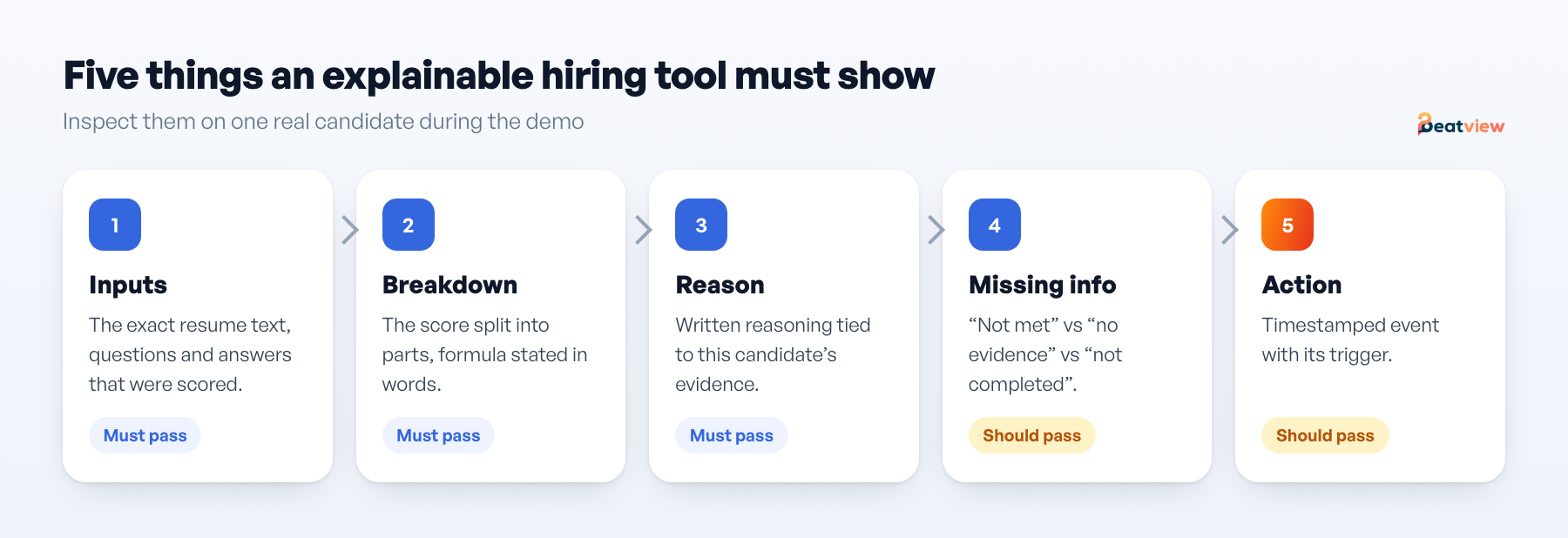
| # | What to look for | Pass condition |
|---|---|---|
| 1 | Inputs | You can see the exact material scored — the resume text the tool read, the questions asked, the answers recorded |
| 2 | Score breakdown | The headline number is split into its parts, and the vendor states the arithmetic in words |
| 3 | Reason | Written reasoning tied to this candidate's own evidence, not generic role advice |
| 4 | Missing information | The tool distinguishes "criterion not met" from "no evidence found" and from "step not completed" |
| 5 | Workflow action | A timestamped record of what happened to the candidate and what triggered it |
An explanation is not validated model behavior
Two different things get sold under the same word. A generated explanation is text a model produces alongside a score — readable and useful for review, but not proof of how the score was computed. Validated model behavior means someone measured how the system performs on defined data and published the method. Ask which one you are being shown. The same caution applies to "audit trail": a list of events shows what the software did; it does not show that the scoring was accurate or the outcome fair.
Five questions to ask in a vendor demo
| Question | What good looks like | Evidence you saw |
|---|---|---|
| Open one rejected candidate. What exactly was scored? | The parsed text and answers are visible on screen | |
| Say the score formula out loud. What are the components? | A stated, repeatable calculation | |
| Show a candidate with a missing step. What does the score do? | No score is invented; the gap is labelled | |
| Who or what moved this candidate, and when? | A timestamped event with its trigger | |
| Has this scoring been evaluated, and how? | A described method — or an honest "no" |
A confident "no" to the last question is more useful than a vague yes. Record it and decide how much weight the score can carry.
How to act on the answers
- Two or more fails on inputs, breakdown or reason: the tool can rank but cannot be reviewed. Do not let it filter candidates out automatically.
- Passes on inputs and breakdown, fails on evaluation: usable as a ranking aid, with a person reviewing the top and the borderline band before anyone is rejected.
- Passes on all five: you can defend how a decision was reached — which is not the same as the decision being lawful where you hire. That needs a qualified adviser.
Worked example: what an explainable candidate record shows
A synthetic candidate created for this article, showing what Beatview displays — not a customer result.
| Element | What appears |
|---|---|
| Resume match score | 72 — with the skills, experience and education read from the resume and the written match analysis behind the score |
| Interview score | 64 — per-question ratings for relevance, clarity and depth of knowledge, an overall rating and written feedback, beside each recorded answer |
| Overall match score | 68 — the plain average of the two. No configurable weighting and no per-rater adjustment |
| Missing information | A criterion with no evidence is shown as absent, not scored zero. An interview never completed produces no interview score and no overall score |
| Event log | Application received → resume read → scored → invitation sent → interview completed → stage change, each with a timestamp and the rule or person that caused it |
That is the honest boundary of what the product explains: inputs, two component scores, the written reasoning behind each and the sequence of events. It does not export feature-attribution values or model versions, and you should not accept such claims from any vendor without seeing them in the product. For the full vendor evaluation, see how to choose AI hiring software.
Should a score ever reject a candidate on its own?
Our view: not for the final decision. Use scores to order a queue and decide who gets reviewed first, and keep rejections with a named person who has read the evidence. See how Beatview's AI interviews work.
Frequently asked questions
What is explainable AI in recruiting?
Explainable AI in recruiting means a hiring tool can show, for any candidate, what information it used, how the score was calculated, the reasoning, what was missing and what action followed, so people can check and explain decisions.
Why is explainable AI important in hiring?
Because hiring decisions affect people’s livelihoods and are regulated. Recruiters need to explain outcomes to candidates and clients, find flawed criteria, and meet rules on notice, human review and bias audits.
What questions should I ask an AI hiring vendor about explainability?
Ask them to open a rejected candidate and show what was scored, state the score formula, show how a missing step is handled, show who or what moved the candidate and when, and explain whether and how the scoring was evaluated.
Is an audit trail the same as explainability?
No. An audit trail records what the software did and when. Explainability also requires seeing what was scored and why, and neither proves the scoring was accurate or fair.