AI Resume Screening: How It Works, Bias Risks and AI vs Manual Review
How AI resume screening works — parsing, matching and stage rules — what good output looks like, how it compares with manual screening, where bias comes from and what recruiters still need to check.
By Beatview Team · Published · Updated · 7 min read
Key takeaways
- AI resume screening covers three mechanisms: parsing the document, matching it to the role with reasons, and optional rules that move candidates between stages.
- Matching reads claims, not facts, and cannot see what a resume leaves out — "missing" evidence is a question, not a rejection.
- Compared with manual review, AI screening is more consistent and records reasons; its errors are systematic, so inspect exceptions.
- Bias risk is documented: a 2024 University of Washington study found language models preferred white-associated names 85% of the time.
- Never auto-reject on score alone; read the reasons and keep the decision with a recruiter.
AI resume screening is the use of software to read applications, compare them with the requirements of a role and produce a score or ranking with reasons, so recruiters review the strongest evidence first. Three different mechanisms are sold under that name — parsing (reading the document into fields), matching (comparing those fields with the role) and automatic stage movement (a rule that acts on the score). Only the third does anything to a candidate on its own, and only if you switch it on. This guide explains how each works, how AI screening compares with manual review, where bias comes from, and what a recruiter still has to check.
How does AI resume screening work?
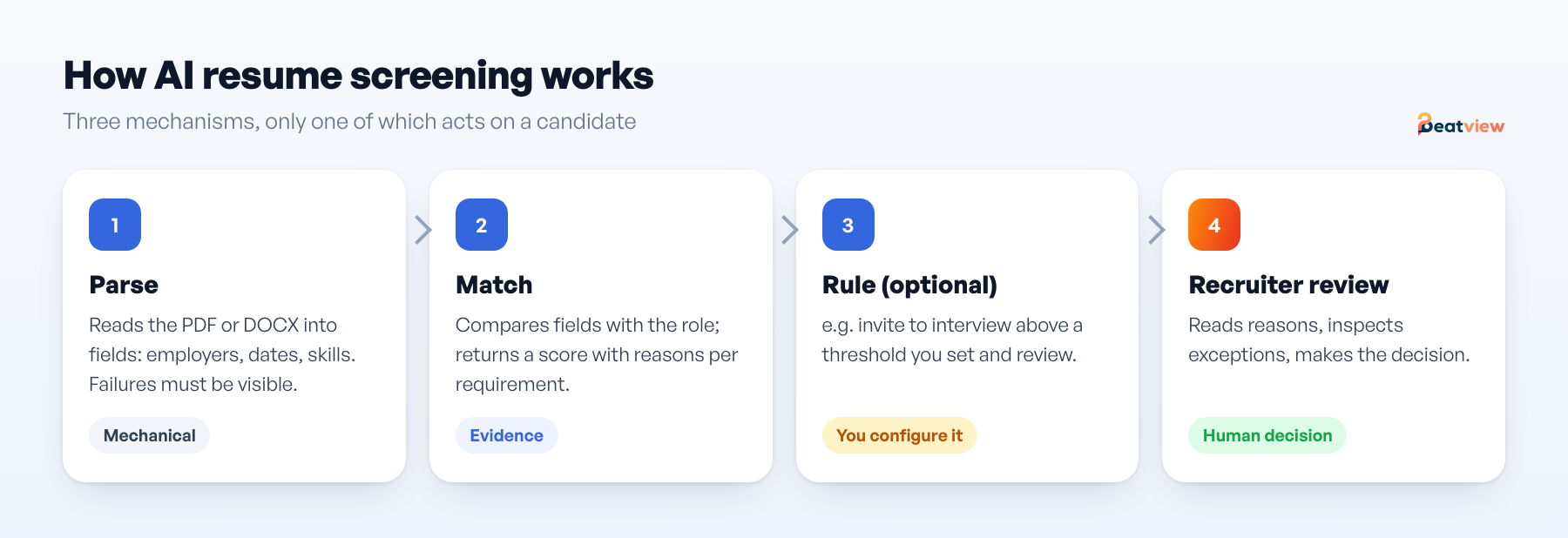
1. Parsing
Parsing extracts contact details, employers, dates, education and skills from a PDF or DOCX. It is mechanical, and it fails predictably: scanned images, multi-column layouts, tables used for formatting, unusual date formats and non-Latin scripts. The important question is not accuracy in the abstract but visibility — a resume that failed to parse must appear somewhere you look, or you lose real candidates without knowing it.
2. Matching
Matching compares the parsed application with the role's requirements and returns a score plus the reasons for it. Older tools match keywords; newer ones use language models that recognise that "ran the weekly rota for 11 people" is evidence of shift scheduling. Either way, matching reads what is written. It cannot verify that the claim is true, and it cannot know what the resume does not mention:
- Evidence present — the resume shows the requirement. Verify it later in the interview or references.
- Evidence missing — the resume is silent. Not a rejection reason on its own.
- Evidence contradicts — the resume shows the requirement is not met. A defensible rejection with a one-line reason.
3. Automatic stage movement
This is a rule, not intelligence: for example, send a structured interview invitation once a resume score clears a threshold you set. It does exactly what you configured, which is why the threshold should be written down and reviewed after the first role. Keep rejection manual with a stated policy, and keep client submissions and hiring decisions with a person.
Example: what good AI screening output looks like
The candidate below is synthetic — invented to illustrate the output format, not a customer record.
| Requirement | Status | Reason shown | What the recruiter does |
|---|---|---|---|
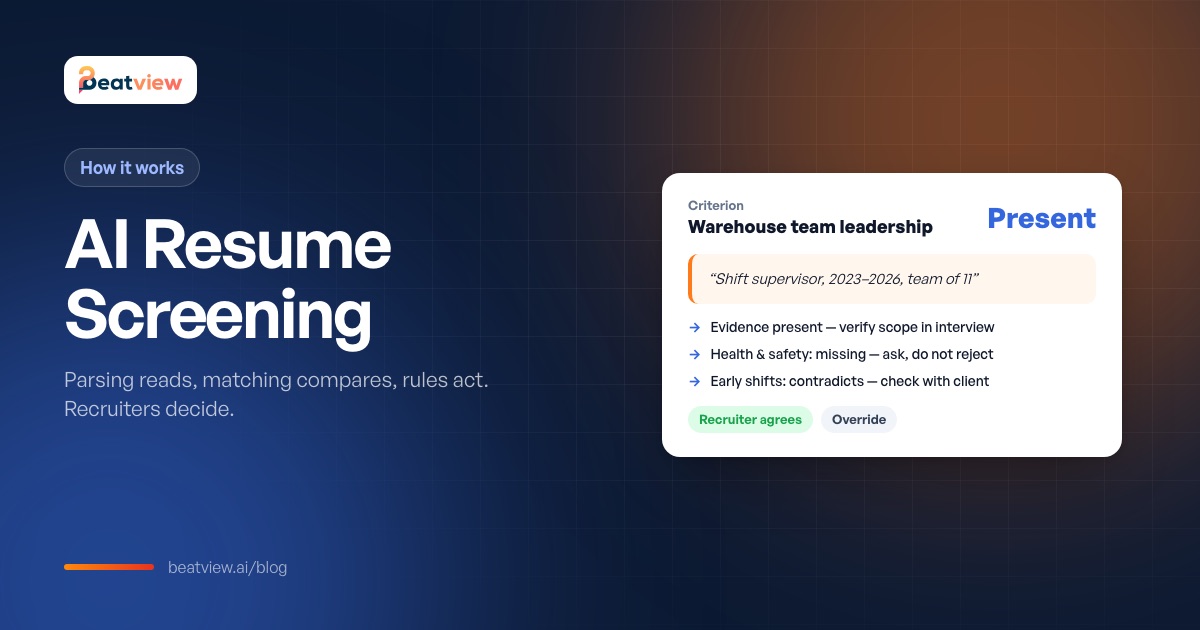
| 2+ years warehouse team leadership | Evidence present | "Shift supervisor, 2023–2026, team of 11" | Confirm scope in the interview |
| Stock system experience | Evidence present | Named system listed under skills | Ask which modules were used day to day |
| Health and safety responsibility | Evidence missing | Not mentioned | Ask directly — not a fail |
| Available for early shifts | Evidence contradicts | Application answer: weekdays after 10:00 only | Check with the hiring manager before rejecting |
The two rows that matter most for a decision have no score attached at all. A score summarises; the reasons decide. If a tool cannot show you reasons like these, you cannot check it.
AI resume screening vs manual screening
| Step | Manual review | With AI screening |
|---|---|---|
| Criteria | Often held in the recruiter's head | Written down, because the tool needs them |
| Intake | Each attachment opened in arrival order | Whole batch read at once; failures must be visible |
| First pass | Read every resume in full | Read reasons on a ranked list; open the unclear ones |
| Consistency | Varies with reviewer, time of day and position in the pile | Same criteria applied to every application |
| Written reasons | Optional, often skipped | Produced as a by-product |
| Errors | Individual and invisible | Systematic — and therefore detectable if you inspect exceptions |
The error row is the real difference. Manual mistakes are one-off and never discovered; software mistakes affect everyone at once, which makes them findable and fixable — but only if someone looks.
An illustrative time calculation
These assumptions are illustrative, not measured results. Substitute your own.
| Assumption | Value |
|---|---|
| Applications for one role | 200 |
| Complete manual review of one application, with a recorded decision | 3 minutes |
| Reading the reasons for one ranked candidate | 45 seconds |
| Candidates still opened in full (top of list plus exceptions) | 40 |
| Setup: criteria, questions, threshold | 45 minutes per role |
Manual: 200 × 3 min = 10 hours. With AI screening: 45 min + (200 × 45 s) + (40 × 3 min) = about 5 hours 15 minutes. At 40 applications the same arithmetic gives 2 hours manual versus about 1 hour 40 minutes with setup — not a reason to buy anything. Below roughly 50 applications per role, structure (written criteria and a scorecard) matters more than software. You can run your own numbers in the screening cost calculator.
Is AI resume screening biased?
It can be, and the risk is well documented. In 2018, Reuters reported that Amazon abandoned an experimental recruiting tool after finding it penalised resumes that included the word "women's". In 2024, University of Washington researchers tested three language models on more than 550 real resumes with only the names changed and found the models preferred white-associated names 85% of the time and never preferred Black male-associated names over white male-associated names. Bias enters through the training data, through criteria that act as proxies (specific universities, continuous employment) and through thresholds nobody reviews.
Practical safeguards:
- Score only job-related criteria you could defend to a candidate, and remove proxies.
- Require reasons for every score, and read them for the top of the list and for rejections.
- Never auto-reject on score alone.
- Check selection rates by group where you lawfully can, and ask vendors for bias-audit information.
- Tell candidates AI is used. Several jurisdictions require notice, and some require bias audits — see AI hiring laws.
Limits worth stating plainly
| Limit | Consequence | Mitigation |
|---|---|---|
| It reads claims, not facts | An overstated resume scores well | Verify in the interview and references |
| Silence is not absence of skill | Good candidates score low on thin resumes | Treat "missing" as a question |
| Criteria quality caps score quality | Narrow criteria rank the wrong people | Inspect exceptions and fix the criteria |
| No compliance guarantee | Automation does not make a process lawful | Scope your obligations with a qualified adviser |
For candidates: how AI resume screening reads your resume
If you are applying for jobs, there is no trick to "beat" AI screening, but there are ways not to be misread. Use a simple one-column layout in PDF or DOCX; describe your experience in the same words the job ad uses where they are true; put scope and results next to each role (team size, volumes, outcomes); answer application questions fully, because they are often read before the resume; and do not hide text or stuff keywords — reviewers see the same document. Well-run processes have a human read the reasons before rejecting anyone.
How Beatview screens resumes
Beatview reads each PDF or DOCX resume, compares it with the role you posted and returns a match score with the skills and experience behind it. Screening answers and a duplicate check sit alongside it. A stage rule can send a structured video interview invitation when the score clears the threshold you set; rejection stays with your recruiters. If the candidate completes the interview, the overall match score is the plain average of the resume and interview scores — no hidden weighting — and an incomplete interview leaves the candidate reviewable rather than scored low. Customer and candidate data is not used to train shared or public AI models. See resume screening, and compare tools with the AI resume screening tools checklist.
Frequently asked questions
How does AI resume screening work?
Software parses the resume into structured fields, compares those fields with the requirements of the role to produce a score with reasons, and — if you configure it — applies rules such as inviting candidates above a threshold to an interview.
Is AI resume screening accurate?
It is consistent rather than infallible. It reads what the resume claims, cannot verify it and cannot see what is missing. Accuracy depends heavily on the criteria you give it and on reviewing the reasons behind scores.
Is AI resume screening biased?
It can be. Documented cases include Amazon’s abandoned tool in 2018 and a 2024 University of Washington study showing name-based racial and gender bias in language models. Use job-related criteria, require reasons, avoid auto-rejection and monitor outcomes.
Is AI resume screening better than manual screening?
For roles with more than roughly 50 applications it usually saves time and improves consistency. Below that, written criteria and a scorecard often matter more than software.
How can candidates get past AI resume screening?
Use a simple one-column PDF or DOCX, describe experience in the job ad’s terms where accurate, include scope and results for each role, and answer application questions fully. Keyword stuffing does not help when a person reviews the reasons.
Does AI resume screening make the hiring decision?
It should not. The software prepares evidence and ordering; a recruiter should review it and decide who moves forward.
Sources
- Wilson, K., & Caliskan, A. (2024). Gender, race, and intersectional bias in resume screening via language model retrieval. AAAI/ACM Conference on AI, Ethics, and Society. Summary: University of Washington.
- Reuters (2018). Amazon scraps secret AI recruiting tool that showed bias against women.