Asynchronous Video Interviews: How Async Interviews Cut Scheduling Delays
What an asynchronous video interview is, how it compares with live interviews, which scheduling delays it removes (and which it does not), when it fits and how to handle unfinished interviews.
By Beatview Team · Published · Updated · 5 min read
Key takeaways
- An asynchronous video interview lets candidates record answers to pre-set questions in their own time; the team reviews later.
- It removes calendar scheduling from the first round only — follow-up calls and client interviews still need slots.
- Async fits high-volume, shift and cross-time-zone hiring; it fits poorly for senior, confidential or small-pool searches.
- Measure six timestamps for ten candidates before promising a faster process.
- Plan for unfinished interviews: deadlines, reminders, a manual route and no scoring of missing evidence.
An asynchronous video interview (async interview) is an interview in which the candidate records answers to pre-set questions at a time that suits them, and the hiring team reviews the recordings later — nobody needs to be online at the same time. Its main job is to remove calendar scheduling from the first round: instead of matching a recruiter's diary with a candidate's, you send an invitation and the candidate answers within a deadline. Every later step — your own follow-up call and the hiring manager or client interview — still needs a slot. This guide explains how async interviews work, where they cut scheduling delays and where they do not, when they fit, and how to handle the interviews candidates never finish.
How an asynchronous interview works
- You write a fixed set of questions for the role — usually four to six — with a time limit per answer.
- Candidates who pass screening receive an invitation link, often automatically, with a deadline.
- Each candidate records answers on their own device, one question at a time, when it suits them.
- Your team reviews the recordings — and, with AI-scored interviews, ratings and written feedback per answer — and decides who moves on.
Async interviews are also called one-way or pre-recorded video interviews. When software also scores the answers, they are usually marketed as AI interviews; see what is an AI interview.
Synchronous vs asynchronous interviews
| Synchronous (live) | Asynchronous (recorded) | |
|---|---|---|
| Scheduling | Both parties book a slot | None — candidate answers before a deadline |
| Time zones | Constrain availability | Irrelevant |
| Consistency | Varies by interviewer and conversation | Same questions and time limits for everyone |
| Dialogue | Two-way; can sell the role and probe | One-way; no follow-up questions |
| Recruiter time | Interview length plus scheduling | Review time only |
| Best stage | Shortlist and final rounds | First-round screening |
Where scheduling delays sit — and which ones async removes
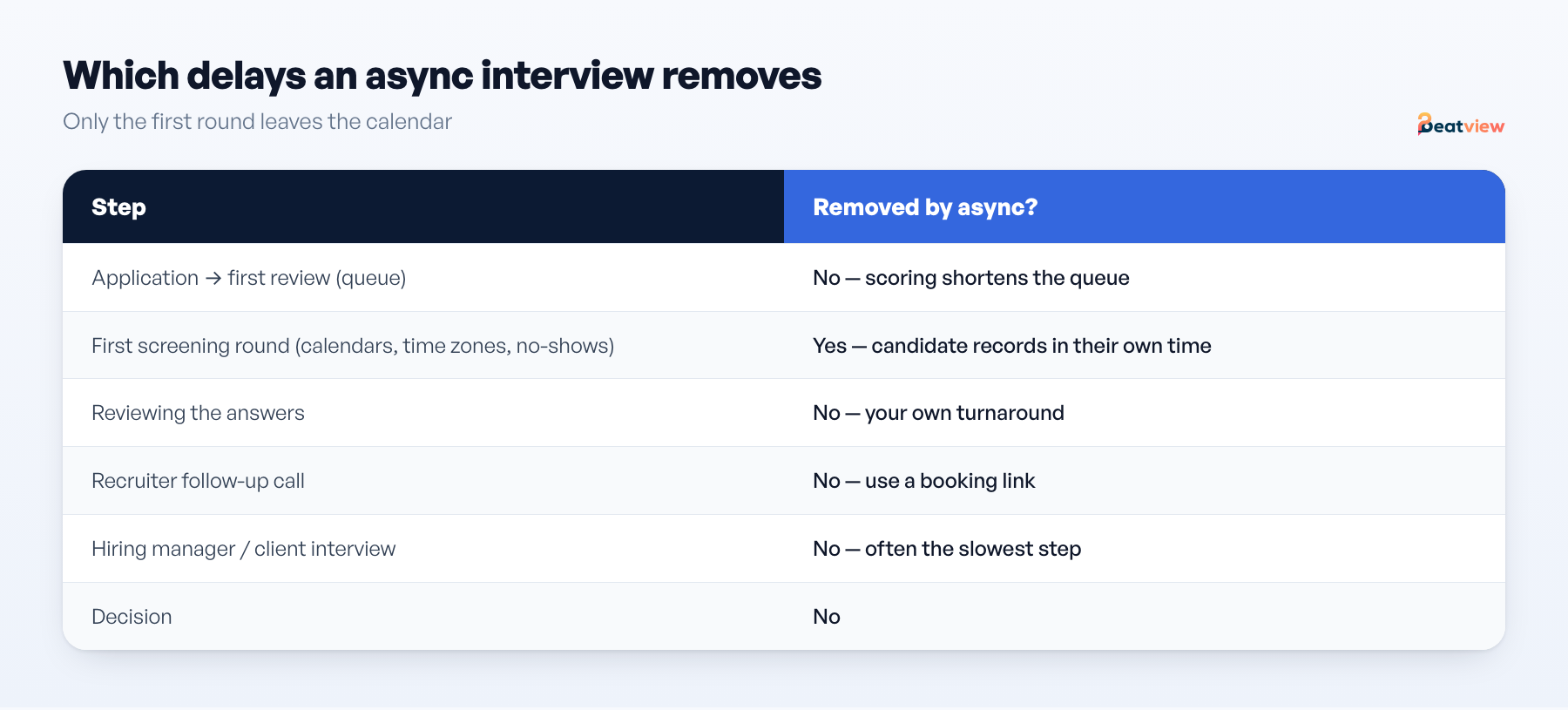
| Step | What creates the delay | Does async remove it? |
|---|---|---|
| Application to first review | Recruiter queue | No — though automatic scoring shortens the queue |
| First screening round | Matching calendars, time zones, rescheduling, no-shows | Yes |
| Reviewing the answers | Your own turnaround | No — a working habit, not a calendar problem |
| Recruiter follow-up call | Two calendars | No — use a booking link |
| Hiring manager or client interview | The slowest calendar in the process | No — often where most remaining delay lives |
| Decision | Internal process | No |
If most of your delay is on the decision side, moving the first round to async helps less than you might expect. Measure before you promise anything.
Measure your own scheduling lag
Record six timestamps for ten candidates on one role, and use medians rather than averages:
| Timestamp | What it tells you |
|---|---|
| 1. Application received | Your clock starts |
| 2. Resume reviewed or shortlisted | Queue time before anyone looked |
| 3. Interview invitation sent | Gap between shortlist and ask |
| 4. Interview completed | Candidate response time — what replaces "time to book a slot" |
| 5. Review finished | Your own turnaround |
| 6. Next meeting held | The calendar-dependent part that remains |
Typical values vary too much by role, seniority and country for a borrowed benchmark to help. Your ten-candidate baseline beats any industry figure. For the whole-process view, see how to reduce time to hire.
When asynchronous interviews fit — and when they do not
Good fit
High applicant volume and similar profiles.
Candidates in other time zones or on shifts.
Hourly and entry-level roles where speed decides who you hire.
Roles where the same five questions genuinely apply to everyone.
Poor fit
Senior or confidential searches where a recording costs you the candidate.
Small, in-demand talent pools.
Roles where you must sell the opportunity in conversation.
Candidates without a reliable device — offer an alternative route.
Handling interviews candidates never complete
- Plan for it. Incomplete interviews are the real operational cost of async. State a deadline and send one or two reminders — for example after two and five days.
- Do not score the gap. An unfinished interview is missing evidence, not a low result.
- Keep a manual route. Losing a strong candidate to a device problem is worse than a slower slot. Offer a call on request.
- Explain the format. Tell candidates how many questions there are, the time per answer, whether they can retry and who reviews the answers.
Keeping the later meetings fast
- Send the shortlist with the recorded answers attached; a hiring manager who has watched three candidates books faster.
- Include a booking link in the same message as the shortlist, so there is no reply cycle.
- Agree a response window at kickoff — the single most effective change to total time.
Asynchronous interviews in Beatview
In Beatview the first round is a structured asynchronous video interview: a stage rule sends the invitation when a candidate meets your criteria, the candidate records answers to your timed questions (recorded video or multiple choice) with no scheduling, and each completed interview is scored on relevance, clarity, depth of knowledge and overall with written feedback per answer. Unfinished interviews produce no score and stay reviewable; follow-up is a recruiter task. Candidates can then be shared with a client through a password-protected link with the answers included. See one-way video interviews, and video interview questions for what to ask.
Frequently asked questions
What is an asynchronous interview?
An asynchronous interview is one where the candidate answers pre-set questions — usually on video — at a time that suits them, and the employer reviews the recorded answers later, so nobody needs to be available at the same time.
What is the difference between synchronous and asynchronous interviews?
Synchronous interviews happen live, with both parties booked into the same slot. Asynchronous interviews are recorded by the candidate and reviewed later, which removes scheduling but also removes two-way dialogue.
How long should an asynchronous video interview be?
Four to six questions with one to two minutes per answer is typical for a first round. Longer sets increase drop-off without adding much comparable evidence.
Do asynchronous interviews reduce time to hire?
They remove the first scheduling loop, which often saves days. They do not speed up review, follow-up calls or hiring manager decisions, which may be where most of your delay sits.
What if a candidate cannot complete an asynchronous interview?
Offer an alternative such as a short call, record the adjustment, and do not treat the missing interview as a low score.