One-Way Video Interview vs AI Interviewer: Differences and When to Use Each
How one-way video interviews, AI-scored interviews and conversational AI interviewers differ in question delivery, reviewer output and consistency — with a decision table for hiring teams.
By Beatview Team · Published · Updated · 4 min read
Key takeaways
- A one-way video interview is recorded without an interviewer; an AI interviewer delivers questions and scores or summarises answers — usually also recorded.
- The real differences are question delivery, what the reviewer receives and whether answers are scored.
- Scored interviews with written feedback suit high volume; plain recordings suit low-volume, senior roles.
- An AI interviewer is not automatically live, adaptive, bias-free or a decision-maker.
- Keep recorded rounds to four to six questions and save live conversation for the shortlist.
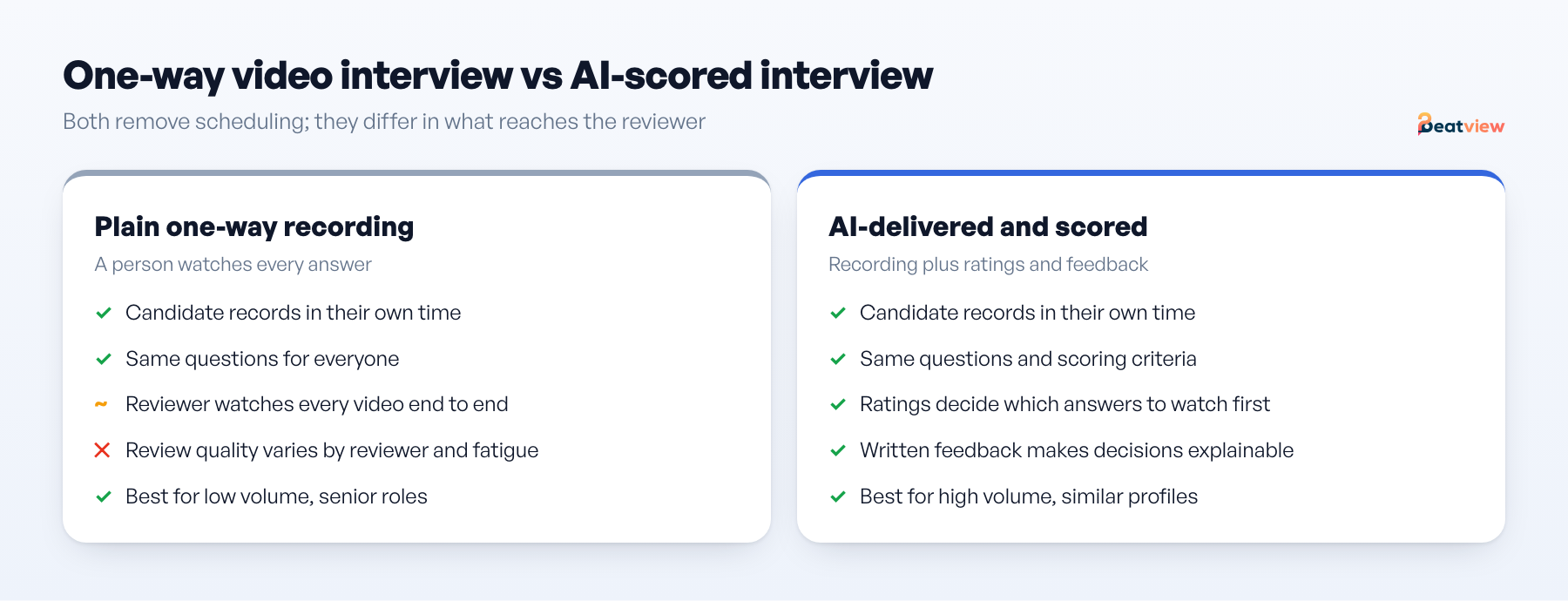
A one-way video interview is a recorded interview in which the candidate answers pre-set questions on camera with no interviewer present, and a person watches the recordings later. An AI interviewer is software that delivers the questions and scores or summarises the answers — and most AI interviewers are also recorded, one-way interviews. So the labels overlap rather than compete. The useful comparison is three separate questions: who delivers the questions, what comes back to your reviewer, and whether anything scores it. This article separates those, compares the formats side by side and ends with a decision table.
One-way video interview vs AI interviewer at a glance
| Variable | Plain one-way recording | AI-delivered and scored interview | Conversational AI interviewer |
|---|---|---|---|
| Question delivery | Text or a pre-recorded prompt | Software presents each prompt with a time limit | Voice or chat agent asks and adapts follow-ups |
| Timing | Candidate's own time | Candidate's own time | Usually on demand, sometimes live |
| What the reviewer receives | Video files to watch | Recordings plus ratings and written feedback per answer | Transcript, summary and often a score |
| Reviewer effort | Watch everything to form any view | Read ratings, watch the answers that matter | Read summaries; check transcripts |
| Consistency | Same questions; review quality varies by reviewer | Same questions and the same criteria for every answer | Follow-ups differ, so comparability drops |
| Best for | Low volume, senior roles | High volume, similar profiles | Eligibility screening, hourly roles |
Four things "AI interviewer" does not automatically mean
- Not live. Most are recorded and reviewed later, exactly like a one-way interview.
- Not adaptive. Many, including Beatview, ask a fixed question set. Adaptive follow-ups are a separate capability to confirm in a demo — and they make candidates less comparable.
- Not bias-free. Consistent criteria reduce avoidable inconsistency; they do not make a process fair or lawful on their own. See bias in hiring.
- Not a decision. A score orders a queue. Whether a candidate advances should stay with a named person.
What a scored interview gives you that a recording does not
A synthetic example: resume match 74, interview 62, overall 68 — with written feedback noting that two answers were on-topic but gave no specific example. That written line is what makes the score reviewable, and it is what a plain video file does not give you. The recording is still there; the feedback tells you which parts to watch.
Which is better for your hiring team?
| Your situation | What fits | Why |
|---|---|---|
| 10–15 applicants per role, senior placements | Plain one-way recording, or straight to a call | A recruiter can watch everything; scoring adds little |
| 100+ applicants per role, similar profiles | AI-delivered and scored | Ratings decide reading order, so nobody watches 100 videos cold |
| Client wants to see answers themselves | Either — check sharing | What matters is sharing the profile with recording and notes, protected |
| Candidates across time zones | Either async option | Both remove the scheduling round |
| You must explain rejections | Scored, with written feedback | Reasons per answer beat "we watched it and passed" |
| The role needs live dialogue to assess | Neither — book a call | Negotiation and discovery skills need two-way conversation |
We have deliberately not put time savings or completion rates in this table; they depend on your roles, market and invitation wording. Measure your own with the worksheet in asynchronous video interviews.
Setup tips for any recorded first round
- Keep the first round to four to six questions; longer sets increase drop-off without adding signal.
- Tell candidates how many questions there are, the time per answer, and — for scored interviews — that answers are scored by software and reviewed by a person.
- Offer a practice question so the first real answer is not the one where they discover the interface.
- Decide in advance what happens to unfinished interviews and who follows up.
- Keep the live conversation for the shortlist. A recorded round replaces the first screen, not the interview where you decide.
For question wording that works in recorded formats, see video interview questions.
How Beatview's interview works
Beatview is an AI-delivered, scored one-way interview with a fixed question set per role. You write the questions, set the language and a time limit per answer; candidates record whenever they choose; each answer comes back with ratings on relevance, clarity and depth of knowledge, an overall rating and written feedback tied to what the candidate said. The interview score and resume score average into the overall match score, and if a candidate never finishes, no interview score is produced. Recruiters review and decide. See one-way video interviews and AI interviews.
Frequently asked questions
What is the difference between a one-way video interview and an AI interview?
Both are usually recorded without an interviewer present. In a plain one-way interview a person watches the recordings; in an AI interview software also scores or summarises each answer, so the reviewer gets ratings and feedback as well as the video.
Is an AI interviewer better than a human interviewer?
Not better — different. An AI interviewer gives every candidate the same questions and removes scheduling, which suits high-volume first rounds. Human interviewers remain better for dialogue, negotiation and final decisions.
Do AI interviewers ask follow-up questions?
Some conversational tools do; many, including Beatview, use a fixed question set. Adaptive follow-ups make answers less comparable across candidates, so confirm how a tool behaves before buying.
Are one-way video interviews fair to candidates?
They can be when every candidate gets the same questions, clear instructions, a practice question and reasonable time limits, and when a person reviews the answers. Offer adjustments on request.