Structured Interview Questions: 40 Examples With Scoring Guides
40 structured and competency-based interview questions to ask candidates, grouped by skill, with the evidence a strong answer contains, a full interview example and worked 1–5 scoring examples.
By Beatview Team · Published · Updated · 10 min read
Key takeaways
- A question is structured when it tests a named competency, every candidate gets it in the same order, and a good answer is defined before interviews start.
- Behavioral questions ask about past situations ("Tell me about a time…"); situational questions ask what the candidate would do; competency-based questions are behavioral questions grouped by competency.
- Use six to ten questions for a 45-minute interview and rate each answer on a 1–5 scale with written anchors.
- Compare candidates question by question, not only by total score.
- Leave out questions about age, family, health, religion, origin and (where restricted) salary history.
Structured interview questions are a fixed set of job-related questions that every candidate for a role is asked in the same order, with each answer rated against evidence standards written before the interviews begin. Below are 40 structured interview questions grouped by competency, the evidence a strong answer contains, a complete first-round interview example, and three worked scoring examples that show how a 1, a 3 and a 5 differ on the same question. You can also download all 40 as a CSV worksheet.
What makes an interview question "structured"?
The wording is not what makes a question structured — the process around it is. A question is structured when four things are fixed in advance:
- It tests a named competency the job actually needs, such as stakeholder communication or problem solving.
- Every candidate gets it, in the same order, in the same stage of the process.
- A good answer is defined before the first interview — the evidence you expect to hear.
- It is rated on a shared scale, usually 1–5, with anchors for what each number means.
That discipline is why structured interviews outperform conversational ones. In a 2022 re-analysis of decades of selection research, Sackett and colleagues found structured interviews had the highest average validity for predicting job performance of any common method (about .42), compared with about .19 for unstructured interviews. For the full method, see our guide to structured interviews.
Behavioral, situational and competency-based questions
Most structured interview questions fall into two types. Both work; many interviews use a mix.
| Type | Format | Example | Best for |
|---|---|---|---|
| Behavioral (past behavior) | "Tell me about a time when…" | "Describe a time you delivered bad news to a client. What did you say, and what happened next?" | Candidates with relevant work history |
| Situational (hypothetical) | "What would you do if…" | "A client asks for a report two days early and your data is incomplete. What do you do?" | Early-career candidates; new types of work |
Competency-based interview questions — the term most UK employers and the Civil Service use — are behavioral questions organized by competency. Candidates are often expected to answer with the STAR structure: Situation, Task, Action, Result. As the interviewer, you do not need candidates to use STAR, but you do need the same four ingredients to rate the answer: a specific situation, the candidate's own actions, and a result.
40 structured interview questions to ask candidates
Pick the two or three competencies that decide success in the role, then choose six to ten questions in total for a 45-minute interview. More questions do not improve a decision if nobody has time to write notes.
Role capability
| # | Question | Evidence to look for |
|---|---|---|
| 1 | Walk me through a piece of work from this role you are most confident about. | Specific scope and the candidate's own part in it |
| 2 | Which tools do you use daily for this work, and what for? | Named tools tied to concrete tasks |
| 3 | Describe the last time you had to learn a required tool quickly. | The method used and the result |
| 4 | Which part of this role is routine for you, and which part is hard? | A realistic read of the work |
| 5 | How would you approach the first task in this job description? | Sequenced steps plus a correctness check |
| 6 | What quality checks do you run before handing work over? | A repeatable check the candidate owns |
| 7 | Tell me about work you had to redo. What changed? | Cause identified and correction applied |
| 8 | Which part of your current work would you keep, and which would you drop? | Reasoning based on outcomes, not preference |
Problem solving and judgment
| # | Question | Evidence to look for |
|---|---|---|
| 9 | Describe a problem where your first answer turned out to be wrong. | How the candidate detected and corrected it |
| 10 | How do you decide when a problem needs escalating? | A stated threshold and a real example |
| 11 | Tell me about a decision you made with incomplete information. | Assumptions named, risk handled |
| 12 | What do you do when two requirements conflict? | A trade-off explained and a decision made |
| 13 | Describe a recurring issue you removed permanently. | Root cause and a fix that held |
| 14 | How do you check that a fix actually worked? | A measurement or verification step |
Communication and stakeholder management
| # | Question | Evidence to look for |
|---|---|---|
| 15 | Explain something technical from your work to a non-specialist. | Plain language and a correct explanation |
| 16 | Describe a time you delivered bad news to a client or manager. | A direct message plus a proposed option |
| 17 | How do you keep a stakeholder informed during a long task? | A stated rhythm and channel |
| 18 | Tell me about a misunderstanding you caused. | Ownership and the correction |
| 19 | How do you write up work so someone else can continue it? | Structure and the right level of detail |
| 20 | Describe pushing back on a request you thought was wrong. | Reasoning and a respectful outcome |
Ownership and delivery
| # | Question | Evidence to look for |
|---|---|---|
| 21 | Which result from the last year are you personally accountable for? | Clear personal ownership |
| 22 | Describe a deadline you missed and what followed. | An honest account and a change made |
| 23 | How do you decide what to do first in a busy week? | A stated prioritization rule |
| 24 | Tell me about work nobody asked you to do. | Initiative tied to a real need |
| 25 | Describe a period of unusual workload. How did you handle it? | Concrete actions, not attitude statements |
| 26 | What would you stop doing if you had less time? | Judgment about what matters |
Collaboration and feedback
| # | Question | Evidence to look for |
|---|---|---|
| 27 | Describe working with someone whose standards differed from yours. | A practical resolution |
| 28 | Tell me about feedback that changed how you work. | Specific feedback and a behavior change |
| 29 | How do you hand over work before time off? | A documented handover step |
| 30 | Describe helping a colleague reach a shared deadline. | Contribution and the shared result |
| 31 | When have you disagreed with a decision and still delivered it? | Commitment after disagreement |
Learning and adaptability
| # | Question | Evidence to look for |
|---|---|---|
| 32 | Describe a process change you had to absorb quickly. | Actions taken during the change |
| 33 | What have you had to unlearn in this field? | Evidence of updating a view |
| 34 | Tell me about work outside your usual scope. | Willingness plus a result |
| 35 | How do you keep current in this field? | Named sources used recently |
| 36 | Describe a mistake you would handle differently now. | Reflection with a concrete alternative |
Role fit and logistics
| # | Question | Evidence to look for |
|---|---|---|
| 37 | What are you looking for in your next role? | Alignment with the actual job |
| 38 | What is your availability and notice period? | Clear dates |
| 39 | What working arrangement do you need to do this role well? | Stated needs you can check against the role |
| 40 | What would make you leave a role within a year? | An honest answer that surfaces real risk |
Structured interview example: a 30-minute first round
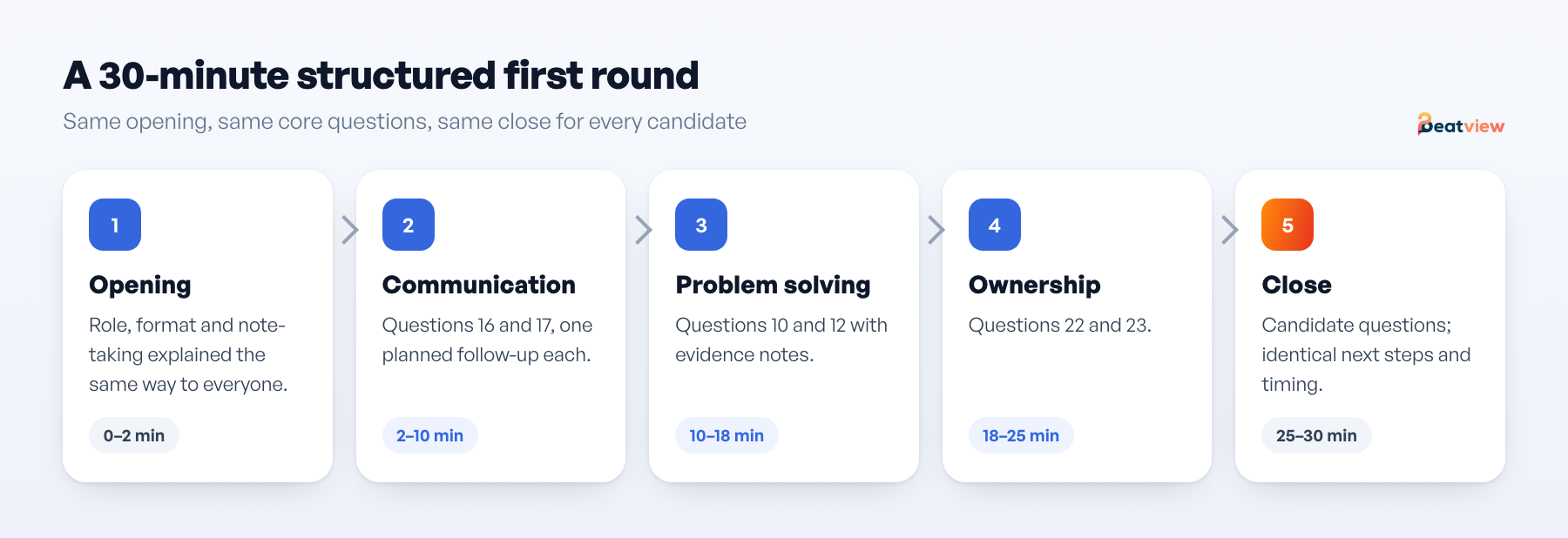
Here is how the questions fit into a complete structured interview for a client-facing coordinator role. Every candidate gets the same opening, the same six core questions in the same order and the same close. Follow-ups can differ — they chase missing evidence — but the core questions cannot.
| Time | Segment | What happens |
|---|---|---|
| 0–2 min | Opening | Same introduction for everyone: the role, the format, that notes are being taken |
| 2–10 min | Client communication | Questions 16 and 17, one planned follow-up each |
| 10–18 min | Problem solving | Questions 10 and 12 |
| 18–25 min | Ownership | Questions 22 and 23 |
| 25–30 min | Candidate questions and close | Same explanation of next steps and timing for everyone |
Score each answer straight after the interview, from your notes, before discussing the candidate with anyone else. Our interview scorecard template has the form to record ratings and evidence.
How to score structured interview answers: three worked examples
The scale is deliberately short: 1 means no relevant evidence, 3 means relevant evidence with gaps, 5 means specific evidence where the candidate's own role and the outcome are both clear. The answers are synthetic, written to illustrate the scale.
Question 1: "Walk me through a piece of work you are most confident about"
| Rating | Answer | Why it scores there |
|---|---|---|
| 1 | "I have done a lot of work like this. I am good at it and clients are happy." | No specific piece of work, no task, no outcome. Nothing to verify. |
| 3 | "I ran the monthly reporting pack for a retail client. It took about two days and it went out on time." | Real work and a real cadence, but no description of the candidate's own actions and no result beyond "on time". |
| 5 | "I rebuilt the monthly reporting pack for a retail client. It took two days because three files were merged by hand, so I wrote one query that produced the merged file, checked it against the previous three months, and cut the pack to about two hours. I still run the check each month." | Specific scope, the candidate's own action, a verification step and a stated result. |
Question 10: "How do you decide when a problem needs escalating?"
| Rating | Answer | Why it scores there |
|---|---|---|
| 1 | "I escalate when it is serious." | No threshold, no example. |
| 3 | "If I am stuck for a while I raise it with my manager, usually the same day." | A rough rule, not defined, and no example of it being used. |
| 5 | "My rule is one hour of no progress, or anything that will move a client deadline. Last month a data feed failed overnight. I could not restore it in an hour, so I flagged it to the account manager before the client called, sent the previous file as a stopgap and fixed it that afternoon." | An explicit threshold, applied in a named situation, with the consequence handled. |
Question 22: "Describe a deadline you missed and what followed"
| Rating | Answer | Why it scores there |
|---|---|---|
| 1 | "I do not really miss deadlines." | Avoids the question, so there is no evidence either way. |
| 3 | "I missed a report deadline once because another project ran long. I told my manager and delivered it a day late." | An honest account, but nothing changed as a result. |
| 5 | "I missed a client report by two days because I had committed to two projects in the same week. I told the client the day I knew, not the day it was due. Since then I only confirm delivery dates after checking what is already committed, and I have not repeated it in the year since." | Ownership, early communication and a specific change that lasted. |
Interview questions to leave out
Keep every question tied to the work. Leave out age, family and pregnancy plans, health and disability, religion, national origin and — where local rules restrict it — current salary. Drop "culture fit" questions that reward similarity to the interviewer, personality guesses and brain teasers with no link to the role. Questioning rules differ by country and state, so check anything sensitive with your own legal adviser for the places you recruit.
How to compare candidates afterwards
Compare question by question, not by total alone. A candidate who is strong on the two competencies that decide the role and average elsewhere is usually a better bet than one with an even, middling spread. Where two candidates are level, return to the notes and compare the evidence itself. For combining interview ratings with resume and assessment evidence, read how to rank candidates fairly.
Using structured questions in a one-way or AI interview
The same questions work in a recorded first round, where every candidate answers the same timed questions on video without an interviewer present. Keep each question to one idea, tell candidates how long they have, and avoid questions that need a back-and-forth. Our list of video interview questions is adapted for that format. In Beatview, invited candidates answer the same timed questions and each completed interview is scored on relevance, clarity, depth of knowledge and an overall rating, with the answer beside each score. The human rubric on this page stays separate: it is for the conversations that come after. See how AI interviews work.
Frequently asked questions
What is an example of a structured interview question?
"Describe a time you delivered bad news to a client or manager. What did you say, and what happened next?" It tests one competency (stakeholder communication), is asked of every candidate, and has a defined strong answer: a direct message, a proposed option and a stated outcome.
How many questions should a structured interview have?
Six to ten core questions for a 45-minute interview, which leaves time for planned follow-ups and note-taking. A 20–30 minute first round usually covers four to six.
What is the difference between structured and competency-based interview questions?
Competency-based questions are a common type of structured question: behavioral questions organized by competency, often answered with the STAR method. An interview is structured when the questions, order and rating criteria are fixed for every candidate.
Can interviewers ask follow-up questions in a structured interview?
Yes. The core questions stay identical for every candidate, while follow-ups can chase whatever evidence is missing, such as the candidate’s own actions or the result.
What is the STAR method in interviews?
STAR stands for Situation, Task, Action, Result. It is a way for candidates to structure answers to behavioral questions, and a useful checklist for interviewers rating whether an answer contains a specific situation, personal actions and an outcome.
Sources
- Sackett, P. R., Zhang, C., Berry, C. M., & Lievens, F. (2022). Revisiting meta-analytic estimates of validity in personnel selection. Journal of Applied Psychology.
- SIOP: summary of the revised validity estimates.