Structured AI Interviews: How They Work and Why They Scale

By Beatview Team · Mon Apr 13 2026 · 16 min read

Structured AI Interviews: How They Work and Why They Scale

Structured AI interviews standardize questions, scoring, and evidence so teams can evaluate thousands of candidates consistently. This guide explains the mechanics, scoring models, compliance controls, decision frameworks, and real outcomes HR leaders can expect—plus how Beatview connects interview evidence to ranked shortlists.

Structured AI interviews are standardized, asynchronous interviews where every candidate receives the same role-scoped prompts and is evaluated against a predefined rubric by AI models calibrated to human criteria. They work by capturing evidence (video or audio), transcribing responses, and applying rubric-based scoring to produce comparable ratings, feedback, and ranked shortlists. They scale because they remove scheduling bottlenecks, reduce rater drift, and turn interviews into analyzable data that can be audited.

In Brief

Structured AI interviews apply the proven validity of structured interviewing to an asynchronous, AI-scored format. Candidates answer the same job-relevant prompts; AI evaluates responses against a transparent rubric and returns scores, qualitative feedback, and rankings. The result is faster cycle time, higher consistency across hiring teams, and a defensible audit trail for compliance and quality-of-hire.

What are structured AI interviews, exactly?

Structured interviewing refers to a method where all candidates are asked the same, job-relevant questions and assessed against a common rubric. Decades of industrial-organizational (I-O) psychology research, including Schmidt & Hunter’s meta-analyses, show structured interviews predict job performance substantially better than unstructured conversations. Structured AI interviews extend this method by using AI to administer prompts asynchronously and score responses consistently at scale.

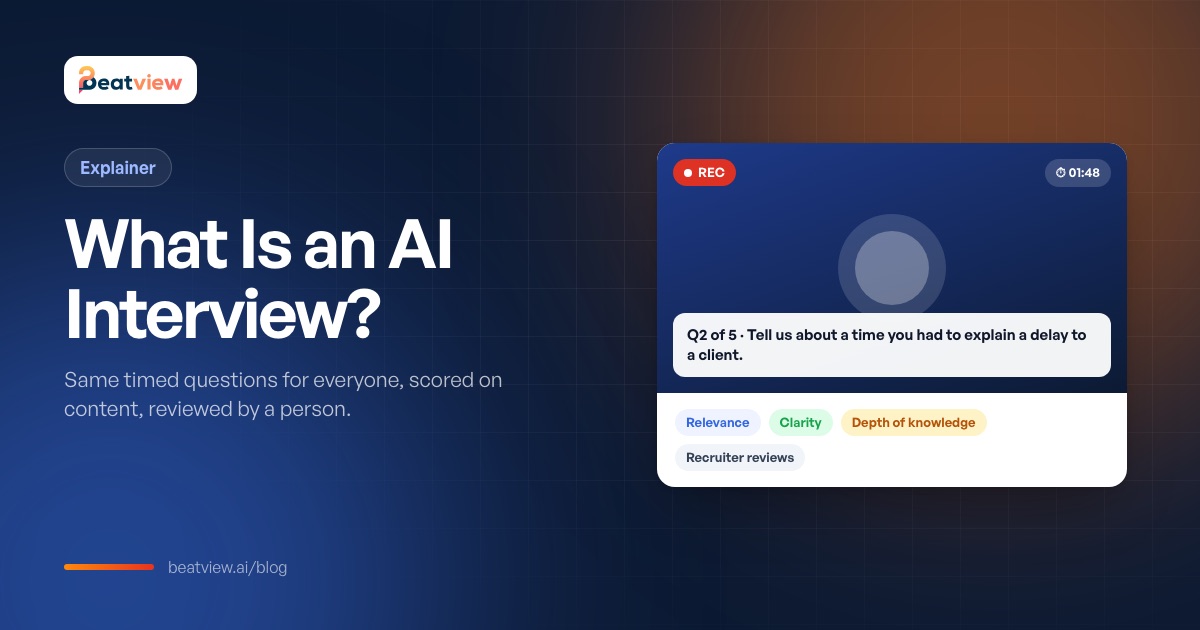
In practice, a structured AI interview consists of 5–8 targeted prompts aligned to clearly defined competencies. Candidates complete the interview on their own time via web or mobile. The system records responses, generates transcripts, and applies rubric-based scoring. Hiring teams receive scores, qualitative feedback, and evidence links to review, compare, and advance candidates without manually watching every minute of video.

Two design elements matter most for rigor: question design and scoring rubrics. Prompts must be job-related and behavioral or situational where possible (per Campion et al. best practices). Rubrics should define observable anchors for each rating level. In regulated contexts, organizations should also document job analysis and validation steps to demonstrate job relatedness and fairness under EEOC Uniform Guidelines and OFCCP expectations.

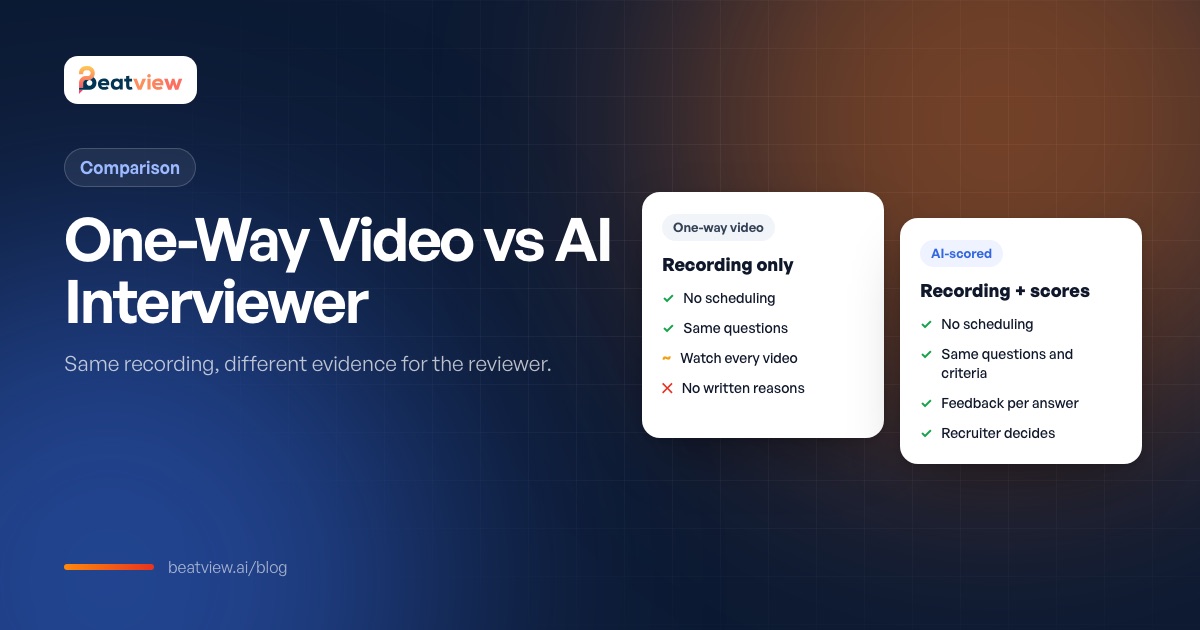
Unstructured live interview

Free-form conversation with varied questions and ad hoc scoring. High interviewer effort; inconsistent evidence across candidates.

Structured human-led interview

Standardized questions and anchored rating scales with trained interviewers. Strong validity but limited by scheduling capacity.

Structured AI interview (asynchronous)

Standardized prompts with AI rubric scoring and rank-ordering. Eliminates scheduling lag and improves comparability across large pools.

Structured AI interviews vs. other approaches: where they fit

For high-volume or distributed teams, the main bottleneck is scheduling live screens. Asynchronous AI interviews remove that bottleneck, turning a 5–10 day coordination lag into same-day completion. They are not a replacement for all human interviews; they are a standardized first-pass or mid-funnel layer that collects consistent evidence and surfaces the top subset for human decision-making.

Compared to chat-based Q&A bots, structured AI interviews emphasize richer evidence (voice, delivery, problem framing) and rubric-aligned scoring rather than keyword matching. Compared to stand-alone assessments (e.g., coding tests), they capture how a candidate explains reasoning, tradeoffs, and stakeholder communication—capabilities that often drive on-the-job success.

Approach How it works Strengths Risks/Limitations Best for
Unstructured live interview Ad hoc questions; subjective notes; variable scoring. Flexible; exploratory conversation. Low reliability; bias risk; hard to audit at scale. Final culture fit after structured stages.
Structured human-led interview Standard prompts; anchored ratings by trained panels. High validity; rich probing; stakeholder buy-in. Scheduling delays; interviewer drift over time. Critical roles where deep probing is essential.
Structured AI interview (asynchronous) Same prompts to all; AI scoring + ranking with audit trail. Scale; speed; consistency; language coverage; cost control. Requires careful rubric design; governance and calibration. High-volume, distributed, or shift-based hiring.
Chat-based screening bot Text prompts; keyword or LLM-based summaries. Low friction; fast; mobile-friendly. Shallower evidence; harder to assess communication. Eligibility checks before interviews.
Assessment-only (e.g., coding test) Task performance; auto-scores; pass/fail thresholds. Objective skills signal; strong criterion link. Narrow scope; limited soft skills/communication insight. Technical roles; complement to interviews.
Phone screen by recruiter Live call; basic qualification; notes in ATS. Human rapport; clarifying questions. Time-intensive; variable rigor; timezone friction. Small pipelines; niche executive roles.

How structured AI scoring works under the hood

An AI-structured interview platform captures audio/video, transcribes speech (ASR), segments responses, and evaluates each segment against a rubric. Modern systems use large language models (LLMs) for semantic analysis, combined with rule- or constraint-based layers to enforce rubric criteria and prevent drift. The output includes scaled ratings (e.g., 1–5), rationales tied to observed evidence, and a confidence indicator based on signal quality and rubric match.

Quality hinges on calibration and controls. Vendors should demonstrate inter-rater reliability between AI and expert humans (e.g., weighted kappa or ICC ≥ 0.70 on validation sets) and show stability across demographics via adverse-impact monitoring (4/5ths rule). Speech models should achieve low word error rate (WER)—generally under ~7% for clear audio—and support domain terms to avoid misinterpretation of technical jargon.

Beatview implements rubric-based scoring with three explicit dimensions per response: Communication (clarity, structure, articulation), Depth of Knowledge (demonstrated expertise and technical reasoning), and Relevance of Answers (directness and specificity to the prompt). This triad creates transparent anchors for both AI evaluation and human review, reducing the “black box” feel common in generic systems.

Beyond numeric ratings, actionable feedback matters. Beatview’s AI Feedback generates concise qualitative notes for each response—e.g., “Explained STAR elements but missed metrics of impact”—so recruiters and hiring managers can understand the why behind a score and decide where to probe in a follow-up live interview.

0.51Structured interview validity (Schmidt & Hunter)
5–10 daysTypical scheduling lag removed by async AI

Why consistency matters in distributed and high-volume hiring

Distributed teams face three compounding problems: interviewer drift, scheduling lag, and uneven documentation. When dozens of interviewers improvise across time zones, question variance increases and rubrics are applied unevenly. Asynchronous structured AI interviews deliver the same prompts and scoring logic to every candidate, collapsing variance and creating a consistent evidence trail in the ATS.

Scheduling lag is a measurable source of funnel leakage. In high-volume roles, extending time-to-first-interview beyond five business days often increases no-show rates and competitor loss. By removing the calendar step, structured AI interviews let candidates complete the process within 24–48 hours of application, lifting conversion while preserving rigor.

Consistency is also a compliance lever. Under EEOC Uniform Guidelines and OFCCP audits, employers must show job-relatedness and fairness. Standardized prompts, anchored rubrics, and monitored score distributions provide documentation for adverse impact analysis (e.g., 4/5ths rule) and support GDPR Article 22 safeguards when automated scoring influences decisions.

Define competencies and outcomes

Start with a brief job analysis: isolate 5–7 competencies linked to on-the-job outcomes (e.g., customer retention, deployment speed). Map each to behavioral indicators and performance metrics.

Author structured prompts

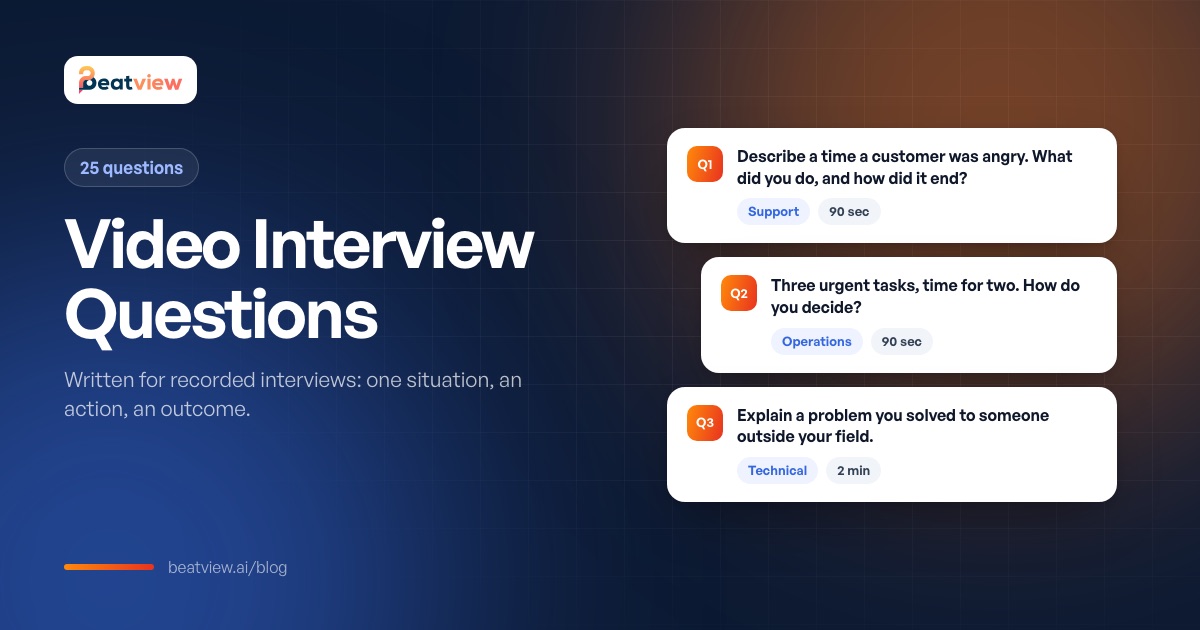
Write 1–2 behavioral or situational prompts per competency. Use past-behavior (STAR) or hypothetical scenarios, with clear instructions and time limits to elicit comparable evidence.

Design anchored rubrics

Define 1–5 rating anchors for each prompt. Specify observable markers for Communication, Depth of Knowledge, and Relevance so AI and humans align on what “3 vs 5” looks like.

Calibrate and test

Pilot with 30–100 sample responses. Compare AI to expert ratings (target ICC ≥ 0.70), check subgroup stability, and refine rubrics where drift or ambiguity appears.

Deploy with guardrails

Enable language selection, accessibility options (captions, replay limits, practice questions), and fallback human review. Document GDPR Art. 22 safeguards and consent.

Monitor and audit

Track score distributions, pass rates by demographic, and reviewer overrides. Investigate anomalies and maintain version control of prompts and rubrics.

Link to downstream decisions

Integrate ranked shortlists into your ATS workflow, attach AI Feedback to candidate profiles, and train interviewers to probe based on prior evidence.

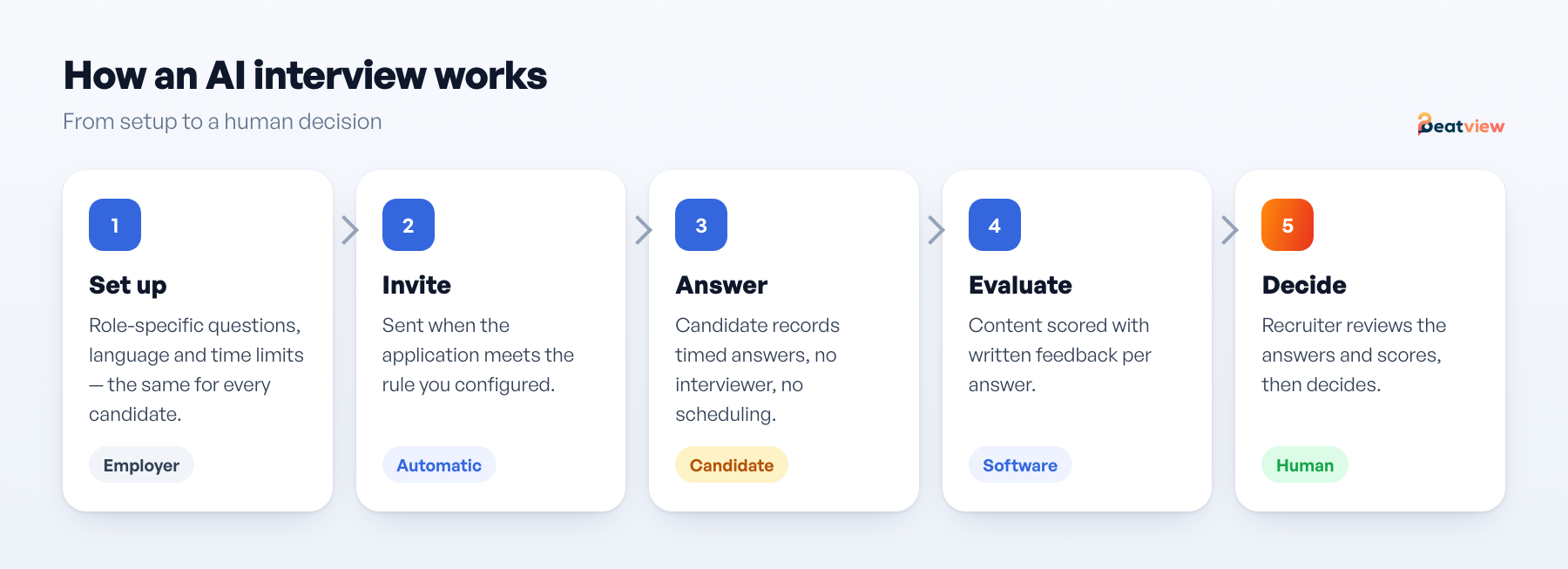
Job profile & competencies Structured prompts & rubrics Candidate completes async interview AI transcription & scoring (Communication, Depth, Relevance) AI Feedback & evidence attached to profile Ranked shortlist Human review & next steps
End-to-end structured AI interview workflow: from competency design to AI scoring, feedback, ranked shortlists, and human decisions.

Evaluation criteria and a vendor checklist

Evaluating structured AI interview software requires more than a feature list. Focus on measurement rigor, operational fit, and compliance posture. Below is a practical checklist HR leaders can use to compare options with their legal and TA operations partners. Favor vendors that publish methods, provide audit artifacts, and align scoring with observable job-related behaviors.

Criterion Why it matters What good looks like Questions to ask
Scoring transparency Managers must trust scores to act on them. Rubric-level rationales; per-question feedback; dimension scores (e.g., Communication/Depth/Relevance). Can we see per-response justifications and anchors? How are edge cases handled?
Reliability & validity Consistency and predictive power determine ROI. AI vs. expert ICC ≥ 0.70; stability across roles; documented validation plans. Show blinded calibration studies and ongoing drift monitoring.
Bias mitigation Fairness and compliance reduce legal risk. Adverse-impact dashboards; 4/5ths checks; accessible design; language parity. How do you detect and remediate subgroup disparities?
Speed & scale High-volume hiring needs fast SLAs. Transcription & scoring in minutes; concurrency at thousands/day. What are real throughput metrics at 10k+ candidates/month?
Integration & workflow Adoption depends on low-friction ops. ATS connectors; webhook events; SSO; evidence in candidate profile. How are ranked shortlists and notes synced to our ATS?
Data privacy & security Protect candidate rights and data. GDPR-ready with Art. 22 safeguards; SOC 2; regional hosting options. Do you support DSRs and data retention policies per region?
Accessibility & languages Wider reach and fairness. Captions; screen-reader support; 30+ languages; low-bandwidth modes. What is ASR WER by language and accent?
Cost structure Unit economics determine scalability. Predictable per-candidate pricing; volume tiers; no hidden transcription fees. What’s the true all-in cost at our expected volume?

Use cases with measurable outcomes

Global retail: seasonal customer support hiring at scale

A global retailer needed to hire 3,500 seasonal support agents across 6 countries within eight weeks. Traditional phone screens created a 7–9 day lag and 42% no-show rate for first interviews. By introducing a structured AI interview with five scenario prompts aligned to customer empathy, problem-solving, and policy adherence, the team reduced time-to-first-interview to 36 hours on average.

Outcomes: 68% reduction in no-shows, 55% faster time-to-offer, and a 1.6x increase in hiring-manager satisfaction scores. Post-hire, QA audits found a 14% lower escalation rate among hires with top-quartile AI scores. With an average SHRM cost-per-hire benchmark around $4,700, the cycle-time reduction and decreased overtime covered tooling costs within the first season.

Enterprise SaaS: distributed engineering hiring

A 5,000-employee SaaS company hired back-end engineers across four time zones. Live technical screens were consistent, but manager interviews were variable. The company introduced a structured AI interview as a pre-onsite step with six prompts: system design tradeoffs, debugging narratives, stakeholder communication, and incident postmortems.

Outcomes: Interview scheduling dropped from 6.4 days to under 48 hours; panel time reduced by 32% because reviewers focused on the top 30% ranked by AI. Six-month performance reviews showed hires in the top AI quartile had 11% higher PRD delivery reliability. The team documented no adverse impact per the 4/5ths rule during quarterly audits and retained human panel interviews for finalists to probe design depth.

Structured AI interviews are most effective when they standardize the early- to mid-funnel, preserve human judgment for final decisions, and tie all evidence back to competencies that matter for the role.

Tradeoffs and how to manage them

Automation vs. human judgment: AI scoring accelerates triage, but final hiring should remain human. Maintain human-in-the-loop checkpoints for edge cases and candidate appeals. Cost vs. accuracy: Cheaper, generic scoring yields opacity and potential bias. Invest in transparent, rubric-aligned systems and track predictive validity post-hire to confirm ROI.

Standardization vs. flexibility: Overly rigid prompts can miss unique signals. The remedy is role-specific question banks and optional “deep-dive” prompts when early answers indicate expertise. Speed vs. thoroughness: Asynchronous interviews move faster, but you still need clear instructions, practice questions, and accessibility features to avoid penalizing unfamiliar candidates.

Implementation considerations: beyond the pilot

Integration: Connect to your ATS so invites, reminders, and results are automated; look for webhook events that update stages and attach AI Feedback to candidate records. Change management: Train recruiters and managers on reading AI-generated feedback and using ranked shortlists; align SLAs so candidates move within 24–48 hours of completion.

Bias controls: Monitor pass rates by demographic using the 4/5ths guideline; where disparities appear, review prompts, audio quality, and rubric anchors. Compliance: Obtain explicit candidate consent, offer a human review process for contested outcomes (GDPR Art. 22), document job analysis, and version-control your question sets. Data privacy: Set regional data residency when needed, define retention windows, and honor data subject requests.

Adoption challenges: Candidates may feel anxious about video. Provide a practice question, clear retake policy (e.g., one retake for technical issues), and low-bandwidth modes with captions. For hiring teams, start with two roles, measure impact on cycle time and quality signals, and expand once reliability is established.

Key Takeaway:

Treat structured AI interviews as a standardized evidence layer—designed with anchored rubrics, audited for fairness, integrated with your ATS, and followed by targeted human interviews. This delivers speed without sacrificing rigor.

How Beatview fits into a structured AI interview workflow

Beatview provides an AI interviewing layer that reduces scheduling lag, standardizes evaluation, and connects interview evidence to ranked shortlists. Each response is scored on three dimensions—Communication, Depth of Knowledge, and Relevance of Answers—so reviewers see precisely where a candidate excels or needs probing. Beatview’s AI Feedback turns scores into qualitative insights that managers can trust.

Operationally, Beatview plugs into your ATS to trigger invites, reminders, and status updates. Recruiters land on a ranking page with top performers highlighted, including confidence indicators and evidence links. Because Beatview AI Interviews sit alongside AI resume screening, teams can move from shortlist to structured interview in one workflow, preserving consistent competency signals throughout.

For buyers evaluating the broader category, see our companion guide, AI Interview Software: How It Works, Top Features, and Best Platforms, which details platform architectures, integration patterns, and selection tips across the market.


A practical decision framework for selecting AI-structured interviewing

Use the following methodology to move from exploration to deployment with alignment across TA, HR, Legal, and Engineering (for integrations). Each step yields an artifact—competency map, rubric, calibration results, and governance checklist—that you can reuse role-to-role.

Anchor to measurable business outcomes

Link competencies to KPIs (e.g., NPS, uptime, renewal rate). Decide how interview evidence will forecast these and how you’ll verify post-hire (30/90/180-day).

Scope roles and volumes

Identify roles with highest scheduling lag or interviewer variability. Estimate monthly candidate throughput to select the right cost and capacity model.

Select evaluation dimensions

Adopt transparent dimensions such as Beatview’s Communication, Depth, and Relevance, adding role-specific anchors (e.g., API design rigor for engineers).

Run a head-to-head pilot

Randomize candidates to current process vs. structured AI interview. Compare time-to-stage, pass-through rates, and hire quality proxies like manager ratings.

Audit fairness & reliability

Compute subgroup pass rates, check 4/5ths compliance, and target ICC ≥ 0.70 vs. expert ratings. Adjust prompts and anchors where gaps appear.

Operationalize in the ATS

Automate invites, reminders, and status updates. Ensure AI Feedback and ranked shortlists sync into the candidate record for panel prep.

Governance & continuous improvement

Establish version control, review cadences, and candidate appeal paths. Measure predictive validity post-hire and retire underperforming prompts.

Buyer FAQs on structured AI interviews

Do structured AI interviews really predict job performance better?

Structured interviews consistently outperform unstructured ones in predictive validity. Schmidt & Hunter’s research reports validity coefficients around 0.51 for structured formats versus ~0.38 for unstructured. AI-structured interviews inherit that advantage by enforcing standardized prompts and anchored scoring. Organizations can further improve validity by aligning prompts to competencies from job analysis and by reviewing post-hire outcomes at 90/180 days to recalibrate rubrics.

How do we ensure fairness and avoid bias with AI scoring?

Use multiple controls: (1) job-related, validated prompts; (2) anchored rubrics grounded in observable behaviors; (3) calibration studies showing AI-human agreement (ICC ≥ 0.70); (4) adverse impact monitoring with the 4/5ths rule; and (5) accessible candidate experiences (captions, language options). Beatview provides subgroup analytics and qualitative AI Feedback so humans can review rationales, plus documented safeguards that support GDPR Article 22 requirements for human oversight.

Where should structured AI interviews sit in our hiring funnel?

They typically replace or augment the recruiter phone screen or early hiring-manager screen. Use them after resume screening to collect standardized evidence and produce ranked shortlists, then proceed to a focused human interview for the top 20–40%. For technical roles, pair the AI interview with a coding or work-sample test to balance communication skills with hands-on proficiency. Beatview integrates these steps in one workflow.

How do we measure success beyond time savings?

Track cycle time and no-shows, but also measure: inter-rater reliability (AI vs. human), adverse impact ratios, manager satisfaction, and post-hire indicators like ramp time, QA error rates, or attainment. In one retail case, top-quartile AI scores correlated with a 14% lower escalation rate. Set quarterly reviews to compare AI score bands with performance data and refine prompts accordingly.

What does a good scoring rubric look like?

A good rubric defines 1–5 anchors per prompt using observable behaviors. For example, Communication “5” might specify logical structure (STAR), quantification of impact, and concise delivery under time limits. Depth of Knowledge “4” could denote accurate tradeoff analysis with relevant terminology. Relevance “3” might flag partial alignment to the question. Beatview operationalizes these exact dimensions to align humans and AI.

How much does this cost and how do the economics work?

Vendors price per candidate or per response minute. At scale, predictable per-candidate pricing with volume tiers is preferable. Consider total cost—including transcription and integration. Many teams see payback via reduced scheduling effort and panel time; for context, SHRM estimates average U.S. cost-per-hire at ~$4,700. Cutting 30–50% from interview labor and time-to-offer often offsets software fees quickly.


Next steps and where to go deeper

If you’re starting from scratch, pilot structured AI interviews on two roles with measurable throughput and clear performance metrics. Validate reliability, monitor fairness, and connect ranked shortlists to your ATS stages. To understand platform-level decisions across the market, review our in-depth explainer, AI Interview Software: How It Works, Top Features, and Best Platforms.

To see Beatview’s AI interview workflow—including rubric setup, AI Feedback examples, and automatic scoring and ranking—visit Beatview AI Interviews or explore features and pricing. You can also connect resume screening and structured interviews end-to-end via Beatview Resume Screening and maintain consistency into work-style assessments.

Tags: structured ai interviews, structured ai interview, ai structured interview software, structured interviewing with ai, ai interview workflow, AI interview scoring, asynchronous video interview, Beatview